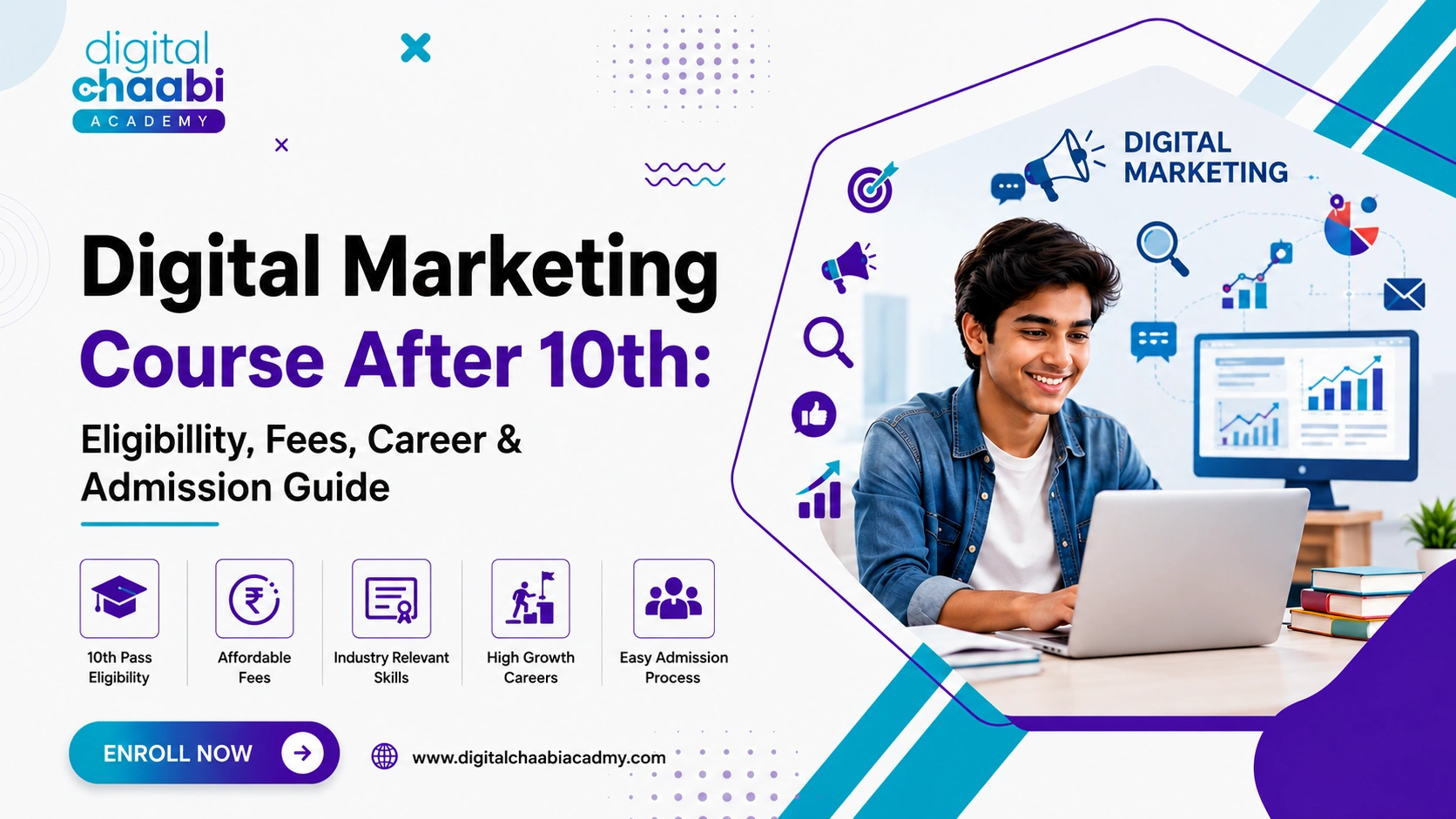
Yes, you can join a digital marketing course after 10th — most beginner and foundation-level programs don’t require you to have completed 12th grade or graduation. Eligibility is usually just basic literacy and comfort with using a computer, though some certification-heavy or advanced diploma programs may prefer 12th pass students.
There’s a particular kind of confusion that happens around age 15 or 16. You’ve just finished 10th, everyone’s asking “science, commerce, or arts?”, and somewhere in that noise you’ve stumbled across digital marketing and thought — wait, can I even start this now, or do I have to wait years?
Fair question. And the honest answer is more flexible than most people assume.
This guide walks through what’s actually true about eligibility, what fees typically look like at this stage, and what a realistic career path looks like if you start early.
What Is a Digital Marketing Course
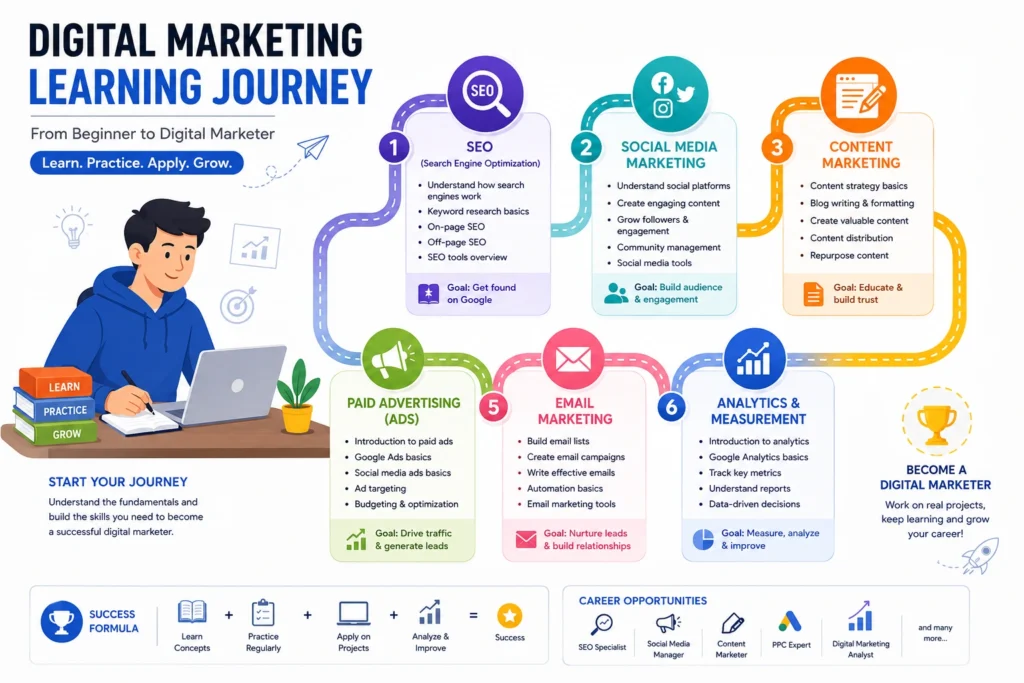
A digital marketing course teaches you how brands and businesses get discovered, build trust, and sell online — through SEO, social media, paid ads, content, and email marketing. For a student straight out of 10th, it’s less about deep technical mastery right away and more about building a genuine foundation early, while school or 11th/12th continues alongside.
The biggest advantage of starting a Digital Marketing Course After 10th is that students get an early introduction to practical skills. Digital marketing rewards creativity, curiosity, communication, and consistent practice more than formal qualifications alone, making it accessible for young learners.
Can I Learn Digital Marketing After 10th
Yes — and this is worth saying plainly because a lot of students assume otherwise. Most foundational digital marketing course after 10th programs are open to anyone with basic literacy, a working understanding of using the internet, and enough discipline to follow a structured curriculum.

You don’t need:
- A specific stream (science/commerce/arts) — none of them is a prerequisite
- Prior coding knowledge
- A laptop with high-end specs — a decent computer with internet access is enough
What helps students succeed in a Digital Marketing Course After 10th is curiosity, creativity, willingness to learn content creation, and interest in online platforms.
Which Course Is Best After 10th
Rather than one “best” course, think in terms of what fits a student’s schedule and goals:
- Short foundation course (1–2 months) — good for testing genuine interest before committing further
- Comprehensive beginner course (3–6 months) — builds real, usable skill across SEO, social media, content, and basic ads
- Specialization-first course (e.g., social media only) — useful if a student already knows they enjoy one specific area
For most students after 10th, a comprehensive beginner-level Digital Marketing Course After 10th is a better choice because it provides exposure to multiple areas before selecting a specialization.
What Are the 7 Types of Digital Marketing
A good Digital Marketing Course After 10th introduces students to the major areas of online marketing. The seven commonly recognized types are:
- SEO (Search Engine Optimization)
- SEM/PPC (Paid Search Advertising)
- Social Media Marketing
- Content Marketing
- Email Marketing
- Affiliate Marketing
- Influencer Marketing
For a student starting after 10th, social media marketing and content marketing tend to be the most natural entry points — both build on skills (writing, creativity, platform familiarity) that many teenagers already have some comfort with.
Can I Do Digital Marketing at 14
Technically, learning the concepts at 14 is absolutely possible — understanding how SEO or social media strategy works isn’t age-restricted. But there are practical limits worth being honest about.
- Learning: No age barrier. A 14-year-old can absolutely study and understand digital marketing concepts.
- Freelancing/earning: Most platforms (ad accounts, payment gateways, freelance marketplaces) require users to be 18, so actually running paid campaigns or getting paid directly usually needs an adult account, often a parent’s.
- Internships/jobs: Formal employment typically starts at 18 due to labour laws in most regions.
So at 14, the realistic path is: learn, practice on personal or family projects, build a portfolio — and hold off on paid client work or formal roles until legally eligible.
Eligibility & Admission Process
Admission for a digital marketing course after 10th is usually simpler than people expect.
Typical Requirements
- 10th pass certificate (marksheet)
- Basic computer/internet access
- No entrance exam for most foundational programs
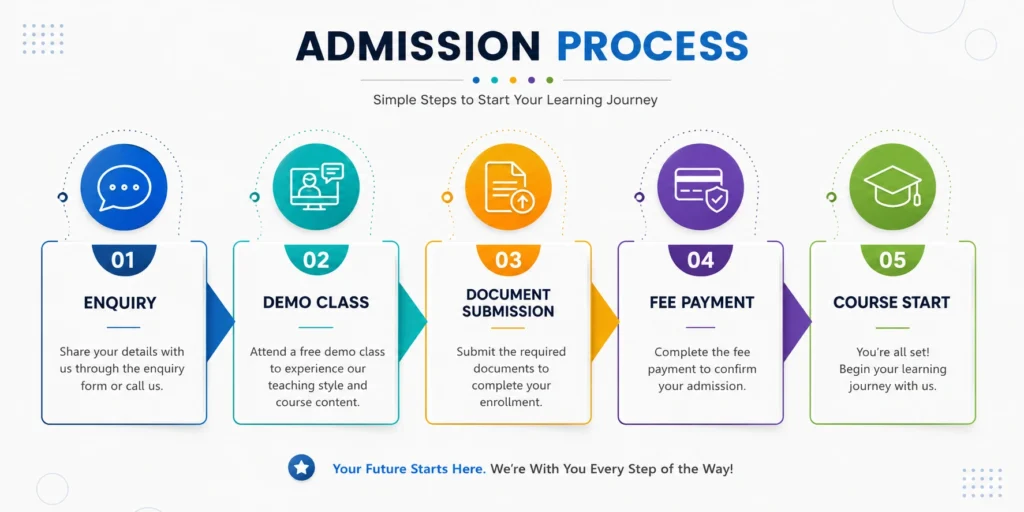
Typical Admission Steps
- Enquire about the course structure and duration
- Attend a demo class or counselling session
- Submit basic documents (10th marksheet, ID proof)
- Pay registration/course fee
- Begin with the foundational module
Some advanced diploma-level programs may prefer 12th pass, so it’s worth confirming eligibility directly with the institute before assuming.
It also helps to ask one specific question during enquiry: “What happens if I can’t attend a class due to exams?” A student-friendly institute will have a clear answer — recorded sessions, makeup classes, or flexible scheduling — while one that doesn’t have a real answer to this is probably not designed with school-going students in mind.
Fee Range for Beginners
Fees vary significantly by institute type, but roughly:
- Short foundation courses: ₹3,000 – ₹10,000
- Comprehensive beginner courses (3–6 months): ₹10,000 – ₹35,000
- Advanced/diploma-level programs: ₹35,000 and above
These are general market ranges, not fixed figures — always confirm directly with the specific institute, since fee structures change and vary by city and course depth.
Digital Chaabi Academy Insights
For students entering right after 10th, Digital Chaabi Academy’s approach focuses on building foundational understanding before pushing into tool-heavy execution — since younger learners benefit more from grasping why a strategy works before jumping into paid ad platforms.
The pacing is also designed to work alongside school schedules, rather than assuming a student has full-time hours to dedicate, which matters a lot for someone balancing 11th grade alongside a digital marketing course.
Career Opportunities After Starting Early
Starting a Digital Marketing Course After 10th does not mean immediately entering a full-time job. Instead, it gives students an early opportunity to build skills and practical experience.
- Ages 15–17: Learn, practice on personal projects, build a small portfolio
- Ages 18+: Take on internships, freelance micro-projects, entry-level roles
- By early 20s: Genuine experience advantage over peers who started only after graduation
Roles this early start feeds into eventually include Social Media Executive, Content Writer, SEO Executive, and later, Digital Marketing Manager.
There’s also a quieter benefit that doesn’t get talked about enough — confidence. A student who’s already comfortable pitching an idea, writing an ad caption, or reading a basic analytics dashboard by the time they’re choosing a college stream simply has more clarity about what kind of work actually excites them.
That clarity alone can save years of uncertainty that a lot of students go through only in their early 20s, after graduation, when the pressure to “figure it out” suddenly feels much higher.
A Note for Parents and Guardians
If a parent is reading this alongside their child, a fair question is whether this is a distraction from academics or a genuine long-term investment.
The honest answer sits somewhere in between, and depends entirely on pacing:
- Done right: A few hours a week, alongside school, treated like a hobby with structure — this rarely conflicts with academics and often improves a student’s writing, research, and presentation skills
- Done wrong: Treating it as a full-time pursuit that eats into study hours or exam preparation — this is where it becomes a genuine risk
Most reputable institutes design their after-10th batches with this balance in mind, scheduling classes on weekends or evenings specifically so it doesn’t clash with school timings.
Common Mistakes Students Make
- Rushing into paid ad campaigns before understanding strategy — wastes money and confidence
- Ignoring school/board studies to chase certificates — balance matters more than people admit
- Choosing a course based only on marketing promises, not actual curriculum depth
- Skipping writing/content skills — they underpin almost every digital marketing role
- Assuming one certificate replaces years of practice — a course builds foundation, not mastery
Step-by-Step: How to Start After 10th
- Talk to the institute directly about age-appropriate pacing
- Start with a foundation-level course, not an advanced/paid-ads-heavy one
- Practice on real but low-risk projects — a personal blog, a family business’s Instagram
- Build a small portfolio of work, even unpaid, to show later
- Revisit specialization (SEO, content, social) once comfortable with basics
Future Scope for Young Learners
As more institutes design age-appropriate, school-schedule-friendly programs, starting a digital marketing course after 10th is becoming genuinely more common rather than unusual. Combined with AI-assisted content tools lowering the technical barrier to entry, younger learners have more room to experiment safely than they did even five years ago.
For further reference on foundational concepts, Google Digital Garage offers free introductory material well-suited to a beginner starting this young.
There’s also a growing number of institutes designing dedicated “school student” batches — shorter class durations, weekend-only scheduling, and simplified assessments — specifically because demand from this age group has grown enough to justify it. That shift itself is a signal that starting after 10th is no longer treated as an edge case.
Conclusion
Starting a digital marketing course after 10th isn’t unusual or premature — it’s genuinely one of the more accessible ways to build an early, practical skill set. The key is choosing age-appropriate pacing, a course that builds strategy before tools, and treating it as a head start rather than a replacement for regular schooling.
If you’re exploring a digital marketing course after 10th and want a program that’s paced sensibly for a younger learner — building real understanding before jumping into paid tools — Digital Chaabi Academy structures its foundational training to grow with you, not overwhelm you from day one.
Pro Tip: If you are looking to master practical marketing skills through real client ad campaigns and in-house agency internships, explore the best digital marketing institute in Hisar at Digital Chaabi Academy.
FAQs
Q: Can I learn digital marketing after 10th?
Yes. Most foundational digital marketing courses have no stream or grade-completion requirement beyond passing 10th, and are designed for absolute beginners.
Q: Which course is best after 10th?
A comprehensive beginner-level course (3–6 months) covering SEO, social media, content, and basic ads generally works best, since it’s broad enough to help identify a genuine area of interest.
Q: What are the 7 types of digital marketing?
SEO, SEM/PPC, Social Media Marketing, Content Marketing, Email Marketing, Affiliate Marketing, and Influencer Marketing.
Q: Can I do digital marketing at 14?
You can learn the concepts and practice on personal projects at 14, but paid client work, ad accounts, and formal employment typically require being 18 due to platform and legal age restrictions.
Q: Do I need 12th or graduation to start a digital marketing course?
No, for most foundational courses. Some advanced diploma programs may prefer 12th pass, so it’s worth confirming directly with the institute.
Q: Is digital marketing a good career choice to start this early?
It can be — starting early builds a multi-year practical head start, as long as it’s balanced with ongoing school studies rather than replacing them.
Q: What skills should a 10th-pass student focus on first?
Writing/content creation and basic social media understanding tend to be the most natural, age-appropriate starting points before moving into paid advertising or technical SEO.