Here’s the direct answer: yes, a Performance Marketing Course for Working Professionals is worth joining in 2026, but only if you pick one that’s built around your job schedule and teaches live ad platforms, not just theory slides. If it doesn’t, you’ll waste both your evenings and your money.
I’ve had this conversation more times than I can count. Someone messages at 11 PM, half-apologetic, asking if it’s “too late” to learn digital marketing while working a full-time job. It never is. But the question underneath that question is really this: will a Performance Marketing Course for Working Professionals actually change anything for me, or is it just another course sitting unfinished in some folder?
That’s what this article is really about. Not the sales pitch version. The real one.
Digital marketing today isn’t optional anymore. Every business, big or small, is fighting for attention on Google and Meta. And performance marketing sits right at the center of that fight, because it’s the one skill that directly ties ad spend to actual revenue. Recruiters know this. Founders know this. It’s why professionals in sales, operations, even finance are quietly picking up performance marketing skills on the side.

Who should actually care about this? If you’re someone stuck in a role that feels stagnant, or you’re running a small side business that isn’t converting, or you just want a skill that makes you indispensable at your current company, keep reading.
What is Performance Marketing, really?
Let’s strip away the jargon for a second. Performance marketing is simply advertising where you only pay for actual results: a click, a sign-up, a sale instead of just paying to “show up” somewhere.
Compare that to traditional advertising. A billboard doesn’t care if anyone actually walks into your shop because of it. You paid for the space, results or not. Performance marketing flips that entirely. Every rupee spent is tied to something measurable.
This is why a Performance Marketing Course for Working Professionals has become so relevant lately. Businesses aren’t interested in “brand awareness” conversations anymore unless they can also see numbers attached, leads generated, cost per acquisition, return on ad spend. Working professionals who understand this language become genuinely useful in almost any team.
A few things fall under the performance marketing umbrella:
- Google Ads (Search, Display, Shopping, YouTube)
- Meta Ads (Facebook and Instagram)
- Conversion tracking and analytics
- Landing page optimization
- Retargeting and remarketing funnels
None of this is abstract theory. It’s applied, hands-on, and honestly kind of addictive once the numbers start clicking into place.
Why a Performance Marketing Course for Working Professionals Makes Sense Right Now
I’ll be blunt. Most working professionals don’t need another degree. What they need is a skill that pays back the time invested, quickly and visibly.
That’s exactly what a well-designed Performance Marketing Course for Working Professionals offers. It doesn’t ask you to quit your job or disappear into a classroom for two years. It asks for a few focused hours a week, in exchange for a skill set that’s genuinely scarce.
Here’s why the timing matters:
- Every industry healthcare, real estate, education, D2C brands is now investing in performance marketing
- Companies are actively looking for people who understand ad platforms, not just marketing “concepts”
- Freelance and consulting opportunities in this space have grown sharply since 2023
- Many working professionals use it to eventually run their own small ad agency on the side
There’s also a quieter reason. Once you understand performance marketing, you stop feeling powerless about your own career visibility. You can run ads for your own resume, your own personal brand, your own side hustle. That shift in control is worth more than most people realize going in.
Can You Actually Learn Performance Marketing While Working a Full-Time Job?
Yes and this is one of the two PAA questions worth answering directly, because it’s the one that stops most people before they even start.
The honest truth is that performance marketing is not a subject you memorize. It’s a skill you build by running actual campaigns, checking actual data, and adjusting actual budgets. That kind of learning fits surprisingly well into a working professional’s schedule because it’s built in short, repeatable cycles.
A good Performance Marketing Course for Working Professionals is structured around this reality:
- Weekend or evening batches
- Recorded sessions for when work runs late (and it always does)
- Practical assignments instead of long theory lectures
- Doubt-clearing sessions that don’t demand your full weekday attention
The professionals who succeed here aren’t the ones with the most free time. They’re the ones who treat two focused hours a week like a non-negotiable meeting with themselves. That’s genuinely all it takes.
Is a Performance Marketing Certification Worth It for Career Growth?
This is the second big question people ask, usually somewhere around message three or four in a conversation.
Here’s the direct answer: a certification alone won’t get you a promotion. But a certification backed by real campaign experience, actual ad accounts you’ve managed, actual budgets you’ve optimized absolutely strengthens your career case.
Recruiters and founders have gotten sharper about spotting the difference between someone who “completed a course” and someone who can actually explain why a campaign’s cost per lead dropped last week. A Performance Marketing Course for Working Professionals that includes live project work bridges that exact gap.

Think about it from a hiring manager’s seat. Two resumes look almost identical on paper. One candidate can talk fluently about ROAS, CTR, and audience segmentation with real examples. The other recites definitions. Who gets picked?
What You’ll Actually Learn: Skills, Tools, and Concepts
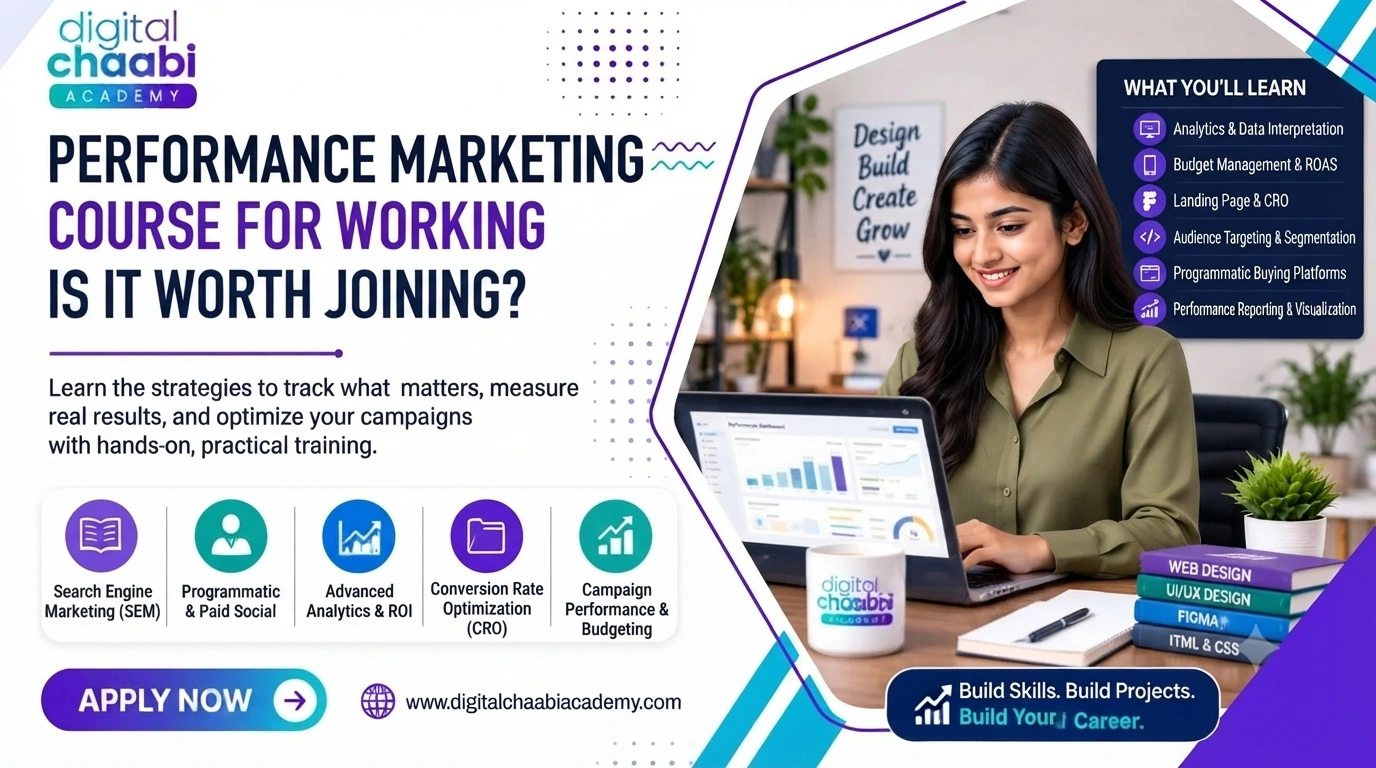
A solid Performance Marketing Course for Working Professionals should cover ground that’s immediately usable, not academic filler.
Core Platforms
- Google Ads search campaigns, keyword bidding, Display Network, Shopping ads
- Meta Ads Manager campaign structuring, audience targeting, retargeting funnels
- Google Analytics tracking user behavior, conversion paths, drop-off points
Strategic Concepts
- Funnel building (awareness → consideration → conversion)
- Audience segmentation and lookalike targeting
- A/B testing ad creatives and landing pages
- Budget allocation and scaling decisions
Practical, Often Overlooked Skills
- Reading a campaign dashboard without panicking at every dip
- Writing ad copy that doesn’t sound like ad copy
- Basic landing page psychology what actually makes someone click “Buy Now”
None of these skills exist in isolation. They connect to each other, and that’s usually where courses fall short teaching each tool separately instead of showing how they work as one system.
How Digital Chaabi Academy Approaches This Differently
I’ll mention this carefully, because I don’t want it to sound like a sales pitch tucked into an educational article that’s not the intent here.
Digital Chaabi Academy built its Performance Marketing Course for Working Professionals around a simple observation: most working professionals don’t fail because the concepts are hard. They fail because the course format assumes they have unlimited free time, which almost nobody actually has.
So the structure leans heavily on:
- Live campaign practice on real ad accounts, not simulated dashboards
- Batch timings designed around evening and weekend availability
- Mentors who’ve actually run ad budgets, not just taught about them
- Doubt-resolution that doesn’t require waiting a week for a reply

What stands out about Digital Chaabi Academy’s approach is the refusal to separate “learning” from “doing.” Students aren’t handed hypothetical case studies they work with live scenarios that mirror what agencies handle daily.
There’s also a quieter emphasis at Digital Chaabi Academy on business thinking, not just platform mechanics. Understanding Google Ads is one thing. Understanding why a client’s business isn’t converting despite good ad performance that’s a different, more valuable skill entirely. And that’s the layer many working professionals say they didn’t expect to get, but ended up valuing the most.
Real Opportunities After Completing the Course
This is usually where the conversation gets genuinely exciting, because the paths open up in more directions than people initially expect.
- In-house marketing roles companies hiring internal performance marketers to manage their own ad budgets
- Freelance consulting small businesses desperately need someone who can run profitable ad campaigns
- Agency roles digital marketing agencies constantly hiring people who understand Google and Meta Ads
- Starting your own micro-agency many working professionals eventually run 3–5 small clients on the side
- Internal promotion becoming the “go-to” person for marketing decisions within your current company
None of these require dramatic career pivots. Most professionals who complete a Performance Marketing Course for Working Professionals start small, maybe managing one client’s Instagram ads on weekends and let it grow from there, at their own pace.
Common Mistakes Working Professionals Make
Let’s talk honestly about where people go wrong, because this matters more than the success stories.
- Treating the course as passive content watching videos without ever touching an actual ad account
- Skipping the “boring” analytics part then wondering why campaigns underperform
- Trying to learn everything at once Google Ads, Meta Ads, SEO, email marketing, all in week one
- Not asking questions when confused assuming it’ll “make sense later”
- Choosing a course based only on price cheaper isn’t always shorter, sometimes it’s just shallower
The biggest one, honestly? Signing up with enthusiasm, then letting the course sit untouched for three weeks because work got busy. Consistency, even inconsistent, imperfect consistency beats intensity that burns out by week two.
Step-by-Step: How to Choose the Right Course
If you’re actually evaluating a Performance Marketing Course for Working Professionals, here’s a practical way to filter your options.
- Check the batch timing. Does it genuinely fit around a 9-to-6 job, or is it “flexible” only on paper?
- Ask about live campaign practice. Will you manage real ad accounts, or just watch screen recordings?
- Look at mentor backgrounds: have they actually run ad budgets, or only taught about them?
- Ask about post-course support. Is there guidance after the course ends, or does it just stop?
- Read between the marketing lines if a course promises overnight success, that’s usually a red flag
- Talk to past students even a five-minute conversation reveals more than any brochure
This process takes maybe an hour of research. It saves months of regret.
Where Performance Marketing Is Headed
Performance marketing isn’t slowing down if anything, it’s becoming more central to how businesses operate. AI-assisted bidding, automated creative testing, and predictive audience targeting are already reshaping how campaigns get built.
But here’s the part that doesn’t change: someone still needs to understand strategy, interpret data with judgment, and make decisions that automation alone can’t make well. That’s exactly the layer a good Performance Marketing Course for Working Professionals prepares you for not just running tools, but thinking clearly about what the numbers actually mean.
For [Internal Link: Digital Marketing Course] readers exploring broader options, or those curious about [Internal Link: SEO Course] as a complementary skill, performance marketing pairs naturally with both. Many professionals also explore [Internal Link: Social Media Marketing Course] alongside this, since ad platforms and organic content strategy tend to reinforce each other.
For additional learning, resources like Google Skillshop and Meta Blueprint offer official platform-level certifications that complement structured course learning well.
Conclusion
So, is a Performance Marketing Course for Working Professionals actually worth it? If you pick one that respects your time and gets you hands-on with real ad accounts, yes genuinely. It’s not a magic career switch, and nobody should sell it to you that way. But it is a practical, learnable skill that keeps paying back long after the course ends.
The professionals who benefit most aren’t the ones with the most spare hours. They’re the ones who show up consistently, even imperfectly, and let the learning compound over a few months.
If you’re tired of watching digital marketing conversations happen around you without being able to contribute meaningfully, Digital Chaabi Academy’s Performance Marketing Course for Working Professionals is built to change that through live campaigns, evening-friendly batches, and mentors who’ve actually managed real ad budgets, not just talked about them.
FAQs
Q1: Can working professionals really learn performance marketing without quitting their job?
A: Yes. A well-structured Performance Marketing Course for Working Professionals is designed around evening and weekend availability, with recorded sessions for backup. Most people manage it with just a few focused hours weekly.
Q2: Is a performance marketing certification worth it for career growth?
A: On its own, not dramatically. Paired with real campaign experience and live project work, it becomes a strong career asset that recruiters and clients genuinely notice.
Q3: How long does a typical Performance Marketing Course for Working Professionals take?
A: Most structured programs run between 2 to 4 months, depending on batch pace and depth of live project work involved.
Q4: Do I need a marketing background to join this course?
A: No. Most working professionals joining a Performance Marketing Course for Working Professionals come from completely unrelated fields sales, finance, engineering, even teaching.
Q5: What’s the realistic earning potential after completing the course?
A: It varies widely based on effort and niche, but freelancers managing 2–3 small clients often earn a meaningful side income within the first six months.
Q6: Is Google Ads or Meta Ads more important to learn first?
A: Both matter, but most courses start with Google Ads for its structured, intent-driven nature, then move into Meta Ads for audience-based targeting.
Q7: Will I get to work on real ad campaigns during the course?
A: In a good program, yes. Live campaign practice is what separates a course that builds real skill from one that’s purely theoretical.
Q8: What makes Digital Chaabi Academy’s course different for working professionals?
A: The batch structure, live account practice, and mentor accessibility are built specifically around working professionals’ limited but consistent time, not around a classroom-first model.