
Learning affiliate marketing for your own website, YouTube channel, or Instagram account is different from offering affiliate services to a client. When you work for yourself, you control the content, audience, affiliate links, and promotional strategy. When you work with a business, you need to understand its products, audience, margins, commission structure, tracking system, brand guidelines, and business goals. That’s the gap an Affiliate Marketing Course for Freelancers should help you close.
A useful course should go beyond teaching you how affiliate links and commissions work. It should help you turn affiliate marketing knowledge into a professional service that businesses can understand and purchase.
This includes affiliate program setup, partner recruitment, influencer outreach, content guidance, tracking, reporting, client communication, pricing, and ongoing program management. If you already understand affiliate marketing personally and want to turn that knowledge into freelance income, learning the client-service side can help you build a more structured approach.
Why Personal Affiliate Skills Don’t Automatically Translate to Client Work
Here is the optimized sentence with the focus keyword added naturally: Personal affiliate marketing experience can provide a useful foundation, but an Affiliate Marketing Course for Freelancers can help you develop the additional skills needed to handle the different level of responsibility involved in client work. For your own affiliate business, you may already understand how to:

- Select products
- Create promotional content
- Add affiliate links
- Track clicks
- Monitor conversions
- Earn commissions
- Communicate with your audience
Client projects require additional skills. You may need to create an affiliate strategy, select an appropriate program structure, recruit partners, establish commission terms, prepare reporting, communicate with business owners, and coordinate ongoing activities.
An Affiliate Marketing Course for Freelancers should therefore explain how personal affiliate experience can be converted into a repeatable client-service process.
From Personal Experience to Client Services
Think about the difference this way:
Personal affiliate marketing: You promote products to your own audience.
Freelance affiliate marketing:
You help a business create, manage, or improve a system through which partners promote that business’s products or services. The second model requires more planning and communication.
Why Documentation Matters
A client cannot see what is happening inside your head. Your strategy needs to be documented through things such as:
- Affiliate recruitment plans
- Commission structures
- Content guidelines
- Outreach templates
- Performance reports
- Campaign calendars
- Tracking documentation
- Monthly action plans
This is one reason an Affiliate Marketing Course for Freelancers should include practical assignments instead of focusing exclusively on theory.
What an Affiliate Marketing Course for Freelancers Should Teach
When evaluating an Affiliate Marketing Course for Freelancers, look beyond lessons about earning commissions personally and focus on whether the course also teaches the practical skills required to provide affiliate marketing services to clients. A freelance-focused program should ideally cover both technical affiliate knowledge and service delivery skills.
Core Affiliate Marketing Knowledge
You should understand:
- Affiliate links
- Tracking parameters
- Conversion tracking
- Commission structures
- Affiliate networks
- Direct affiliate programs
- Cookies and attribution
- Payout models
- Affiliate disclosures
- Partner relationships
Freelance Service Skills
You should also learn how to:
- Identify client requirements
- Create a service proposal
- Build an affiliate strategy
- Define deliverables
- Communicate timelines
- Prepare reports
- Price your services
- Manage client expectations
- Retain clients
A course that combines these two areas can provide a stronger foundation for someone who wants to sell affiliate marketing freelance services.
What Skills Do You Need for Affiliate Marketing Freelancing?
An Affiliate Marketing Course for Freelancers should help you develop a combination of technical, analytical, marketing, and communication skills.
1. Affiliate Program Setup
You should understand how affiliate programs are structured and what information needs to be configured. This may include:
- Commission percentage
- Commission rules
- Tracking links
- Conversion events
- Cookie duration
- Payment terms
- Promotional restrictions
- Affiliate approval rules
The exact setup depends on the platform and business model.
2. Affiliate Recruitment
A client may have a good product but no suitable promotional partners. Your responsibility could include finding:
- Content creators
- Bloggers
- YouTubers
- Influencers
- Niche websites
- Newsletter publishers
- Industry-specific publishers
The goal should not simply be to find people with large audiences. Relevance, audience quality, content alignment, trust, and conversion potential can also matter.

3. Content Strategy
Affiliate partners need useful promotional material. You may help them understand:
- Target audience
- Product benefits
- Content angles
- Keywords
- Calls to action
- Promotional guidelines
- Disclosure requirements
4. Analytics and Reporting
A freelance affiliate specialist should understand important metrics such as:
- Clicks
- Conversion rate
- Orders
- Revenue
- Commission
- Earnings per click
- Return on investment
- Affiliate contribution
The exact metrics depend on the client’s business model and tracking setup.
5. Client Communication
Technical knowledge alone is not enough. You should be able to explain complicated affiliate concepts in simple language. For example, instead of saying:
“The EPC decreased because of attribution inefficiency.”
You might explain: “Partners are generating clicks, but fewer visitors are completing the desired action, so we need to review the offer, landing page, and partner traffic.” Clear communication makes reporting more useful to business owners.
Building an Affiliate Strategy for a Client
An affiliate strategy should begin with the client’s business rather than with an affiliate platform. Before recommending a setup, understand:
- What does the business sell?
- Who is the target customer?
- What is the average order value?
- What is the profit margin?
- Which products are suitable for affiliate promotion?
- What type of partners can reach the target audience?
- What commission can the business sustainably afford?
- How will conversions be tracked?
Choose the Right Affiliate Model
A client might use:
- An in-house affiliate program
- An affiliate network
- A combination of affiliate and influencer partnerships
- A creator-focused partnership model
The appropriate option depends on the business’s resources, products, audience, and operational requirements.
Set a Sustainable Commission Structure
Commission should be attractive enough for potential partners while remaining commercially viable for the business. For example, a strategy could consider:
- Standard commission
- Higher commission for high-performing partners
- Product-specific commission
- Promotional bonuses
- Limited-time campaigns
The numbers should be based on the client’s economics rather than copied from another business.
Select Relevant Partners
Follower count should not be the only selection criterion. Evaluate:
- Audience relevance
- Engagement quality
- Content quality
- Historical performance
- Brand alignment
- Traffic sources
- Promotional methods
- Compliance with disclosure requirements
This approach can help businesses build partnerships around relevance instead of vanity metrics.
The Client-Facing Side of Affiliate Freelancing
An Affiliate Marketing Course for Freelancers should also prepare you for the communication side of the job.
Explaining Affiliate Programs
Business owners may understand sales and marketing but have limited knowledge of affiliate systems. Your job is to explain:
- How affiliates are paid
- How sales are tracked
- What counts as a conversion
- What promotional methods are allowed
- How partners are recruited
- How results will be reported
Managing Affiliate Relationships
Affiliate program management can involve ongoing communication. You may need to:
- Answer affiliate questions
- Approve new partners
- Share promotional assets
- Provide campaign updates
- Review partner performance
- Identify inactive affiliates
- Communicate new offers
Setting Expectations
Affiliate programs may require time to develop. Partner recruitment, content creation, traffic generation, testing, and optimization can take time. Avoid promising guaranteed revenue or instant results. A professional freelancer should explain the variables that can affect performance.
Affiliate Program Setup and Management
This is one of the most practical areas for freelancers.
H3: Affiliate Program Setup
The initial setup may include:
- Selecting a platform
- Defining commission rules
- Creating affiliate terms
- Configuring tracking
- Preparing promotional assets
- Creating an affiliate application process
- Testing the customer journey
H4: Tracking and Attribution
Tracking should be tested before launching a campaign. Check whether:
- Affiliate clicks are recorded
- Conversion events fire correctly
- Orders are attributed correctly
- Commission calculations work
- Reports display expected data
H5: Quality Checks
Before launch, test the complete path:
Affiliate link → Landing page → Customer action → Conversion tracking → Commission calculation → Reporting
H6: Final Tracking Review
A small tracking problem can make an otherwise good affiliate campaign difficult to evaluate. Always test the setup before relying on the data for client reporting.
Pricing Affiliate Marketing Freelance Services
Pricing is another important topic for an Affiliate Marketing Course for Freelancers. There is no universal price that works for every freelancer or client. Your pricing can depend on:
- Project scope
- Number of products
- Number of affiliates
- Platform complexity
- Recruitment requirements
- Reporting frequency
- Expected working hours
- Client support
- Ongoing optimization
Common Pricing Models
1. One-Time Setup Fee
You charge for creating and launching the affiliate program. This can work when the client wants implementation but plans to manage the program internally.
2. Monthly Retainer
You manage the program continuously for a recurring monthly fee. This can cover:
- Affiliate recruitment
- Communication
- Reporting
- Campaign planning
- Optimization
3. Setup + Monthly Management
Some freelancers separate implementation from ongoing management. This makes the scope easier to understand because the client can see what they are paying for during launch and what they are paying for afterward.
4. Performance-Based Component
In some arrangements, compensation may include a performance component. However, the terms should be clearly documented, including how conversions are attributed and when payment is calculated.
How Digital Chaabi Academy Approaches Affiliate Marketing Training
Digital Chaabi Academy can be positioned within this article as an example of training that connects affiliate marketing knowledge with practical digital marketing skills. The important distinction is between learning affiliate marketing only as a personal income method and learning how affiliate knowledge can become a professional service. A training approach focused on freelancing can include areas such as:
- Affiliate strategy
- Program setup
- Client communication
- Service packaging
- Reporting
- Pricing
- Practical marketing applications
For someone exploring an Affiliate Marketing Course for Freelancers, this service-focused approach can be particularly relevant when the goal is to work with businesses rather than only promote products independently.
Freelance Services You Can Offer
After developing the right affiliate marketing skills, you can build different service packages.
Affiliate Program Setup
Help a business establish its initial affiliate system.
Affiliate Program Management
Manage recruitment, communication, campaigns, reporting, and optimization.
Affiliate Recruitment
Research and approach relevant creators, publishers, influencers, and niche partners.
Influencer Affiliate Campaigns
Help brands structure partnerships where creators earn commissions from tracked sales.
Affiliate Content Strategy
Help partners understand content topics, promotional angles, landing pages, and calls to action.
Affiliate Audit
Review an existing affiliate program and identify:
- Tracking problems
- Recruitment gaps
- Low-performing partnerships
- Commission issues
- Content opportunities
- Reporting weaknesses
Training and Consulting
Some companies may prefer to manage affiliate marketing internally and hire a freelancer for training, strategy, or consulting. This gives freelancers another potential service model.
Common Mistakes New Affiliate Freelancers Make
Mistake 1: Assuming Personal Success Guarantees Client Success
Your own audience, products, and content style are different from a client’s. A strategy must be adapted to the client’s:
- Audience
- Product
- Market
- Pricing
- Business model
- Customer journey
Mistake 2: Underpricing the Service
Affiliate program management can involve ongoing recruitment, communication, reporting, and optimization. Treating the entire process as a quick setup can lead to unclear scope and excessive unpaid work.
Mistake 3: Promising Immediate Results
Avoid guarantees about revenue, sales, rankings, or conversions. Instead, define:
- Deliverables
- KPIs
- Testing periods
- Reporting schedules
- Optimization activities
Mistake 4: Recruiting Partners Without Vetting
A large affiliate list does not automatically mean a successful program. Evaluate partner quality and relevance before prioritizing quantity.
Mistake 5: Ignoring Agreements
Commission terms, promotional restrictions, payment conditions, disclosures, and responsibilities should be documented clearly.
Mistake 6: Focusing Only on Setup
Launching an affiliate program is only the beginning. Many programs require ongoing recruitment, communication, content support, reporting, and optimization.
Step-by-Step: How to Get Your First Affiliate Client
If you want to turn affiliate knowledge into freelance work, use a structured process.
Step 1: Build Practical Experience
Start with your own affiliate project or a controlled practice project. Learn how links, tracking, content, and conversions work.
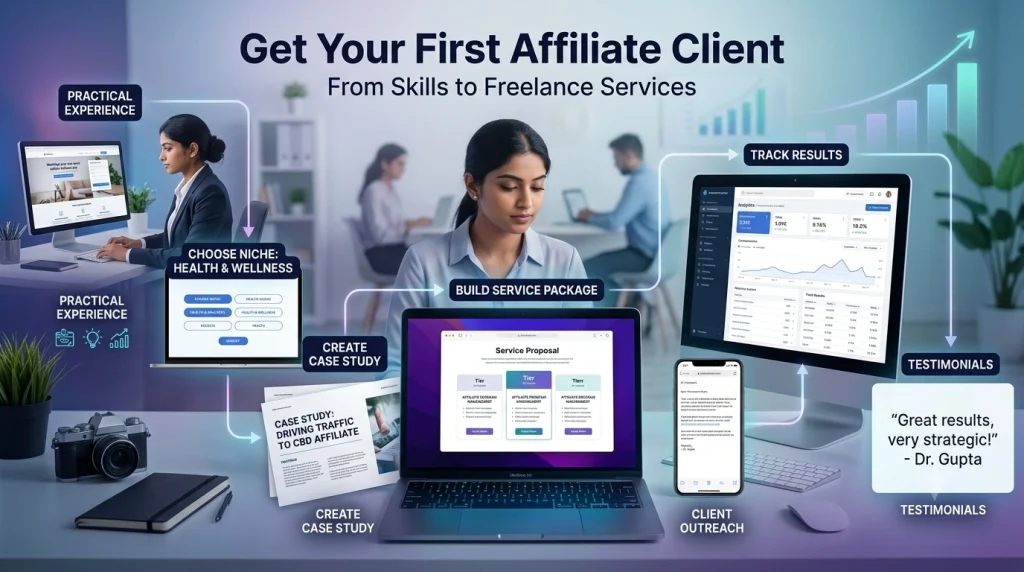
Step 2: Choose a Niche
You could focus on areas such as:
- E-commerce
- SaaS
- Education
- Beauty
- Fitness
- Technology
- Finance
- Travel
Choose an area where you can understand the customer journey.
Step 3: Create a Mock Case Study
Select a business and create a sample affiliate strategy. Include:
- Target audience
- Potential partners
- Commission approach
- Recruitment strategy
- Content ideas
- Tracking requirements
- Reporting plan
Clearly label it as a sample or hypothetical case study.
Step 4: Create a Service Package
For example:
Affiliate Program Setup
- Strategy
- Platform configuration
- Tracking setup
- Affiliate terms
- Launch support
Monthly Affiliate Management
- Recruitment
- Partner communication
- Campaign planning
- Reporting
- Optimization
Step 5: Start Outreach
Contact businesses where affiliate partnerships make commercial sense.
Personalize your outreach around a specific opportunity rather than sending the same generic message to every business.
Step 6: Document Results
Track meaningful metrics such as:
- Partners recruited
- Active affiliates
- Clicks
- Conversions
- Revenue
- Commission
- Conversion rate
Step 7: Build Social Proof
Once you have completed legitimate projects, request testimonials or permission to create case studies where appropriate.
Step 8: Improve Your Offer
Use experience from each project to improve:
- Pricing
- Deliverables
- Reporting
- Processes
- Client onboarding
Using AI Tools for Affiliate Marketing Freelancing
AI tools can help freelancers complete certain tasks faster, but they should support rather than replace professional judgment. You can use AI for:
- Outreach drafts
- Affiliate program guidelines
- Content ideas
- Report summaries
- Research organization
- Email drafts
- Campaign brainstorming
- Data interpretation support
However, client-facing recommendations should be reviewed before delivery. An Affiliate Marketing Course for Freelancers can be more useful when it teaches you how to combine automation with human decision-making. For example:
AI: Helps summarize campaign data.
Freelancer: Explains why the data matters and what action should be taken.
AI: Helps draft affiliate outreach.
Freelancer: Personalizes the message and decides which partners are worth contacting.
This distinction is important because clients pay for outcomes, judgment, communication, and accountability—not simply for generating text quickly.
Where Affiliate Freelancing Is Headed
Affiliate marketing continues to overlap with several areas of digital marketing, including creator marketing, content marketing, social media, e-commerce, and performance marketing. This creates opportunities for freelancers who can combine multiple skills. For example, a client may initially hire you for affiliate program management and later need:
- Social media marketing
- Content creation
- SEO
- Performance marketing
- Influencer marketing
- Email marketing
- Conversion optimization
This makes affiliate marketing particularly useful as one component of a broader digital marketing service portfolio. For readers interested in expanding their skills, related training in Performance Marketing and Social Media Marketing can complement affiliate services.
FAQs
Q1. Which Affiliate Marketing Course for Freelancers should I choose?
Look for a program that covers more than personal affiliate income. It should address affiliate program setup, recruitment, reporting, client communication, pricing, and ongoing management.
Q2. Can I use ChatGPT for affiliate marketing?
Yes. AI can assist with research organization, content ideas, outreach drafts, reporting summaries, and other repetitive tasks. Human review and strategic judgment are still important.
Q3. What skills do I need for affiliate marketing freelancing?
Important skills include affiliate program setup, tracking, affiliate recruitment, content strategy, analytics, reporting, client communication, pricing, and relationship management.
Q4. What services can an affiliate marketing freelancer offer?
Services can include affiliate program setup, affiliate recruitment, program management, influencer partnerships, affiliate content strategy, audits, reporting, and consulting.
Q5. How much should I charge for affiliate marketing services?
Pricing depends on scope, complexity, working hours, recruitment requirements, reporting, and ongoing management. Freelancers may use setup fees, retainers, or combinations of different pricing structures.
Q6. How long does it take for an affiliate program to produce results?
There is no universal timeline. Results depend on the product, audience, commission structure, partner recruitment, content quality, traffic, conversion process, and other business factors.
Q7. Do I need my own successful affiliate website before offering affiliate services?
Personal experience can help demonstrate practical understanding, but it is not the only way to build credibility. A strong portfolio, practical case studies, technical knowledge, and clear service process can also demonstrate capability.
Q8. What makes an Affiliate Marketing Course for Freelancers different from a general affiliate course?
A freelance-focused course should address service delivery in addition to affiliate marketing fundamentals. This includes client communication, pricing, reporting, program management, recruitment, and strategy.
Conclusion
An Affiliate Marketing Course for Freelancers should teach more than how affiliate links generate commissions. If your goal is to work with clients, you need to understand how to turn affiliate marketing knowledge into a professional service. That means learning:
- Affiliate program setup
- Partner recruitment
- Affiliate strategy
- Tracking and analytics
- Content guidance
- Client communication
- Reporting
- Pricing
- Ongoing management
The key difference between personal affiliate marketing and freelance affiliate services is responsibility. You are no longer promoting products only for yourself. You are helping another business build and manage a marketing channel.
Digital Chaabi Academy‘s affiliate marketing training can be positioned around this service-focused approach for learners who want to develop affiliate marketing skills alongside broader digital marketing capabilities. For freelancers who already understand affiliate marketing and want to move toward client work, building these additional skills can create a clearer path from personal experience to professional service delivery.