Learning social media marketing today involves much more than creating attractive posts or writing engaging captions. Businesses also need professionals who understand paid advertising, audience targeting, campaign optimization, analytics, and conversion tracking. That is why a Social Media Marketing Course with Meta Ads Training can be useful for students, freelancers, and aspiring digital marketers who want to develop both organic and paid social media skills.
Organic content helps a brand build visibility and community, while Meta Ads can help businesses reach specific audiences and support measurable marketing goals. When these skills are taught together, learners can understand how content, advertising, audience behavior, and campaign data work as parts of one marketing strategy.
If you are comparing training programs, the important question is not simply whether a course mentions Instagram, Facebook, or Meta Ads. The better question is whether the curriculum gives you enough practical knowledge to plan content, create campaigns, analyze results, and make informed optimization decisions.
Why Organic Content and Paid Ads Work Better Together
Social media marketing and paid advertising were once treated as separate areas of digital marketing. Today, businesses often use both approaches as part of the same marketing strategy, which is why a Social Media Marketing Course with Meta Ads Training can help learners understand how organic content and paid campaigns work together.

Organic content can help a business establish its brand voice, educate its audience, answer questions, and encourage engagement. Paid advertising can then help distribute selected content or promotional messages to specific audiences.
For example, a business might publish several educational Instagram posts and discover that one particular Reel receives significantly more engagement than the others. That information can become useful when planning future advertising experiments.
A Social Media Marketing Course with Meta Ads Training should therefore explain the relationship between organic content and paid campaigns instead of treating them as completely unrelated subjects.
Organic Social Media Skills
Students should understand:
- Content planning
- Social media calendars
- Caption writing
- Reels and short-form video
- Stories and carousels
- Community engagement
- Brand voice
- Audience research
- Organic performance analysis
Paid Social Media Skills
Students should also learn:
- Meta Ads Manager
- Campaign objectives
- Campaign structure
- Audience targeting
- Ad creatives
- Budget management
- Testing
- Conversion tracking
- Performance analysis
- Campaign optimization
The combination creates a broader understanding of how social media marketing works from content creation through paid distribution and measurement.
What Should a Meta Ads Course Include?
When someone searches for a Meta Ads course, they are usually looking for more than an explanation of the Ads Manager interface. A Social Media Marketing Course with Meta Ads Training should also teach practical campaign setup, audience targeting, creative testing, budgeting, and performance analysis. A practical course should explain how to make advertising decisions.
Meta Ads Manager
Students should become familiar with the basic structure of Meta Ads Manager, including campaigns, ad sets, advertisements, budgets, audiences, placements, and reporting. A Social Media Marketing Course with Meta Ads Training should explain these components through practical examples so students can understand how to create, manage, and analyze Meta advertising campaigns.
The course should explain why each level exists and how changes at one level can affect campaign performance.
Audience Targeting
Audience research is another important part of Meta Ads training. In a Social Media Marketing Course with Meta Ads Training, students should learn how to identify the right audience, understand customer needs, select relevant targeting options, and build campaigns around specific marketing goals.
A course can introduce learners to different audience approaches, including:
- Broad audiences
- Interest-based audiences
- Custom audiences
- Website visitors
- Engagement audiences
- Lookalike audiences where appropriate
- Retargeting strategies
The objective should not simply be memorizing audience types. Students should understand when a particular audience approach may make sense for a campaign.
Creative Development
Advertising creative can include:
- Images
- Reels
- Videos
- Carousels
- Primary text
- Headlines
- Calls to action
Students should learn how to connect the creative with the audience, offer, and campaign objective.
Campaign Measurement
A practical Meta Ads course should also cover metrics such as:
- Impressions
- Reach
- Frequency
- CPM
- CTR
- CPC
- Landing-page views
- Leads
- Conversions
- Cost per result
- Return on ad spend where relevant
Understanding the numbers is essential because launching a campaign is only one part of paid advertising.
What the 5-5-5 Rule Means for Social Media
The 5-5-5 rule is sometimes discussed as a simple engagement routine for social media beginners. One version involves spending five minutes engaging with other accounts, following five relevant profiles, and leaving meaningful comments on five posts. A Social Media Marketing Course with Meta Ads Training can introduce this type of organic engagement activity to help students understand how community building complements paid social media campaigns. It should be treated as a basic engagement exercise rather than a universal algorithm formula.
For beginners, the larger lesson is that social media marketing involves participation and community building, not just publishing content. A Social Media Marketing Course with Meta Ads Training can use activities like this to help students understand organic engagement before moving deeper into paid advertising.
However, paid advertising should still be evaluated using campaign objectives and actual performance data rather than assuming that an engagement routine will automatically improve advertising results.
What a Social Media Marketing Course with Meta Ads Training Should Cover
A strong curriculum should connect strategy, content, advertising, analytics, and practical execution.
Organic Social Media Fundamentals
The first part should establish a foundation in organic social media. Students should learn:
- Audience research
- Competitor research
- Content pillars
- Content calendars
- Platform selection
- Brand positioning
- Copywriting
- Visual content
- Community management
The goal is to understand why particular content is created rather than simply learning how to publish a post.
Meta Ads Fundamentals
The advertising component should include:
- Meta Ads Manager navigation
- Campaign objectives
- Campaign setup
- Ad set configuration
- Audience selection
- Placements
- Budget and scheduling
- Ad creative
- Calls to action
- Basic tracking
- Campaign reporting
Campaign Testing and Optimization
A Social Media Marketing Course with Meta Ads Training should not stop after campaign creation. Students should learn how to compare different:

- Audiences
- Creatives
- Hooks
- Headlines
- Offers
- Landing pages
- Calls to action
They should also learn that a campaign should be evaluated according to its objective instead of relying on one metric.
Analytics and Reporting
Reporting is an important professional skill. A student should be able to explain:
- What happened?
- Why did it happen?
- Which audience responded?
- Which creative performed differently?
- What should be tested next?
- What should be changed or maintained?
This turns advertising from a simple campaign-launching activity into an ongoing optimization process.
The Skill That Connects Organic Content and Paid Advertising
One of the most useful skills is learning how to interpret content and advertising data together. Suppose an organic Reel receives strong engagement. That does not automatically mean it should receive advertising budget. In a Social Media Marketing Course with Meta Ads Training, students should learn to consider the campaign objective, audience, offer, creative quality, conversion path, and available data before deciding whether to promote the content through Meta Ads.
Likewise, a post with modest organic engagement may still have value in a paid campaign if its message, offer, or creative is appropriate for the intended audience. This is why practical judgment matters. A Social Media Marketing Course with Meta Ads Training should teach students to ask:
- What is the marketing objective?
- Who is the intended audience?
- What problem does the content address?
- What action should the audience take?
- What evidence supports the advertising decision?
- Which metric should determine success?
- What should be tested next?
These questions help learners move beyond simply boosting posts.
How Digital Chaabi Academy Approaches This Training
Digital Chaabi Academy presents social media marketing and Meta Ads as connected skills rather than completely isolated subjects.
The training approach described for the program focuses on building organic social media fundamentals before applying paid advertising concepts. This Social Media Marketing Course with Meta Ads Training can help students understand how content planning, audience engagement, and advertising decisions relate to each other.
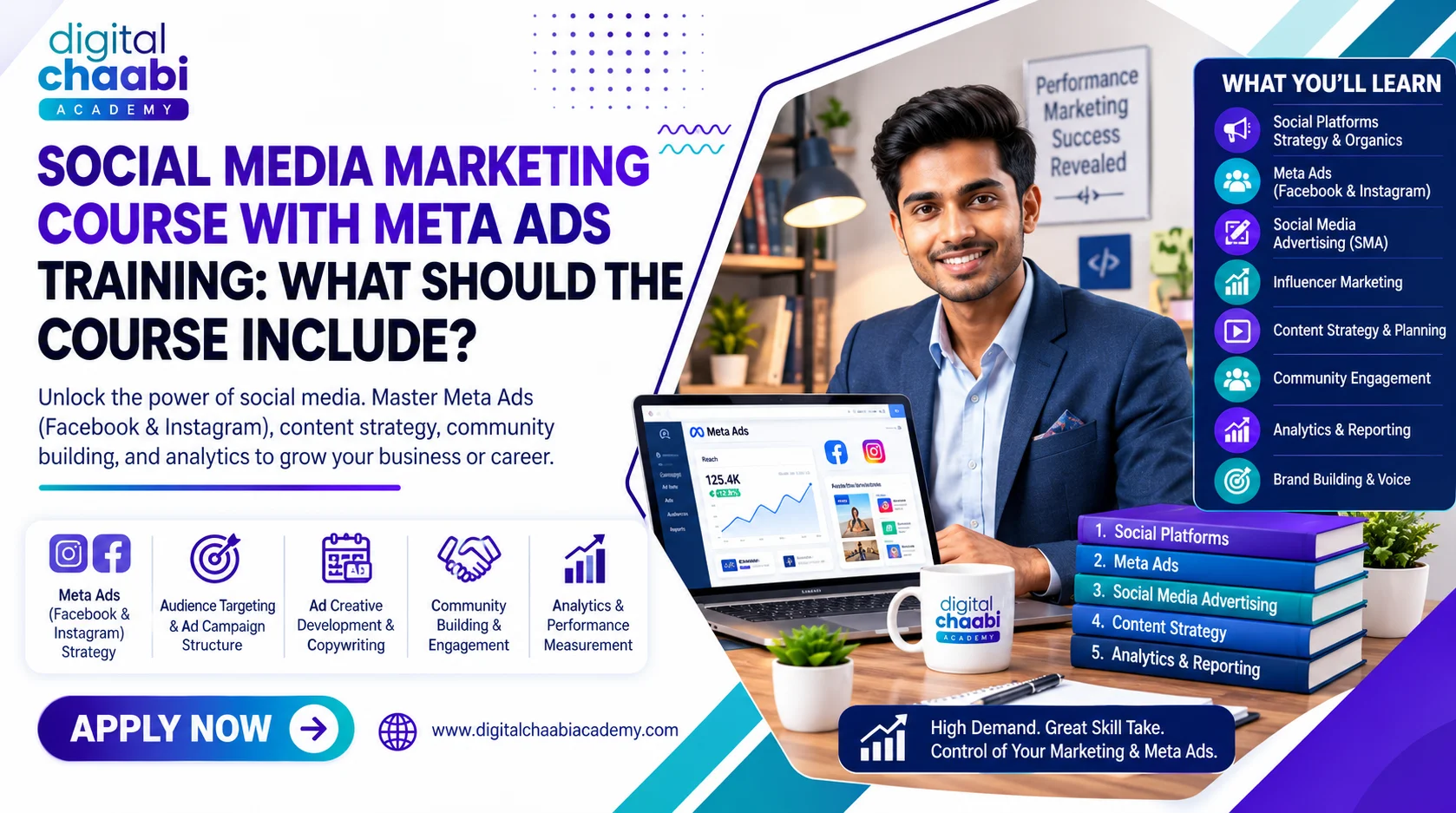
The learning process can include areas such as content strategy, social media platforms, campaign planning, Meta Ads Manager, audience targeting, creative development, and performance analysis. For students considering a course, it is useful to verify the current syllabus, practical assignments, mentor support, campaign access, and project structure directly with the academy before enrollment.
The broader learning objective should be clear: students should finish with an understanding of both content execution and paid social advertising rather than knowing only how to navigate an advertising dashboard.
Career and Freelance Opportunities
Learning organic social media and Meta Ads can support several professional paths.
Social Media Executive
A social media executive may work on content calendars, captions, publishing, engagement, and performance reporting. A Social Media Marketing Course with Meta Ads Training can help students build these skills while also learning how paid campaigns support broader social media marketing goals.
Paid Social Media Executive
A paid social professional may focus more heavily on campaign setup, audience research, creative testing, budget management, and reporting.
Digital Marketing Executive
A broader digital marketing role may involve social media, paid advertising, SEO, analytics, email marketing, and other channels. A Social Media Marketing Course with Meta Ads Training can provide a useful foundation in social media strategy and paid advertising while helping learners understand how these channels fit into a broader digital marketing strategy.
Freelance Social Media Marketer
Freelancers can offer services such as:
- Social media management
- Content planning
- Creative coordination
- Meta Ads management
- Lead generation campaigns
- Monthly reporting
Social Media Advertising Consultant
With experience, professionals may provide strategic support to businesses that need help planning and measuring paid social campaigns. A Social Media Marketing Course with Meta Ads Training can help learners develop a combined understanding of content strategy, audience targeting, campaign management, and performance measurement. This skill set can give learners more flexibility when exploring entry-level jobs, freelance services, or social media advertising opportunities.
Common Mistakes in Organic and Paid Social Media
Learning both areas is useful, but beginners can still make several common mistakes.
Boosting Every Post
Not every organic post needs advertising budget. Paid promotion should have a clear purpose and measurement framework.
Ignoring the Campaign Objective
A campaign designed for awareness should not necessarily be judged using the same criteria as a lead-generation campaign.
Using One Creative
Testing different creative concepts can provide useful information about what resonates with a particular audience.
Focusing on One Metric
A low CPC alone does not necessarily mean that a campaign is achieving the business objective. Metrics need to be interpreted in context.
Ignoring the Landing Page
For campaigns that send users to a website, the advertising experience and landing-page experience should work together.
Making Changes Without Enough Data
Frequent changes can make it difficult to understand why performance changed. Students should learn to evaluate data carefully before making optimization decisions.
How to Choose the Right Course
If you are comparing a Social Media Marketing Course with Meta Ads Training, use a practical checklist.
1. Review the Curriculum
Check whether the syllabus covers both organic social media and paid advertising.
2. Check Practical Training
Find out whether students get opportunities to work through campaign setup, audience creation, creative testing, and reporting.
3. Examine Mentor Experience
Look for instructors who can explain both the strategic and technical sides of social media advertising.
4. Look for Projects
Projects can help students practice campaign planning, content creation, reporting, and optimization.
5. Check Analytics Training
A course should explain how to interpret campaign results instead of focusing only on campaign creation.
6. Ask About Support
Find out whether students receive feedback on assignments, projects, or campaign exercises.
7. Verify the Current Course Details
Course modules, tools, platforms, pricing, and practical components can change over time. Check the provider’s current information before enrolling.
Where Social Media and Meta Ads Training Is Headed
Social media advertising continues to become more data-driven and automated.
Platforms increasingly provide automated recommendations, campaign optimization features, audience solutions, and creative tools. This makes strategic understanding increasingly important for marketers. A Social Media Marketing Course with Meta Ads Training can help learners understand how to use these tools while developing skills in campaign strategy, audience research, creative testing, and performance analysis.

A future-ready Social Media Marketing Course with Meta Ads Training should therefore teach more than button-by-button campaign setup. Students should develop skills in:
- Marketing strategy
- Audience research
- Creative thinking
- Data interpretation
- Conversion measurement
- Testing
- Communication
- Reporting
- Responsible use of automation and AI tools
These skills can remain useful even as advertising platforms change their interfaces and automation features.
Related Digital Marketing Skills
Social media advertising also connects naturally with other digital marketing disciplines. Learners may want to explore:
- Performance Marketing
- Search Engine Optimization
- Content Marketing
- Google Ads
- Email Marketing
- Analytics
- Conversion Rate Optimization
This broader understanding can help marketers see how different channels contribute to the same business objectives.
Frequently Asked Questions
What Is the Best Course for Learning Meta Ads?
A practical Meta Ads course should cover campaign structure, audience targeting, creative development, budgeting, measurement, testing, and optimization. If social media is also part of your goal, a Social Media Marketing Course with Meta Ads Training can combine these areas into one learning path.
What Is the 5-5-5 Rule for Social Media?
The 5-5-5 rule is commonly described as a beginner engagement routine involving five minutes of engagement, five relevant profiles, and five meaningful comments. It is better viewed as a simple engagement exercise rather than a guaranteed social media growth formula.
What Course Should I Take for Social Media Marketing If I Also Want to Learn Ads?
Look for a course that teaches organic content and paid advertising together. Check whether it includes content strategy, Meta Ads Manager, audience targeting, creative testing, analytics, and practical campaign exercises.
What Are the 7 C’s of Social Media?
A commonly used version of the 7 C’s includes Content, Community, Curation, Conversion, Consistency, Creativity, and Conversation. Different educators may use slightly different versions of the framework.
Do I Need Previous Experience?
Not necessarily. Beginners can start with foundational social media concepts and gradually move into Meta Ads. The important factor is whether the course provides a structured learning path and enough practical exercises.
How Long Does Meta Ads Training Take?
The time required depends on the learner, course structure, and amount of hands-on practice. Basic campaign concepts can be learned relatively quickly, while becoming comfortable with testing, optimization, analytics, and different campaign scenarios generally requires continued practical experience.
Can I Freelance After Learning Social Media and Meta Ads?
These skills can be used when offering freelance services such as social media management, content planning, Meta Ads management, reporting, and lead-generation campaign support. However, building a freelance career also requires communication, portfolio development, pricing, client management, and business skills.
What Should I Check Before Joining a Social Media Marketing Course?
Review the syllabus, practical training, projects, instructor experience, analytics coverage, support, and current course details. Also check whether the course teaches both strategy and execution.
Conclusion
A useful Social Media Marketing Course with Meta Ads Training should teach more than content creation and more than advertising dashboard navigation. The strongest learning structure connects organic strategy, content creation, audience research, Meta Ads, campaign testing, analytics, and optimization. Before choosing a course, look beyond promotional claims. Review the curriculum, practical work, instructor experience, projects, reporting training, and student support.
For learners considering Digital Chaabi Academy, the key areas to evaluate are how the current program teaches social media strategy, content creation, Meta Ads, practical campaign work, and performance analysis. Ultimately, the goal of combined training is to understand how content and paid advertising can work together while making decisions based on audience needs, campaign objectives, and measurable data.


