

Digital marketing course fees in haryana typically range from ₹5,000 for short foundation courses to ₹1,00,000+ for advanced diploma or MBA-integrated programs, with most quality 3–6 month beginner courses falling between ₹15,000 and ₹50,000. Fees vary by institute reputation, course depth, city, and whether live projects/certification are included.
Here’s a question that comes up in almost every counselling call: “Why does one institute charge ₹8,000 and another charge ₹80,000 for what looks like the same course on paper?”
It’s a fair question, and the honest answer is that fees in this space aren’t standardized the way, say, a university degree fee structure is. Two courses with near-identical module names can differ wildly in depth, mentorship, and actual outcomes.
This guide breaks down what you’re actually paying for, so the number on the brochure makes more sense.
What Determines Digital Marketing Course Fees in Haryana
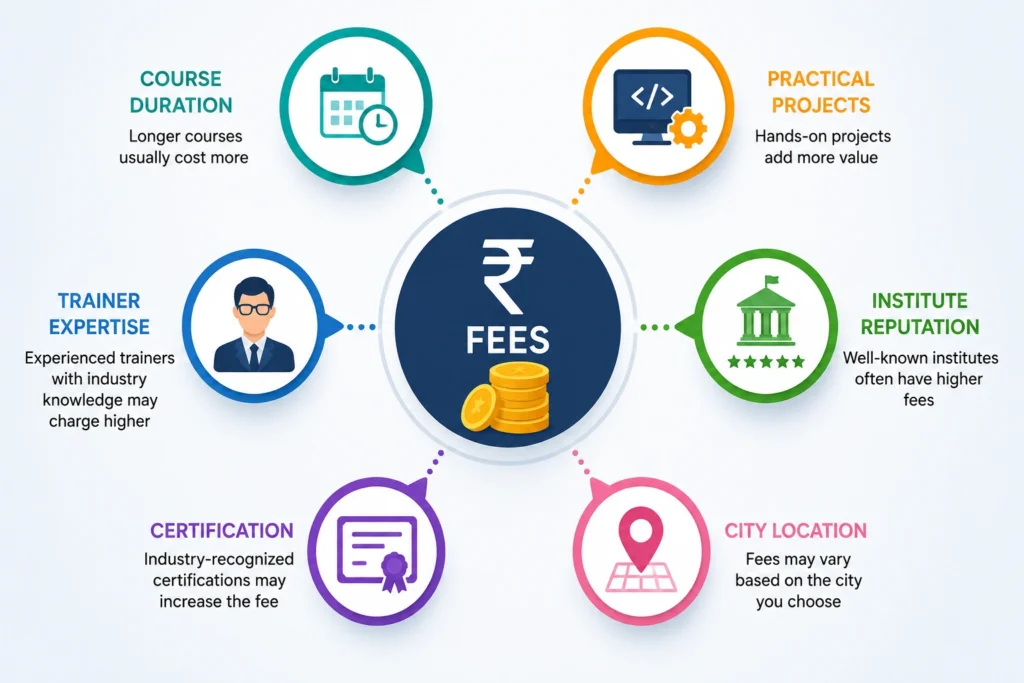
Before looking at numbers, it helps to understand what actually drives them. Digital marketing course fees in haryana depend on:
- Course duration — a 1-month course costs less than a 6-month one, naturally
- Depth and practical component — live projects and mentorship cost more to deliver
- Institute reputation and placement support — established names often charge a premium
- City — metro-city institutes tend to price higher than smaller-city ones
- Certification value — internationally recognized certifications can add to cost
None of these alone tells you whether a course is “worth it” — but together, they explain why fees swing so widely across the market.
What Are 7 Types of Digital Marketing
Since digital marketing course fees in Haryana often depend on how many of these areas are covered in depth, it helps to understand the seven core types of digital marketing before comparing courses.
- SEO
- SEM/PPC (Paid Search)
- Social Media Marketing
- Content Marketing
- Email Marketing
- Affiliate Marketing
- Influencer Marketing
A course charging a premium fee should be covering most or all of these in genuine depth — not just listing them in a brochure while spending 80% of class time on one or two areas.
Can I Learn Digital Marketing in 3 Months

Yes. A 3-month program is often considered the ideal balance between affordability and practical learning. Many institutes offering digital marketing course fees in Haryana provide beginner-friendly 3-month programs that cover both theory and hands-on experience.
In 3 months, a well-structured course can realistically cover:
- Foundational strategy across most of the 7 core areas
- Hands-on practice with major tools (Google Analytics, Ads Manager, Canva)
- At least one or two live/practice projects
- Basic proficiency to start freelancing or apply for entry-level roles
It won’t make you an expert in every specialization, but it’s enough to be functional and continue learning on the job — which is exactly why 3-month courses tend to sit in a moderate, mid-range fee bracket.
Which 3-Month Course Is Best
The best 3-month course isn’t necessarily the cheapest or the most expensive. When comparing digital marketing course fees in Haryana, focus on the value offered rather than the price alone.
- A syllabus covering at least 5–6 of the 7 core marketing types
- Confirmed live project or internship component
- Recorded sessions or revision access (useful given the pace of 3 months)
- Transparent fee breakdown — no vague “additional charges” later
A 3-month course priced unusually low compared to the market average is often cutting corners somewhere — usually mentorship quality or practical exposure.
Fee Structure by Course Duration
| Duration | Typical Fee Range | What’s Usually Included |
| 1 month (foundation) | ₹5,000 – ₹12,000 | Basic concepts, limited tool exposure |
| 3 months | ₹15,000 – ₹35,000 | Core modules, moderate practical work |
| 6 months (comprehensive) | ₹30,000 – ₹60,000 | Full curriculum, live projects, mentorship |
| Advanced diploma/PG program | ₹60,000 – ₹1,50,000+ | Deep specialization, placement support, certifications |
These are broad market ranges — actual digital marketing course fees in haryana vary by institute and should always be confirmed directly rather than assumed from averages.
Fee Structure by City & Institute Type
- Metro cities (Delhi NCR, Mumbai, Bangalore): Generally 20–40% higher due to overheads and demand
- Tier-2 cities: More moderate pricing for similar course depth
- Online-only institutes: Often priced lower than physical-campus institutes, though quality varies widely
- University-affiliated/MBA-integrated programs: Significantly higher, often bundled with broader business education
Location affects cost more than it affects actual course quality — a well-structured online course from a Tier-2-based institute can outperform an overpriced metro-city classroom course.
Installments, Scholarships, and Payment Flexibility
Fee flexibility is often overlooked when comparing institutes, but it can matter just as much as the base number.
- EMI/installment options — many institutes now split fees into 2–4 installments, which makes a ₹40,000 course feel far less intimidating upfront
- Early-bird discounts — enrolling before a batch starts often saves 5–15%
- Merit or referral scholarships — some institutes reduce fees for students who complete an entrance quiz well or come through referrals
- Group/corporate batch discounts — relevant if enrolling alongside colleagues or friends
Before ruling out a course purely on the listed fee, it’s worth asking directly whether any of these apply — the actual out-of-pocket cost is often lower than the number printed on the website.
What Is a Digital Marketing Salary (ROI Context)
Understanding fees only makes sense alongside what the course can lead to. Entry-level digital marketing salaries in India typically range from ₹2,00,000 to ₹4,50,000 per year, depending on city, role, and company size. With 2–3 years of experience, this can move into the ₹5,00,000 to ₹9,00,000 range, especially in specialized roles like performance marketing or SEO strategy.
This context matters when evaluating fees — a ₹30,000 course that genuinely builds job-ready skill pays for itself within the first month or two of an entry-level salary, while an overpriced course with weak practical training doesn’t guarantee that outcome regardless of the fee.
Freelancing adds another angle to this ROI conversation. A single freelance client project — say, managing social media for a small local business — can often bring in ₹5,000 to ₹15,000 a month, which means a well-chosen ₹20,000–₹30,000 course can realistically pay for itself within one or two client projects, well before a full-time salary even enters the picture.
Digital Chaabi Academy Insights
Digital Chaabi Academy structures its fee-to-value ratio around practical outcomes rather than brochure length — meaning the pricing reflects genuine mentorship, live project exposure, and depth across the core marketing areas, rather than charging extra for buzzword-heavy modules that don’t translate into usable skill.
The philosophy here is straightforward: a fee should map to what a learner can actually do afterward, not just what topics were technically “covered” in a slide deck.
What You’re Actually Paying For
Beyond the syllabus itself, course fees typically account for:
- Trainer expertise and mentorship time
- Live project access and feedback cycles
- Tool access (some ad platforms, premium SEO tools)
- Certification and, where offered, placement assistance
- Recorded content/revision access
A course that skips most of the above but charges premium fees is charging for brand name, not delivered value.
It’s worth asking institutes directly to break this down before enrolling — a simple line-item explanation (trainer hours, project count, tool access, certification cost) tells you far more than a single lump-sum figure ever will. Institutes confident in their value tend to answer this readily; ones that hesitate are usually padding the number somewhere.
Common Mistakes While Comparing Fees
- Comparing only the number, not what’s included — two similarly priced courses can differ hugely in depth
- Assuming higher fee always means better quality — brand premium isn’t the same as content quality
- Ignoring hidden costs — some institutes add certification or project fees separately
- Choosing solely by lowest fee — often means fewer live projects or weaker mentorship
- Not asking about refund/installment policies upfront
Step-by-Step: How to Evaluate a Fee Quote

- Ask for a detailed module breakdown, not just a topic list
- Confirm whether live projects/mentorship are included in the base fee
- Compare against 2–3 other institutes offering similar duration
- Check for hidden/add-on charges before enrolling
- Ask about installment options if the fee feels like a stretch upfront
Future Scope of Course Pricing
As competition among institutes grows and more free/low-cost resources (like Google Digital Garage and HubSpot Academy) become available, expect digital marketing course fees in haryana to gradually shift toward value-based pricing — where institutes differentiate through mentorship and outcomes rather than just charging for access to information that’s increasingly free elsewhere.
This also means learners will have more leverage to negotiate or compare, since the free-resource baseline keeps rising. A course charging premium fees purely for information that’s freely available elsewhere will find it harder to justify that pricing going forward — the real differentiator will increasingly be structured mentorship, feedback, and live project exposure rather than content access alone.
Conclusion
Digital marketing course fees in haryana span a wide range, but the number alone rarely tells the full story. What matters more is whether that fee buys genuine depth across the core marketing areas, real mentorship, and practical project exposure — because that’s what actually determines whether the course pays for itself down the line.
If you’re comparing digital marketing course fees in haryana and want clarity on what you’re actually paying for — real mentorship, live projects, and a curriculum built around outcomes, not just topic count — Digital Chaabi Academy is happy to walk you through a transparent fee breakdown before you commit to anything.
FAQs
Q: What are 7 types of digital marketing?
SEO, SEM/PPC, Social Media Marketing, Content Marketing, Email Marketing, Affiliate Marketing, and Influencer Marketing — most course fee structures scale with how many of these are covered in genuine depth.
Q: Can I learn digital marketing in 3 months?
Yes, 3 months is generally enough to build functional, job-ready basics across most core areas, making it one of the most common and reasonably priced course durations.
Q: Which 3-month course is best in terms of value?
One that covers at least 5–6 of the 7 core marketing types, includes a live project component, and has transparent, upfront fee details without hidden add-ons.
Q: What is a digital marketing salary after completing a course?
Entry-level salaries typically range from ₹2,00,000 to ₹4,50,000 per year in India, rising with experience and specialization, particularly in performance marketing and SEO roles.
Q: Are digital marketing course fees the same across India?
No. Fees vary by city, with metro-based institutes generally charging 20–40% more than Tier-2 city or online-only institutes for similar course depth.
Q: Do digital marketing course fees include certification?
This varies by institute — some bundle certification into the base fee, while others charge separately. It’s worth confirming this before enrolling.
Q: Is a more expensive digital marketing course always better?
Not necessarily. Fee should correlate with depth, mentorship, and live project exposure — not just institute reputation or brand name alone.