There’s a specific kind of question that trips people up right before they commit to a course not “will I learn something,” but “how long is this actually going to take, and will it be enough.” It’s a fair question, and most course pages don’t answer it honestly.
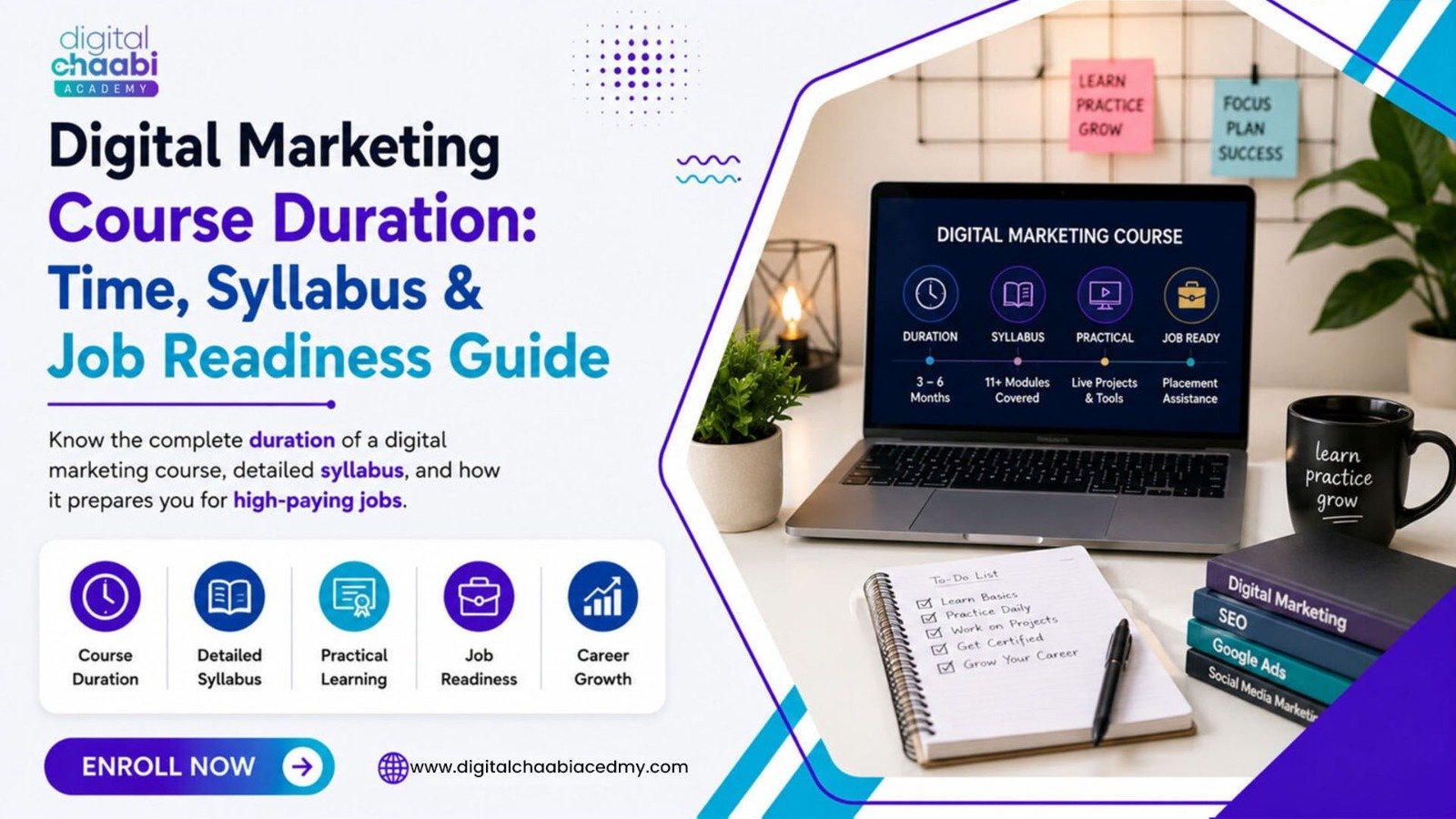
The digital marketing course time period typically ranges from 3 to 6 months for a practical, job-oriented course, depending on how deep the syllabus goes and whether it includes real hands-on projects and an internship. Shorter 4 to 6 week crash courses exist too, but they usually cover only the basics not quite enough to walk into an interview feeling genuinely confident.
Duration alone doesn’t decide job-readiness, though, and that’s the part worth sitting with before choosing anything. A 3-month course built around real projects can prepare someone far better than a 6-month course that’s mostly lectures and downloadable PDFs nobody actually opens twice.
What Is a Digital Marketing Course?

A digital marketing course teaches you how to promote products and services through online channels SEO, social media, paid ads, content, and email marketing usually through some combination of lectures, tools training, and live projects.
Who should choose one? Students exploring a career switch away from a traditional degree path, 12th-pass students unsure what to do next, and working professionals wanting an additional, genuinely in-demand skill on their resume. Eligibility stays simple across most institutes 12th pass onward, with no specific stream required, which removes a barrier a lot of other career paths still put up.
Why Course Duration Matters More Than People Realize

People often pick a course based on price or a familiar brand name, and duration quietly becomes an afterthought somewhere in that decision. That’s a mistake, because duration directly affects how much hands-on practice you actually walk away with, not just how many topics got mentioned in a syllabus PDF.
Shorter courses, the 2 to 4 week variety, rarely leave enough room for genuine projects. Medium-length courses, somewhere between 3 and 6 months, usually strike a decent balance between theory and practical application. Longer courses, running 6 to 12 months, often build in internships, and internships tend to matter more for actual employability than a few extra weeks of lecture ever will.
Is digital marketing a good career in 2026? Yes, without much doubt. But the course you pick, and specifically how much practical time it sets aside, plays a real role in how quickly you become someone an employer actually wants to hire.
What Is the Duration of a Digital Marketing Course?
Most practical digital marketing courses run somewhere between 3 to 6 months, though the range genuinely spans from short 4-week crash courses all the way to longer 12-month programs with internships built directly into the structure.
Crash courses typically run 4 to 6 weeks and cover only fundamentals, which suits someone testing the waters more than someone trying to get hired quickly. Standard courses, sitting at 3 to 6 months, tend to balance theory, tools, and live projects in a way that actually prepares someone for interviews. Advanced or diploma-style courses, running 6 to 12 months, usually add specialization tracks and real internship exposure on top.
The right digital marketing course time period really depends on where you’re starting from. A complete beginner benefits far more from a longer, project-heavy course than from a quick crash course that skips the practical work entirely just to keep the timeline short.
Can I Earn 10 Lakh Per Month from Digital Marketing?
It’s possible but rare, and honestly it has very little to do with which course duration you picked. It comes down to years of specialization, usually through running your own agency or consultancy, rather than something a course however long can promise on its own.
A more grounded salary picture, based on actual experience level, looks like this. Freshers typically start around ₹15,000 to ₹30,000 a month. One to three years in, that moves toward ₹30,000 to ₹60,000. By three to six years, specialists and managers often land somewhere between ₹60,000 and ₹1,50,000.
No course, regardless of how many months it runs for, guarantees a specific salary at the end of it. What a good course can genuinely do is shorten the time it takes you to become skilled enough to matter to an employer and that’s really what drives income growth over time, not the certificate itself.
What Is the Syllabus of a Digital Marketing Course?
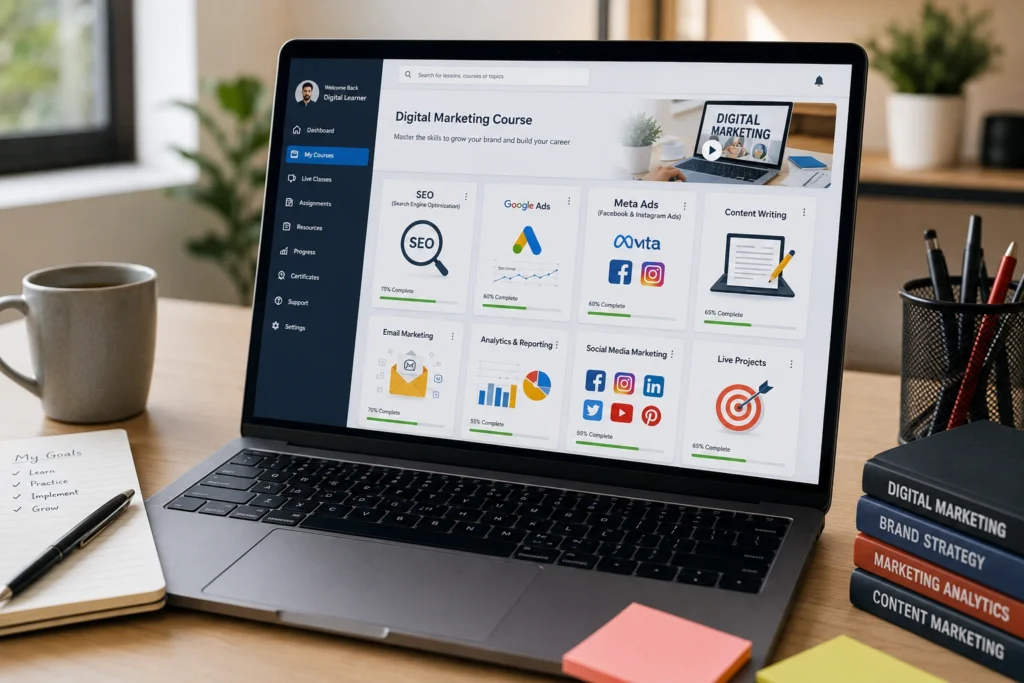
A solid digital marketing syllabus covers SEO, social media marketing, paid advertising, content marketing, email marketing, and analytics, usually in roughly that order, building from fundamentals toward more advanced strategy.
It typically starts with fundamentals what digital marketing actually is, and how the different channels work together rather than in isolation. From there it moves into SEO, covering keyword research and both on-page and technical optimization. Social media marketing follows, focused on content planning, engagement, and platform-specific strategy, since what works on Instagram rarely works the same way on LinkedIn.
Paid advertising covers Google Ads and Meta Ads Manager basics. Content marketing focuses on writing for blogs, ads, and websites in a way that actually holds attention. Email marketing introduces automation basics and campaign structure. Analytics ties everything together through Google Analytics, Search Console, and reporting. And live projects or an internship, ideally, sit at the very end, applying everything learned against something closer to a real campaign than a classroom exercise.
Courses that skip that last piece actual live project work tend to leave students holding a head full of theory but nothing they can genuinely point to as proof of skill.
Is Digital Marketing a Full-Time Job?
Yes, it absolutely can be. Most digital marketing roles are full-time positions inside companies and agencies, though freelance and part-time paths exist comfortably alongside that as well.
Full-time roles are common at agencies, startups, and in-house marketing teams that need someone consistently managing campaigns day to day. Freelancers often start part-time while building a client base, then scale toward full-time income as that base grows steadily. Some professionals end up combining both, holding a full-time role while running smaller freelance projects on the side for extra income or variety.
So the field is flexible by nature. You can build it as a traditional 9-to-5 career if that suits your life better, or shape it around freelance and remote work instead the underlying skills transfer either way.
Skills You’ll Gain Across the Course Duration
Over a typical 3 to 6 month digital marketing course time period, you should come out with practical SEO skills, not just theory read off a slide but applied keyword and on-page work you’ve actually done yourself. Comfort running small ad campaigns on Google and Meta usually comes next, along with genuine content writing ability for blogs and ad copy.
Basic analytics reading rounds this out Google Analytics and Search Console specifically plus, ideally, a small portfolio built from real or simulated projects completed during the course itself.
If a course doesn’t leave you with at least a small, tangible portfolio by the end of it, the duration was probably spent mostly on theory, regardless of how many months the syllabus technically covered.
Short Course vs Long Course: What Actually Changes?
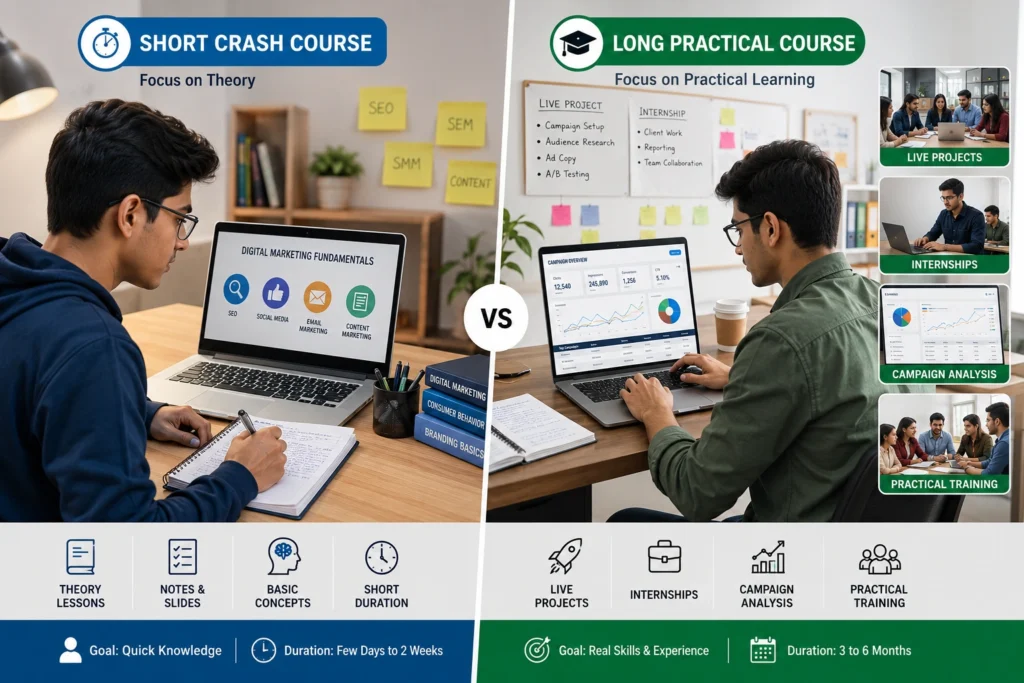
This comparison trips a lot of people up, so it’s worth being direct about it. A short crash course teaches vocabulary you’ll know what SEO stands for, what a CTR is, roughly how ad campaigns work. A longer course teaches application you’ll have actually run something, made mistakes in a low-stakes setting, and adjusted based on real feedback.
The difference shows up clearly in interviews. Someone from a short course can define terms accurately. Someone from a longer, project-heavy course can walk through a decision they made on a real campaign and explain why it worked or didn’t. Employers notice that difference almost immediately, and it’s usually the deciding factor in who actually gets hired.
Digital Chaabi Academy Insights
A pattern worth noticing across students who succeed quickly after finishing their course the ones who benefit most aren’t necessarily in the longest programs available. They’re in the ones with real, hands-on project work genuinely built into the course duration, not just added as an afterthought at the end.
That’s the approach at Digital Chaabi Academy, structuring the course time around live campaigns and practical tools rather than lecture hours alone, so students leave with something they can actually show an interviewer, not just describe from memory.
Common Mistakes Beginners Make
Choosing a course based only on price, without checking whether it includes practical projects, is probably the most common one. Assuming a longer course automatically means better training is another length alone says very little about depth. Skipping courses with internships because they take slightly longer often backfires too, since that extra time usually pays for itself in job-readiness.
And rushing through a crash course expecting full job-readiness within a few weeks tends to leave people disappointed once actual interviews start asking for specifics a crash course never covered.
Step-by-Step Guide to Choosing the Right Course Duration
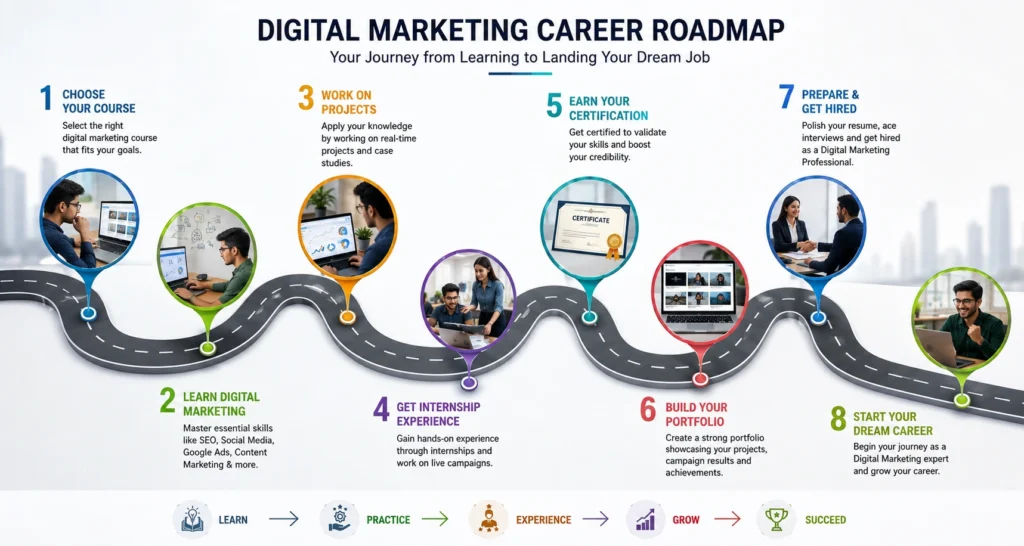
Start by honestly assessing your own starting point are you a complete beginner, or do you already know a bit? Prioritize courses that include live projects over ones built purely around lectures and slide decks. Choose something in the 3 to 6 month range if you want a solid, practical foundation without an enormous time commitment.
Go longer, 6 to 12 months, if internship exposure and real specialization matter to you specifically. Confirm the course includes actual tool training, not just concept explanations delivered verbally. And check whether a portfolio or project output is genuinely part of course completion, not an optional add-on mentioned only in the sales pitch.
What Happens in the Weeks Right After the Course
This part rarely gets discussed, but it matters. The weeks immediately after finishing a course tend to be the most important, not the course itself. That’s when you apply what you learned to a real internship or your first freelance client, and inevitably discover gaps that no classroom setting could have fully prepared you for.
Courses that stay in touch during this stretch, offering guidance as students hit real-world snags, tend to produce far more confident graduates than ones that simply hand over a certificate and move on to the next batch.
Future Scope After Completing the Course

Once the course duration ends, the future of digital marketing careers opens up across SEO, paid ads, content, and analytics roles, all growing steadily as more businesses continue moving online rather than pulling back.
AI tools are increasingly handling repetitive tasks, which means graduates who focus on strategic thinking and creative application, rather than just tool operation, will have a genuine edge as the field keeps evolving over the next few years.
Why Should Students in Hisar Choose This Career?
Hisar’s local businesses are steadily moving online, creating real demand for digital marketing skills right within the city, with no relocation required before someone can start applying what they’ve learned.
A well-chosen course duration, especially one built around practical projects, lets students in Hisar compete for the same remote and freelance opportunities available to students sitting in far bigger cities.
Which Institute Offers Practical Training and Internships in Hisar?
For students in and around Hisar, Digital Chaabi Academy offers a practical digital marketing course structured around real campaigns and internships, not just theoretical lecture hours stretched across a fixed calendar.
The course duration is built to leave students genuinely job-ready, with actual project work completed by the end rather than just topics ticked off a syllabus.
Conclusion
The right digital marketing course time period isn’t really about picking the longest or shortest option available on paper. It’s about choosing a course where the time gets spent building real, applicable skills instead of just moving through a checklist of topics. A 3-month course with genuine projects can outperform a 6-month course built mostly around lectures.
What matters most, in the end, is walking out with a small portfolio and real, earned confidence, not just a completion certificate sitting in a folder somewhere.
If you’re choosing a digital marketing course and want the time you invest to actually translate into job-ready skills, Digital Chaabi Academy can help through a practical, project-based course structured around real campaigns and internships.
FAQs
Q: What is the duration of a digital marketing course?
A: Most practical courses run 3 to 6 months, though crash courses can be as short as 4 weeks and advanced diploma programs can extend to 12 months with internships included.
Q: Can I earn 10 lakh per month from digital marketing?
A: It’s possible but rare, usually tied to running your own agency or consultancy after years of specialization, not something a course duration alone determines.
Q: What is the syllabus of a digital marketing course?
A: A solid syllabus covers SEO, social media marketing, paid advertising, content marketing, email marketing, and analytics, ideally alongside live projects or an internship.
Q: Is digital marketing a full-time job?
A: Yes, most digital marketing roles are full-time positions at companies and agencies, though freelance and part-time paths are also common and genuinely flexible.
Q: Is a 3-month digital marketing course enough to get a job?
A: It can be, provided the course includes practical projects and tool training rather than just theoretical lectures practical exposure matters more than the raw number of months.
Q: Should I choose a course with an internship even if it takes longer?
A: Generally yes. Internship exposure tends to prepare you better for real job interviews than a shorter course without any hands-on, client-style work involved.
Q: What should I do in the first few weeks right after finishing a course?
A: Apply immediately to an internship or a small freelance project, since that’s where real gaps in your learning show up, and where the fastest growth actually happens.