The website looks perfect. Fast homepage, sharp design, solid content. And still, nothing ranks. Here’s the frustrating part. The problem is usually invisible. A blocked page, a broken redirect, a duplicate URL, a sitemap pointing nowhere. Visitors never notice. Google does.
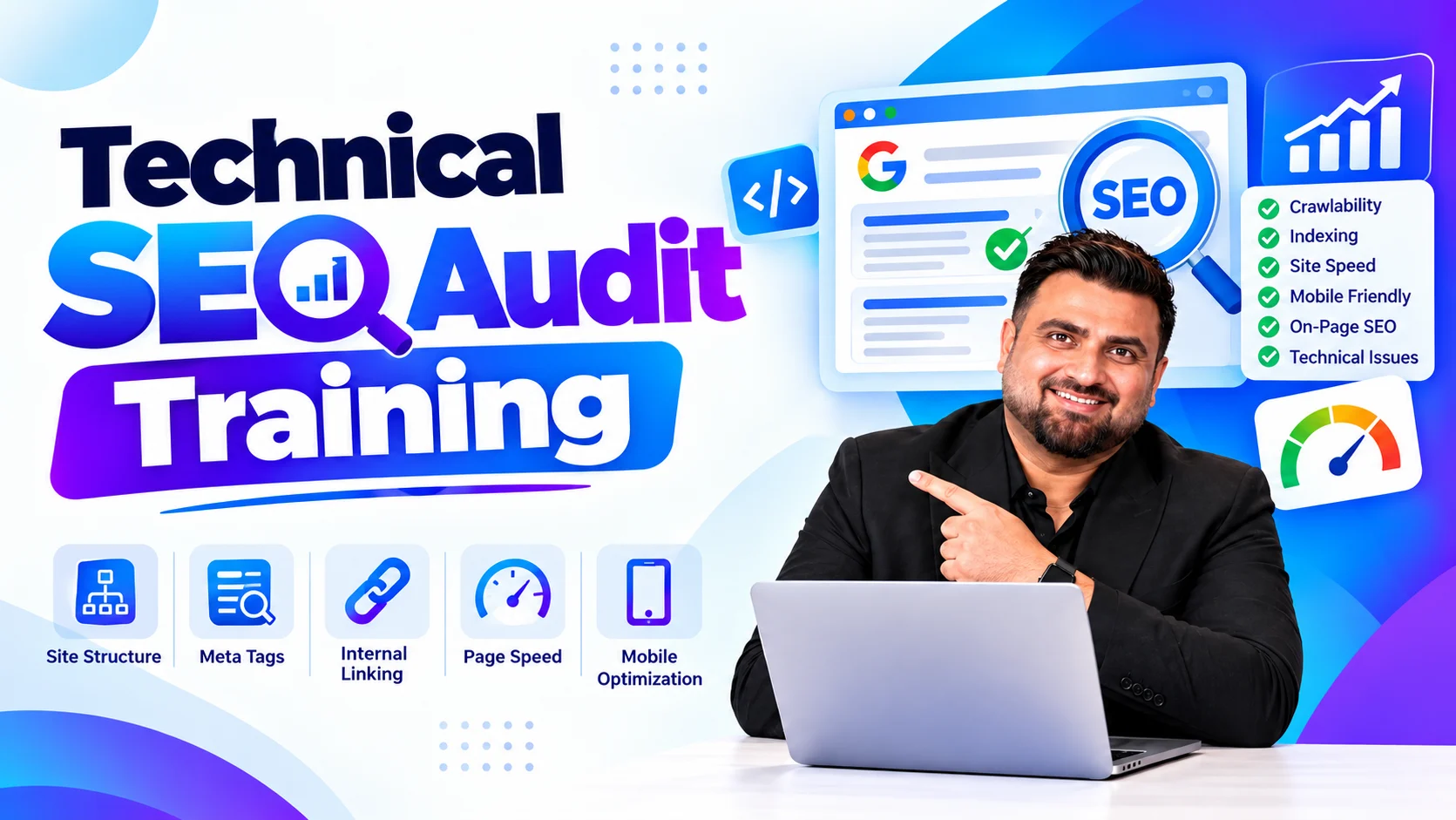
Technical SEO Audit Training teaches you how to find these hidden problems, understand why they hurt rankings, and fix them in the right order. You learn to check crawling, indexing, speed, mobile usability, and site structure using real tools on real websites.
This matters more now than it did a few years ago. Websites are heavier, search engines are smarter, and AI-powered results only pull from pages they can access and understand. If the technical base is weak, great content never gets its chance.
Whether you’re a student, a marketer, a freelancer, or a business owner tired of guessing, Technical SEO Audit Training gives you a method instead of a hunch.
What Is Technical SEO Audit Training?
Think of your website as a shop. Content is what’s on the shelves. Technical SEO is whether the door opens, the lights work, and customers can find the right aisle.
Technical SEO Audit Training is a structured programme where you learn to inspect a website the way a search engine does, spot what’s blocking it, and write a clear fix list. It’s less about writing keywords and more about the foundation underneath them.
A good programme usually covers:
- How search engines crawl and index pages
- Site speed and mobile usability
- Redirects, broken links, and duplicate content
- Site structure and internal linking
- Audit tools and report writing
Most general SEO courses skim this layer. Technical SEO Audit Training goes deep on the problems that stop pages from ranking at all.
The good news? You don’t need to code. You need curiosity, a checklist, and a few reliable tools.

Why This Skill Pays Off
Ask any experienced SEO what separates a good one from a great one. Many will say: the ability to diagnose.
Anyone can suggest “write more blogs.” Far fewer people can open a stuck website and explain exactly why it’s stuck. Here’s why that matters:
- Diagnosis is rare. Businesses often know something is wrong but can’t say what.
- Audits are easy to sell. A clear report with a fix list is a tangible deliverable.
- It pairs with everything. Web design, content, ads, and e-commerce all depend on a healthy site.
- Problems repeat. Sites change, so audits come back every few months.
Picture a clinic whose enquiries dropped after a redesign. The new site looks great, but the old service URLs now lead nowhere. Someone trained in audits can spot that in an hour.
That’s the value Technical SEO Audit Training builds. No course can promise rankings or income. What it gives you is a skill businesses regularly struggle to find.
Curious what a real audit report looks like? Ask for a sample deliverable before joining any Technical SEO Audit Training programme.
What Is a Technical SEO Audit and What Does Training Cover?
A technical SEO audit is a structured check of a website’s backend health. It looks at how easily search engines can crawl, index, and understand the site, and how well it performs for users. Training covers crawlability, indexing, speed, mobile usability, site architecture, and structured data.
In plain words, you’re asking two questions. Can Google reach every important page? And does it like what it finds there?
A solid curriculum should include these modules:
- Crawling and indexing: robots.txt, XML sitemaps, and index coverage.
- Site architecture: URL structure, depth, and internal links.
- On-site errors: broken links, redirect chains, and status codes.
- Duplicate content: canonical tags and parameter issues.
- Speed and Core Web Vitals: what slows pages and how to fix it.
- Mobile and security: responsive checks and HTTPS.
- Structured data: schema markup basics.
- Reporting: turning findings into a prioritised action plan.
The last module is the one most courses skip, and it’s the one clients actually pay for. A strong Technical SEO Audit Training programme makes you finish every audit with a written report.
Technical SEO Audit Training at a Glance: Checks, Tools and Deliverables
Short on time? Here’s the quick view.
- Best for: beginners, SEO executives, freelancers, web designers, and site owners.
- Checks covered: crawlability, indexing, speed, mobile, redirects, duplicates, structured data.
- Tools used: Google Search Console, PageSpeed Insights, a site crawler like Screaming Frog, and an audit tool such as Semrush or Ahrefs.
- Deliverables: a full audit report, a prioritised fix list, and a before-and-after summary.
- Typical duration: around 4 to 6 weeks, depending on practice hours.
- Prerequisites: basic SEO knowledge helps, but isn’t mandatory.
When you compare any Technical SEO Audit Training option, ask four things. Do you audit live websites? Do you write an actual report? Do you get feedback on your findings? Are the tools current?
If two answers are no, keep looking.

How to Do a Technical SEO Audit?
Start by crawling the site, then check indexing in Google Search Console, review speed and mobile usability, fix errors like broken links and redirects, and finish with a prioritised report. Work from the most damaging issues to the least.
Here’s the sequence in more detail:
- Crawl the site. Use a crawler to list every URL, status code, title, and canonical.
- Check indexing. In Search Console, see which pages are indexed and which are excluded, and why.
- Review robots.txt and sitemap. Make sure important pages aren’t blocked and the sitemap is clean.
- Fix errors. Repair broken links, shorten redirect chains, and remove duplicate URLs.
- Test speed and mobile. Run key pages through PageSpeed Insights and a phone.
- Check structure. Confirm that important pages are a few clicks from the homepage.
- Write the report. Group issues as high, medium, and low priority, with a fix for each.
Notice the order. Blocked pages come before slow pages, because speed doesn’t matter if Google can’t reach the page.
This is the exact workflow practised in Technical SEO Audit Training, repeated on different sites until it feels automatic.
Can ChatGPT Do an SEO Audit?
ChatGPT can help with parts of an SEO audit, such as explaining issues, drafting checklists, and summarising reports. It cannot replace crawling tools or Search Console data, and it can get facts wrong. A trained person still has to verify and prioritise everything.
Here’s where AI helps:
- Explaining what an error means in simple words
- Drafting a client-friendly summary
- Suggesting a checklist to follow
And where it falls short:
- It can’t crawl your live site on its own.
- It doesn’t see your Search Console or analytics unless you feed it the data.
- It may sound confident while being wrong.
So use AI as an assistant, not as the auditor. That’s exactly why Technical SEO Audit Training stays relevant. AI speeds up the boring parts, but someone has to know whether the answer is right.
Want to practise on a real site instead of a demo? Pick a Technical SEO Audit Training programme that gives you live websites to audit.
Skills You Build in Technical SEO Audit Training
Tools change every year. Skills are what you keep.
Crawling and Indexing Skills
You learn to read crawl reports, spot blocked or orphan pages, and understand why Google skips certain URLs. This is the heart of every audit.
Performance and Mobile Skills
You learn what actually slows a page: heavy images, bulky scripts, too many plugins. Then you learn which fixes are worth the effort and which are noise.
Site Structure and Content Signals
You’ll work with canonicals, internal links, and URL hygiene. You’ll also learn to catch duplicate and thin pages that quietly drag a site down.
Reporting and Communication Skills
Finding a problem is half the job. Explaining it to a client who isn’t technical, and ranking fixes by impact, is the other half.
The best Technical SEO Audit Training programmes blend all four, because clients never hire you for just one.
Where You Can Use These Skills
- Freelancing: one-time audits and monthly health checks for small businesses.
- Agency roles: SEO executive, technical SEO analyst, or audit specialist.
- In-house roles: keeping a company’s own site healthy.
- E-commerce: large product catalogues create duplicate and indexing issues constantly.
- Migrations and redesigns: auditing before and after a launch to protect traffic.
Take an online store with thousands of product URLs and filters. Half the pages may be duplicates competing with each other. After Technical SEO Audit Training, you can map that mess and fix it in priority order.

Common Mistakes Beginners Make
Most beginners don’t struggle with SEO itself. They struggle with these habits:
- Running a tool and pasting the output. A raw report isn’t an audit. Interpretation is.
- Fixing everything at once. Without priorities, you waste time on low-impact items.
- Ignoring indexing. A page that isn’t indexed can’t rank, however fast it loads.
- Skipping mobile checks. Most visitors arrive on phones.
- Never re-crawling after fixes. If you don’t verify, you don’t know it worked.
- Joining theory-only training. Programmes where you audit live sites and write reports, such as the one at Digital Chaabi Academy, build skills that a slide deck never will.
- Choosing Technical SEO Audit Training without real deliverables. If you finish without a sample report, you’ve finished without proof.
Fix these early and you’ll be ahead of most people starting out.
Step-by-Step Roadmap to Start Technical SEO Audit Training
- Learn SEO basics. Know how search, keywords, and on-page SEO work.
- Set up Search Console. Connect a practice site and explore every report.
- Learn one crawler. Crawl a small site and study each column.
- Practise one issue at a time. Redirects first, then duplicates, then speed.
- Audit a real site. Start with a friend’s or family member’s business website.
- Write your first report. Add findings, impact, and recommended fixes.
- Re-crawl and compare. Show before-and-after results.
- Build 3 sample audits. Keep them as your portfolio.
Follow the order. Depth beats speed here.
Future Scope
Search is changing. AI summaries, new result formats, and heavier websites are all making technical health more important, not less.
AI tools will automate simple checks. What they won’t replace is judgment: knowing which issue matters, why, and what to fix first.
Stack this skill with content, ads, or conversion tracking and you can handle a project from traffic to results. Technical SEO Audit Training is a strong base to build on.
FAQs
Q: How to increase SEO ranking of website?
A: Fix technical issues first, so search engines can crawl and index your pages. Then improve content quality, match search intent, build relevant internal links, and earn trustworthy backlinks. Skills from Technical SEO Audit Training help with the first step, which is often the biggest hidden blocker.
Q: What is the 80/20 rule in SEO?
A: It’s a popular idea that a small share of your efforts drives most of your results. In SEO, a few key pages, keywords, or fixes often bring most of the traffic. It’s a guideline, not an exact formula. Use it to prioritise high-impact work first.
Q: Do I need coding for Technical SEO Audit Training?
A: No. Basic computer skills are enough to start. Knowing a little HTML helps you read page code and spot tags, but it isn’t required. Most audit work involves reading tool reports, understanding what they mean, and recommending fixes to developers or site owners.
Q: How long does Technical SEO Audit Training take?
A: Most beginners need around 4 to 6 weeks with regular practice. The exact time depends on how many sites you audit and how much you practise reporting. Rushing through tools without real audits usually leaves gaps, so focus on finishing complete reports.
Q: Which tools should I learn first in Technical SEO Audit Training?
A: Start with Google Search Console and PageSpeed Insights, both free. Then add one crawler such as Screaming Frog and one audit platform like Semrush or Ahrefs. Master a small toolkit before adding more. Tools matter less than your ability to interpret the data.
Q: Can I earn after completing Technical SEO Audit Training?
A: Many people use this skill for freelancing, agency jobs, or in-house SEO roles. Results depend on your portfolio, how you pitch, and your consistency. There are no guarantees, but clear audit reports and before-and-after proof give you a real advantage.
Conclusion
Rankings rarely fail without a reason. Behind most stuck websites is a technical problem nobody has found yet.
The path is simple. Learn how search engines see a site, practise on real websites, write clear reports, and prove your fixes worked. That’s what separates people who “know SEO” from people who get hired to fix it.
If you want that outcome, choose Technical SEO Audit Training that makes you audit, fix, and report on real sites. Skip the one that only shows tool screenshots.
Ready to Find What’s Holding Websites Back?
If you’re serious about fixing real ranking problems instead of just learning SEO theory, Technical SEO Audit Training at Digital Chaabi Academy lets you audit live websites, write client-ready reports, and build a portfolio of before-and-after results. Start your next batch and learn to diagnose what others miss.