Video editors in India are earning ₹20,000–₹60,000/month from freelance. Hisar ka yeh 60-day course woh skill deta hai.
Think about how many videos you watched today. YouTube. Instagram Reels. WhatsApp status. A brand ad before a song. A tutorial before you cook something. Video is everywhere — and every single frame of it was edited by someone.
That someone could be you.
The demand for skilled video editors in India in 2026 is real, it’s growing, and it isn’t concentrated only in Mumbai or Bengaluru. Brands in every city need video content. Coaches need course videos. YouTubers need editors. Reels creators need cutting-room help. And most of them are actively looking for reliable, trained editors they can pay on a project or retainer basis.
A video editing course in Hisar that actually teaches industry tools — Adobe Premiere Pro training, After Effects course content, AI editing tools — can take a complete beginner from zero to earning in 60 days. Not years. Not even one year. Sixty focused days.
This guide is for anyone in Hisar who’s curious about video editing as a career. We’ll cover what the course looks like, what tools you’ll learn, what the income potential is, and why 2026 might genuinely be the best moment to start.
What Is Video Editing and Why Is It a Career in 2026?
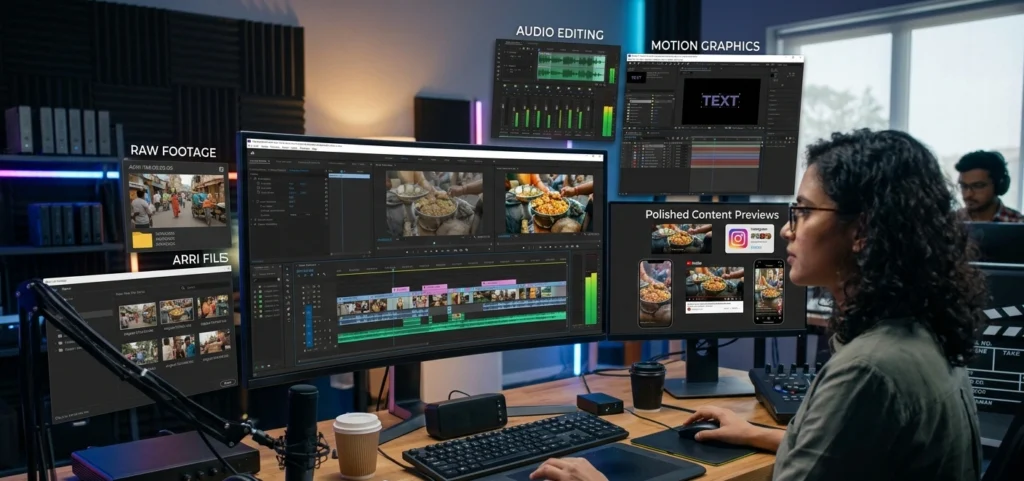
Video editing is the process of taking raw footage — recorded clips, audio, graphics — and assembling them into something that communicates. A story. A tutorial. A brand message. A Reel that makes someone stop scrolling.
It sounds straightforward. But good video editing is invisible in the best possible way. When it’s done right, the viewer doesn’t notice the cuts, the colour, the pacing. They just feel the content.
Video editing for beginners starts with understanding the basics — cutting, sequencing, audio sync, basic colour correction. As you advance, you move into colour grading and motion graphics, After Effects course level animation, and now, increasingly, AI video editing tools that speed up repetitive tasks dramatically.
In 2026, the content creator course market has exploded — which means more creators need editors. More brands are producing more video. More coaches are running more courses. More businesses are doing more Reels. The demand side keeps growing. The trained professional side hasn’t kept up. That gap is your opportunity.
A video editing course in Hisar that’s current, practical, and taught by people who work in the industry is the fastest path into that gap.
Which is the Best Video Editing Course in Hisar for Beginners in 2026? | Digital Chaabi Academy
If you’re searching for a video editing course in Hisar, you’ll find a range of options — from YouTube self-study to generic computer institutes to dedicated training academies.
The difference in outcomes is significant, which is why choosing the right video editing course in Hisar matters more than most beginners realise.
Digital Chaabi Academy’s video editing program is built specifically for two kinds of people: the waiting graduate who needs a job-ready skill fast, and the homemaker who wants a flexible freelance video editor income that works around their life. Both need the same thing — practical training, real output, and guidance on where to take that output to earn.
Here’s what makes DCA’s approach different:
Tool relevance
The course covers what employers and clients actually use. Adobe Premiere Pro training is the industry standard for professional editing. After Effects course modules cover motion graphics that every agency wants. And AI video editing tools — CapCut AI, Adobe Firefly, Runway ML — are integrated because ignoring AI in 2026 is not an option.
Project-first learning
From week two, students are editing real content — not watching someone else do it. Practice projects, client simulations, feedback sessions. By the end of 60 days, you have a portfolio reel that proves you can do the work.
Short-form focus
Reels and short form video editing is one of the most in-demand skills right now. Instagram Reels, YouTube Shorts, and LinkedIn video content are where brands are spending budget. The course treats short-form as its own skill set — not an afterthought.
Freelance pathway
Beyond technical skills, the course covers how to find clients, price your work, deliver professionally, and build a retainer-based freelance video editor income from Hisar itself. That last part is what most courses skip entirely.
Is Video Editing Still in Demand in 2026?
Not just still in demand. More in demand than ever.
Here’s the reality of what’s happening:
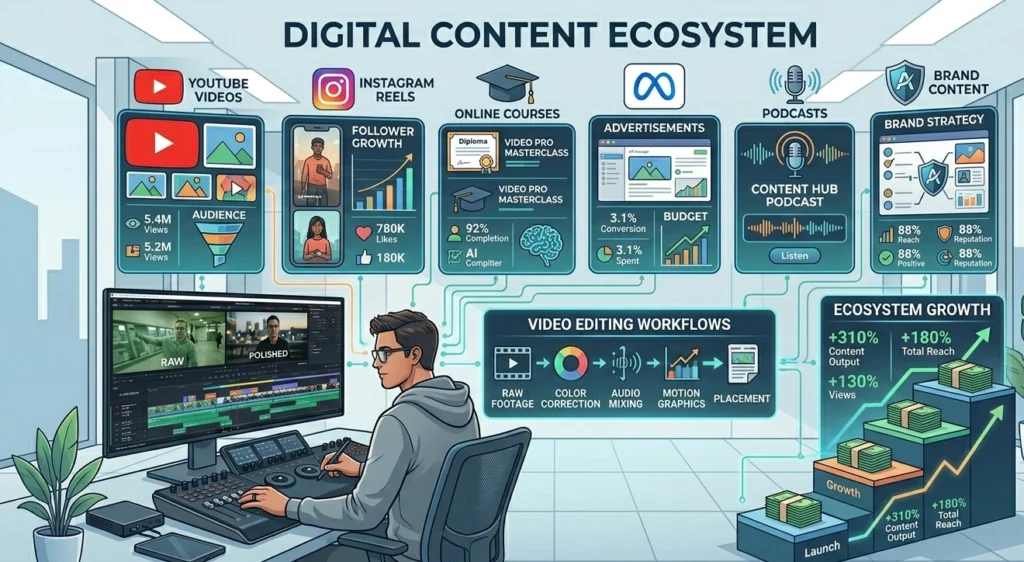
Short-form video has become the primary content format across every major platform. Instagram, YouTube, LinkedIn, WhatsApp — all of them are prioritising video in their algorithms. That means every brand, creator, and business that wants visibility needs video. And video needs editing.
YouTube video editing alone sustains thousands of full-time editors across India. The YouTube ecosystem — tutorials, vlogs, educational content, news channels — produces an enormous and consistent volume of editing work. Channels with 10,000–100,000 subscribers often outsource editing because the creator’s time is better spent creating, not cutting.
Reels and short form video editing has added another layer entirely. A business that needs two Instagram Reels per week is a steady client. Multiply that across 5–10 clients and you have a full-time income.
AI video editing tools have changed the workflow — not eliminated the job. AI can auto-cut silence, generate captions, and suggest edits. What it can’t do is understand brand voice, make creative decisions, or ensure a video feels right to a specific audience. Human judgment is still the product. AI just makes it faster to deliver.
Video editor jobs in India have grown in every category, making a video editing course in Hisar a practical option for anyone looking to enter the field in 2026.
Which Course Is Best for Video Editing?
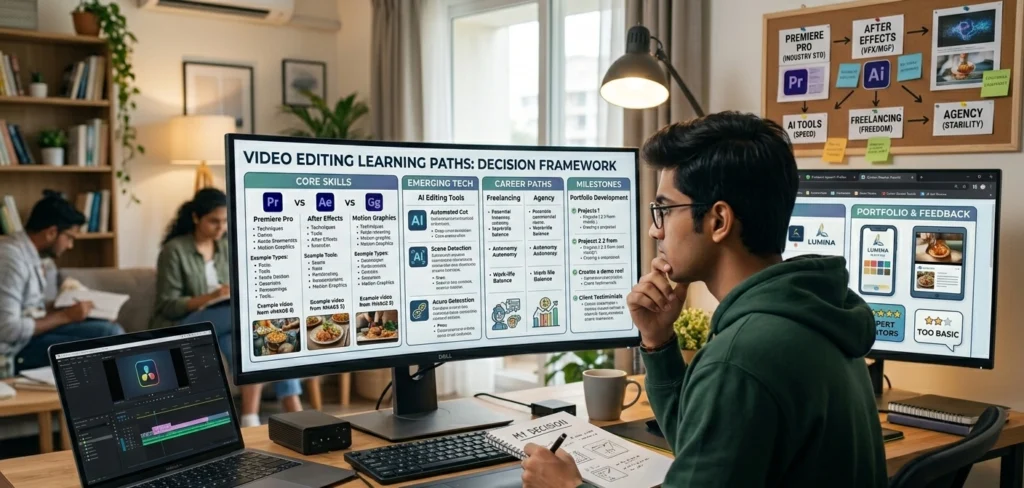
The best video editing course in Hisar — or anywhere — is the one that teaches you what the market actually uses, in a structure that builds real skill rather than surface familiarity.
Here’s the honest evaluation framework:
Does it cover industry-standard tools?
Adobe Premiere Pro training is non-negotiable. It’s what professional editors use. Courses that only teach mobile apps or free tools are fine for hobbyists. For a career, Premiere Pro is the starting point.
Is After Effects included?
After Effects course content — motion graphics, title animations, visual effects basics — separates a basic editor from a complete one. Clients pay significantly more for editors who can add graphics and animation.
Does it address short-form video?
Reels and short form video editing is a distinct skill. Pacing for 30-second content is different from pacing for a 10-minute YouTube video. A course that only teaches long-form editing is missing half the current market.
Are AI tools covered?
AI video editing tools are now part of every professional’s workflow. A course that doesn’t cover them is already outdated.
Is there a portfolio output?
The best video editing for beginners programs end with a portfolio reel — 3–5 edited pieces that demonstrate range and competence. Without that, you have a certificate but no proof.
Is freelancing guidance included?
Technical skills plus zero client acquisition knowledge equals an editor who can’t find work. Freelance strategy, pricing, and client management are essential parts of a complete course.
Digital Chaabi Academy’s video editing course in Hisar ticks all of these boxes. That’s not marketing language. That’s curriculum design.
Professional Video Editing Course in Hisar, Haryana | Premiere Pro to Freelance Income | Digital Chaabi Academy
Let’s go inside the actual course structure — because knowing exactly what you’re learning is the only way to make an informed decision.
Phase 1 — Foundations (Days 1–15)
- Understanding video formats, frame rates, resolution, aspect ratios
- Introduction to Adobe Premiere Pro training — interface, timeline, basic cuts
- Importing, organising, and labelling footage like a professional
- Audio basics — syncing, cleaning, music layering
- Video editing for beginners essentials — pacing, rhythm, story structure
No one starts here and stays here. These two weeks build the foundation that everything else sits on.
Phase 2 — Core Skills (Days 16–35)
- Advanced Premiere Pro — multi-cam editing, nested sequences, export settings
- Colour grading and motion graphics fundamentals — LUTs, colour wheels, correction vs grading
- After Effects course basics — keyframes, text animation, lower thirds, simple motion graphics
- YouTube video editing — thumbnail strategy, chapters, retention-focused editing
- Audio mastering for video — EQ, compression, background music balance
This is where the real skill builds. Slow, repetitive, cumulative. Every technique is practised on actual footage.
Phase 3 — Short Form & AI (Days 36–50)
- Reels and short form video editing — hook structure, transition styles, caption placement
- Platform-specific editing — Instagram Reels vs YouTube Shorts vs LinkedIn video
- AI video editing tools in practice — CapCut AI, Runway ML, Adobe AI features
- Batch editing workflows — how to edit fast without sacrificing quality
- Brand-consistent editing — maintaining visual identity across a content series
This phase is where most institutes stop. DCA doesn’t.
Phase 4 — Portfolio & Freelance (Days 51–60)
- Building a portfolio reel — selecting, sequencing, presenting your best work
- Setting up on Fiverr, Upwork, and Instagram for client acquisition
- Pricing your services — per project vs retainer, how to negotiate
- Client communication, revision management, delivery protocols
- Introduction to content creator course editing packages — serving YouTubers and creators as clients
By day 60, you have a portfolio reel, a freelance profile, and the knowledge to start earning. That’s the design. Not accidental.
Who Should Join This Course?
Fresh graduates from any stream who want a skill that earns fast can benefit greatly from a video editing course in Hisar designed around current industry requirements.
Homemakers who want flexible income from home. Video editing is one of the most genuinely remote-friendly skills — a laptop, the software, and an internet connection is all you need. Deadlines are manageable. Work hours are flexible.
Content creators who make videos but spend too long editing. Learning to edit faster and better directly improves your content output.
Government exam aspirants who want to earn income while preparing for other goals. 60 days is short enough to fit alongside other preparation.
Anyone who loves video and wants to turn that into income. Passion plus skill is a powerful combination. The training handles the skill part.
How to Learn Video Editing in 2026?
This is a practical question that deserves a practical answer.
Step 1 — Start with one software
Don’t try to learn Premiere Pro, Final Cut, DaVinci Resolve, and CapCut simultaneously. Pick Adobe Premiere Pro training as your primary tool. It’s industry-standard and widely used. Mastery in one tool beats surface knowledge in five.
Step 2 — Edit every day
Fifteen to thirty minutes of daily editing practice beats a four-hour weekend session. Repetition builds muscle memory. The timeline starts to feel intuitive only with consistent use.
Step 3 — Watch with intention
Start noticing how your favourite YouTube videos or Reels are edited. Where are the cuts? How is the music used? What makes the pacing feel fast or slow? Active watching builds passive understanding.
Step 4 — Get feedback
This is the step most self-learners skip — and it’s the most important one. Structured training at Digital Chaabi Academy builds in feedback loops at every phase. You can’t see your own blind spots.
Step 5 — Build before you’re ready
Start editing for small clients — local businesses, coaching centres, friends with YouTube channels — before you feel fully ready. The learning that comes from real client work is different from practice projects. You grow faster when something is actually at stake.
Step 6 — Add AI tools early
AI video editing tools are not cheating. They’re workflow efficient. Learning to use them alongside manual skills makes you faster — and faster editors earn more.
A structured video editing course in Hisar compresses all six steps into a guided 60-day experience. You could self-learn. Or you could shortcut 12 months of trial-and-error into two focused months with a mentor.
Freelance Video Editor Income — What to Expect
Real numbers, honestly:
| Work Type | Beginner (0–6 months) | Experienced (1–2 years) |
| Per Reel/Short Edit | ₹300–₹800 | ₹800–₹2,500 |
| Per YouTube Video | ₹500–₹1,500 | ₹1,500–₹5,000 |
| Monthly Retainer (1 client) | ₹4,000–₹10,000 | ₹10,000–₹25,000 |
| Full Freelance (5–8 clients) | ₹20,000–₹40,000 | ₹45,000–₹80,000+ |
The freelance video editor income ceiling in India is not fixed. Editors who specialise in high-value niches — corporate videos, wedding films, brand commercials, course production — earn significantly more than general content editors.
What builds that income is not magic. It’s portfolio quality, client relationships, and consistent delivery. All three are trainable.
Video editor jobs in India on the employment side start at ₹12,000–₹18,000 for freshers at local agencies in Hisar, climbing to ₹30,000–₹55,000 for editors with 1–2 years of strong portfolio work. Remote roles for Delhi/NCR agencies or national brands typically pay 25–40% more.
Common Mistakes Beginners Make
Learn from these before you make them:
- Over-using transitions — Jump cuts and cross-dissolves are tools, not decoration. Beginners overuse them. Less is almost always more.
- Ignoring audio — Bad audio ruins good video. Most beginners focus only on visuals. Professional editors know that audio does half the emotional work.
- Not organising project files — Messy file structure leads to lost footage, broken links, and wasted hours. Organise from day one.
- Skipping colour correction — Raw footage almost always needs correction before grading. Jumping straight to aesthetic colour grading on uncorrected footage is a common beginner error.
- Editing too long — Most videos need to be shorter than you think. If a section doesn’t add value, cut it. Retention data on YouTube is ruthless about this.
- Not building a portfolio early — Every practice project is a potential portfolio piece. Save everything. Archive your best work from the first week.
Career and Freelance Opportunities After This Course
Job roles:
- Video Editor at digital marketing agencies in Hisar and Haryana
- In-house editor for coaching institutes, real estate brands, healthcare
- Junior Motion Graphics Designer with After Effects course skills
- Social Media Video Editor for brands managing Instagram and YouTube
Freelance routes:
- YouTube channel editing on retainer — consistent, recurring income
- Instagram Reels editing for businesses and creators
- Wedding and event videography editing (high value, seasonal)
- Corporate and brand video editing via Fiverr or direct clients
- Content creator course video editing — producing course content for educators
Remote income: Many editors in Hisar already work remotely for clients in Delhi, Mumbai, or Bengaluru after completing a video editing course in Hisar and building a strong portfolio.
Future of Video Editing in India
Short-form video will keep growing. AI will keep improving editing workflows. But the fundamental need — for human creative judgment, for brand-consistent storytelling, for content that connects with real audiences — is not going anywhere.
AI video editing tools will handle the mechanical parts. The creative parts still need a person who understands what the audience wants to feel.
India’s creator economy is projected to be one of the largest in the world by 2028. Every creator in that economy either edits their own content or pays someone else to. Trained editors with portfolio evidence are going to be in demand for a very long time.
Starting a video editing course in Hisar in 2026 is not late. It’s early for what’s still coming.
Conclusion
Video is not a trend that’s passing. It’s the dominant format of this decade — and the next one.
Every minute, thousands of videos are uploaded across platforms in India alone. Every single one needed an editor. A trained, skilled, portfolio-holding editor who knows Adobe Premiere Pro training, understands reels and short form video editing, and can use AI video editing tools to deliver fast — that person is not hard to find work for. They are the work.
A video editing course in Hisar that builds all of this in 60 days is not a shortcut. It’s a structured path. The difference between where you are now and earning ₹30,000–₹60,000/month as a video editor is 60 days of serious, focused training.
The footage is waiting. Someone has to edit it.
If you’re ready to build a skill that earns from home, on your schedule, for clients who need you every week — Digital Chaabi Academy’s Video Editing Course in Hisar gives you Premiere Pro, After Effects, AI tools, and the freelance framework to start earning within 60 days. Real training. Real portfolio. Real results.
FAQs
Q1: Is video editing still in demand in 2026?
Absolutely — and growing. Short-form video dominates every major platform, and the volume of video content being produced in India has never been higher. Video editor jobs in India span YouTube channels, brand content, social media, corporate videos, and course production. AI tools have changed how editors work but have not reduced the demand for trained professionals. If anything, faster production timelines mean more editing work, not less.
Q2: How to learn video editing in 2026?
Start with Adobe Premiere Pro training as your core tool, practise daily on real footage, and get structured feedback from an experienced trainer. Self-learning through YouTube works for basics but slows down significantly when you hit colour grading and motion graphics or After Effects course content without guidance. A focused video editing course in Hisar at Digital Chaabi Academy compresses 12 months of self-learning into 60 structured, mentored days — with a portfolio to show for it.
Q3: Which course is best for video editing?
The best course covers Adobe Premiere Pro training, After Effects course modules, reels and short form video editing, AI video editing tools, colour grading, and freelance income basics — all with real project output. A certificate without a portfolio reel is not enough in 2026. Digital Chaabi Academy’s video editing course in Hisar is built around exactly this — practical, current, and career-oriented from day one.
Q4: Who is the No. 1 video editor?
In terms of software, Adobe Premiere Pro is the No. 1 professional video editing tool used globally — which is why Adobe Premiere Pro training is the core of any serious course. In terms of professionals, editors like those working for top YouTube channels, major film productions, and global ad agencies set the benchmark. For someone starting out, the goal isn’t to be No. 1 immediately — it’s to build the skills and portfolio that get you your first paid client, then your first retainer, then your first ₹50,000 a month.
Q5: Can I do video editing from home in Hisar?
Yes — completely. Freelance video editor income is one of the most genuinely location-independent earning paths available. Everything is delivered digitally. Most editors in Hisar work with clients in other cities and even internationally through platforms like Fiverr and Upwork. A laptop with Premiere Pro, decent internet, and a strong portfolio is all the infrastructure you need.
Q6: How much can a beginner video editor earn in India?
A beginner editing reels and short form video editing for local businesses or creators can start earning ₹8,000–₹20,000/month within the first few months. With 3–5 retainer clients, that grows to ₹25,000–₹45,000. Editors who add After Effects course skills and take on higher-value projects regularly cross ₹60,000/month within 18–24 months of consistent work. The income curve is steep once you have a portfolio and your first few client referrals.