How to become a UX designer after learning web design comes down to a clear and practical path: build on your existing design skills, learn user research and UX principles, improve your Figma and prototyping skills, create research-backed case studies, and develop a portfolio that demonstrates your design thinking
If you already work with website layouts, responsive design, visual hierarchy, or tools such as Figma, you are not starting from zero. Web design gives you a strong foundation for moving into UX designer. The biggest difference is that UX design goes beyond making a website look good. It focuses on understanding users, identifying problems, testing solutions, and making design decisions based on evidence rather than assumptions. This guide explains how to become a UX designer after web design, including the skills you already have, what you need to learn, the tools to use, portfolio requirements, realistic timelines, qualifications, and career opportunities in 2026.
Why Web Design Is a Strong Starting Point for UX Design
Web designers already understand several concepts that are important when becoming a UX designer after web design, including layout, visual hierarchy, responsive design, readability, and basic user interaction. If you have worked on websites, you may already understand:
- Where users naturally look first on a page
- Why cluttered layouts can create confusion
- How spacing and contrast affect readability
- How responsive layouts work across different devices
- How navigation affects the way users move through a website
- How visual hierarchy guides attention
- How clients and users respond to different design choices
- UX design adds a more structured research and problem-solving process to these existing skills. Instead of only asking, “Does this design look good?”, UX designers also ask: “Does this design solve the user’s problem, and what evidence tells us that?” This shift in thinking is one of the most important steps when becoming a UX designer after web design.
What Does a UX Designer Actually Do?
UX stands for User Experience. UX design focuses on how people interact with a website, application, software product, or digital service. Understanding these principles is an important foundation for becoming a UX designer after web design. A UX designer studies user needs, identifies problems, plans user flows, creates wireframes and prototypes, tests solutions, and improves the experience based on feedback. For anyone becoming a UX designer after web design, these activities help turn existing design skills into a more structured, user-focused approach. Common UX activities include:
- User research and interviews
- Surveys and questionnaires
- User persona development
- Information architecture
- User journey mapping
- User flow creation
- Wireframing
- Interactive prototyping
- Usability testing
- Analyzing user feedback
- Iterating on designs
Web design and UX design overlap, but UX generally involves more research, testing, and structured problem-solving, making this transition especially relevant for those becoming a UX designer after web design.
Web Design vs UX Design: What’s the Difference?
Understanding the difference between web design and UX design makes the transition easier.
| Web Design | UX Design |
| Focuses heavily on website appearance | Focuses on the overall user experience |
| Visual layout and hierarchy | User research and problem solving |
| Typography and color | User flows and information architecture |
| Responsive design | Usability testing |
| Website interfaces | Product and interaction experience |
| Visual execution | Research-backed design decisions |
The two fields are closely connected. A web designer who learns UX research, usability testing, information architecture, and structured design thinking can build a strong foundation for a UX career and successfully transition to becoming a UX designer after web design.
Is UI/UX Design a Hard Career?
UI/UX designer is not necessarily harder than web design, but it requires a different way of thinking. Web designers often spend significant time thinking about visual appearance, layout, responsiveness, and interface presentation.UX designers need to think more deeply about user behavior, research, usability, and problem-solving. The biggest mindset shift is moving from: “I think this looks good.” to “Research and testing suggest this solution works better for the user.” That transition takes practice, but it is learnable. If you already understand web design fundamentals, you have an advantage when becoming a UX designer after web design, because you can spend more time developing the UX-specific skills you do not yet have.
Skills You Already Have From Web Design
A web design background can give you several transferable UX skills. You may already have experience with:
- Visual hierarchy
- Page layouts
- Responsive design
- Basic wireframing
- Website navigation
- Typography
- User interface principles
- Design tools such as Figma
- Client communication
- Understanding website requirements
These skills are valuable because UX design does not exist separately from visual and interaction design. Your goal is not to throw away your existing web design knowledge. Instead, you should expand it with research, usability, and structured problem-solving skills to build a strong foundation as a UX designer after web design.
UX Design Skills You Need to Learn
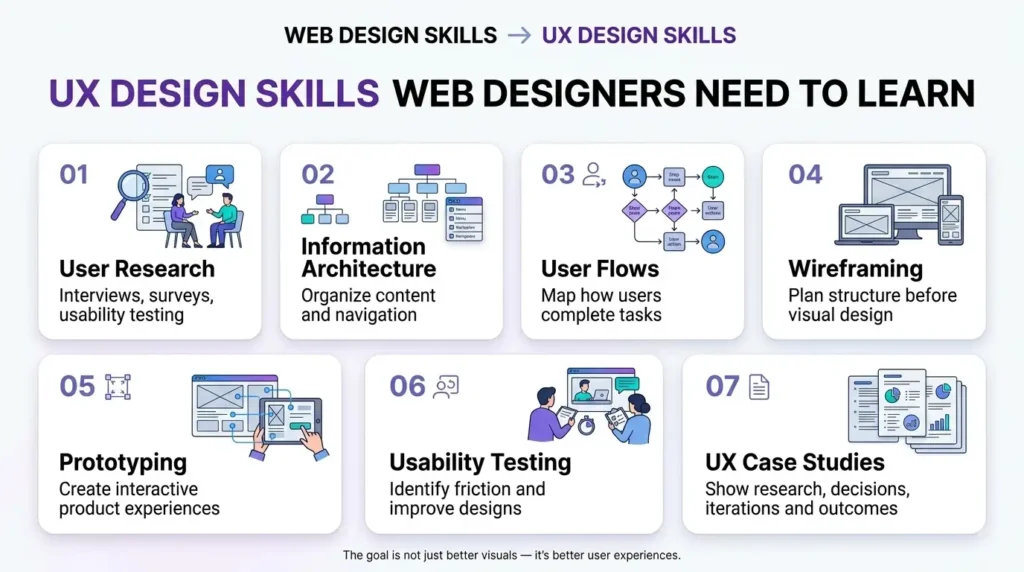
To successfully move from web design to UX design, focus on building the following skills.
1. User Research
Learn how to understand users before designing solutions. This is an essential step when becoming a UX designer after web design. Important areas include:
- User interviews
- Surveys
- User observation
- Competitor research
- Usability testing
- Research synthesis
The goal is to understand what users actually need rather than designing entirely from assumptions.
2. Information Architecture
Information architecture is about organizing content and features so users can find what they need easily. Understanding these principles is important when becoming a UX designer after web design. You should understand:
- Navigation structures
- Content organization
- Categories
- Labels
- Site structures
- User flows
3. User Flow Mapping
User flows show the steps a person takes to complete a task. For example, an e-commerce flow might look like:
Homepage → Product → Product Details → Cart → Checkout → Confirmation
Learning to identify unnecessary steps and friction points is an important UX skill.
4. Wireframing
Wireframes allow you to plan structure before spending time on visual details. For anyone becoming a UX designer after web design, practicing different wireframing formats is important. Practice creating:
- Low-fidelity wireframes
- Mobile wireframes
- Desktop wireframes
- Website layouts
- App screens
5. Prototyping
Prototypes allow you to demonstrate how an interface works before development. For those becoming a UX designer after web design, tools such as Figma can help you create interactive prototypes and test user flows.
6. Usability Testing
Learn how to observe users interacting with your design. Ask:
- Can users complete the task?
- Where do they get confused?
- What information do they miss?
- Which steps create friction?
- What changes would improve the experience?
7. UX Case Study Writing
A UX portfolio needs more than attractive screens. You should explain:
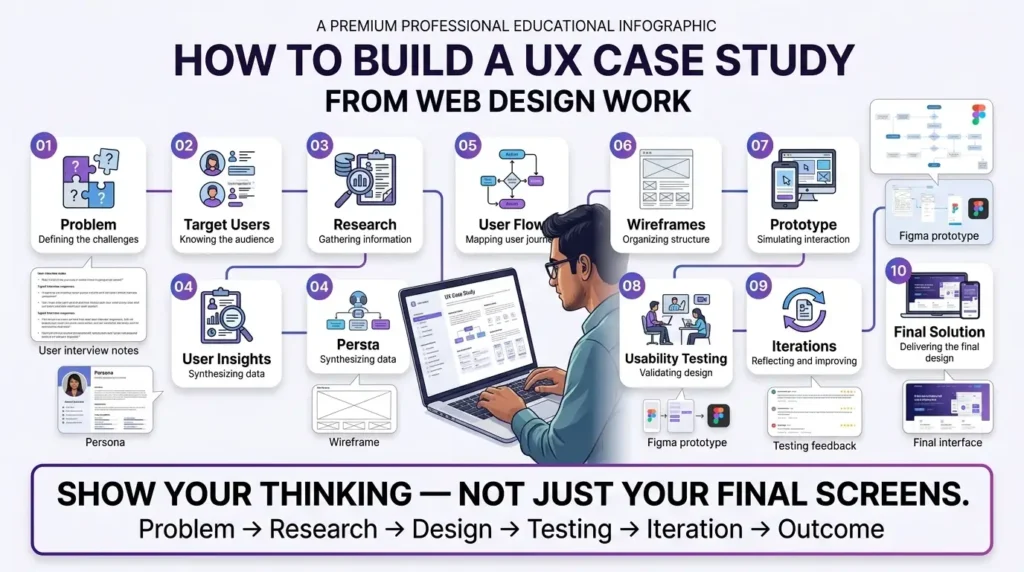
Problem → Research → Insights → Design → Testing → Iteration → Outcome
This demonstrates how you think, not just what you can make.
What UX Tools Should a Web Designer Learn?
Figma is particularly useful for designers transitioning into becoming a UX designer after web design because it supports wireframing, interface design, prototyping, and collaboration. Focus on learning tools according to the workflow rather than trying to master every available application. Your core toolkit can include:
- Figma for wireframes, interfaces, and prototypes
- FigJam for brainstorming and user-flow work
- Research and survey tools
- Usability-testing platforms
- AI-assisted tools for research synthesis and rapid iteration
Tool knowledge is useful, but tools alone do not make someone a UX designer after web design. Strong UX comes from understanding users, identifying problems, making informed decisions, and validating solutions.
How to Become a UX Designer After Web Design: Step-by-Step
Step 1: Learn Core UX Principles
Start by understanding:
- User-centered design
- Usability
- Accessibility
- Design thinking
- Interaction design
- Basic user psychology
Do not jump directly into creating polished interfaces. First understand why UX decisions are made.
Step 2: Learn User Research Methods
Practice conducting simple research.
Learn how to:
- Write interview questions
- Conduct user interviews
- Create surveys
- Identify user pain points
- Organize research findings
- Translate insights into design decisions
Even small practice projects can help you develop research skills.
Step 3: Deepen Your Figma Skills for UX
If you already use Figma for web design, move beyond visual design and focus on developing the skills needed to become a UX designer after web design.
Practice:
- Wireframes
- User flows
- Components
- Interactive prototypes
- Design systems
- Responsive layouts
- Prototype testing
Step 4: Reframe 2–3 Existing Web Design Projects
Your existing web design projects can become valuable UX portfolio material. Go back to previous projects and ask:
- What problem was the website solving?
- Who were the users?
- What assumptions did I make?
- What user feedback was available?
- Why did I choose this layout?
- What could have been improved?
- How would I test the design today?
This changes a simple web design project into a potential UX case study.
Step 5: Complete a UX Practice Project
Choose a real website or app and identify a usability problem.
Then document:
- The problem
- Target users
- Research
- Key findings
- User flow
- Wireframes
- Prototype
- Testing
- Design iterations
- Final solution
Avoid presenting a redesign as if it were automatically successful. Clearly distinguish between assumptions, research findings, and measurable outcomes.
Step 6: Build a UX Portfolio
Create a portfolio that shows your process. A strong case study should explain:
- The problem
- Your role
- The users
- Research methods
- Key insights
- Design decisions
- Iterations
- Testing
- Final solution
- Results or learnings
For UX positions, the reasoning behind the work is often more important than simply showing polished screens.
Step 7: Get Feedback
Ask UX designers, mentors, peers, or instructors to review your case studies. This feedback can be especially valuable when developing your skills as a UX designer after web design. Request specific feedback about:
- Research quality
- Problem definition
- User flows
- Design decisions
- Testing
- Case-study storytelling
Feedback can help you identify gaps much faster than working completely alone.
Step 8: Apply for Junior or Hybrid UX/UI Roles
Once your portfolio demonstrates genuine UX thinking, begin exploring opportunities to work as a UX designer after web design.
- Junior UX Designer
- Junior UI/UX Designer
- UX/UI Designer
- Product Designer Intern
- UX Design Intern
- Web Designer + UX roles
Hybrid roles can be particularly suitable for web designers who want to become a UX designer after web design, because they allow you to use your existing visual skills while developing deeper UX experience.
Can I Learn UX in 3 Months?
Yes, you can build foundational UX skills and complete one or two initial case studies within three months of focused learning. However, three months should not be treated as a guaranteed job-ready timeline for becoming a UX designer after web design.
In the first month
Focus on:
- UX fundamentals
- User-centered design
- Research basics
- Usability
- Figma fundamentals for UX
In the second month
Focus on:
- User flows
- Wireframes
- Prototypes
- User research
- Usability testing
- Your first case study
In the third month
Focus on:
- Improving your case study
- Completing another project
- Building your portfolio
- Getting feedback
- Preparing for applications
For stronger job-ready confidence, a 4–6 month period of consistent practice can be more realistic, particularly when you are building a portfolio alongside existing work.
How Long Does It Take to Become a UX Designer?
There is no single timeline that works for everyone. A practical roadmap can look like this:
| Timeline | Main Focus |
| Months 1–2 | UX theory, research, and Figma |
| Months 2–4 | Case studies and practical projects |
| Months 4–6 | Portfolio, feedback, and applications |
| 6+ months | Interview learning and real-world experience |
Structured mentorship can make the process more efficient, while independent learning without feedback may take longer. For those becoming a UX designer after web design, the goal should be demonstrated ability rather than simply completing a certain number of months.
What Qualifications Do I Need to Become a UX Designer?
A specific degree is not necessarily required for every UX design role, especially for those building a career as a UX designer after web design. Employers can place significant value on:
- Problem-solving ability
- UX knowledge
- Research skills
- Portfolio quality
- Prototyping skills
- Communication
- Practical project experience
Useful educational backgrounds can include:
- UX design
- Graphic design
- Web design
- Psychology
- Human-computer interaction
- Computer science
A dedicated UX course, certification, self-directed learning, or related degree can all provide useful foundations. The important thing is to combine learning with practical projects.
How to Build a UX Portfolio From Web Design Work
You do not need to throw away your existing web design portfolio. Instead, reframe your strongest projects from a UX perspective to strengthen your profile as a UX designer after web design.
Add the “why”
Explain why you made important design decisions.
Include user feedback
If you received feedback from clients or users, explain what you learned from it.
Show iterations
Don’t only display the final design. Show how the design changed.
Create dedicated UX case studies
At least one project should demonstrate a complete UX process from problem identification through testing and iteration, helping showcase your capabilities as a UX designer after web design.
Make the reasoning visible
A UX portfolio should communicate your thought process, not just visual polish.
Common Mistakes When Moving From Web Design to UX
1. Treating UX as Purely Visual Work
UX is not simply about creating attractive interfaces. Research, usability, information architecture, interaction design, and problem-solving are central to the discipline and essential skills for becoming a UX designer after web design.
2. Showing Only Final Screens
A beautiful final screen does not explain how you arrived at the solution. Show your process.
3. Skipping User Research
Even small research exercises can demonstrate that your decisions are based on users rather than assumptions.
4. Creating Too Many Weak Projects
One well-documented case study can be more useful than several shallow projects. Focus on depth and clarity.
5. Ignoring Accessibility
Good UX should consider different users and their needs, including accessibility and readability.
6. Ignoring AI Tools
AI can assist with activities such as research synthesis, brainstorming, wireframe exploration, and repetitive tasks. However, AI should support UX thinking rather than replace user research, validation, empathy, and human judgment, especially when developing your skills as a UX designer after web design.
Is UI/UX Design Being Replaced by AI?
No. AI is changing how UX designers work, but that does not mean the entire profession is being replaced.
AI tools can help designers with:
- Research synthesis
- Brainstorming
- Initial wireframe ideas
- Content generation
- Rapid iteration
- Repetitive design tasks
However, designers still need to understand users, identify the right problems, evaluate research, make strategic decisions, validate solutions, and communicate with stakeholders. For someone moving from web design to UX, learning to use AI responsibly can therefore become an additional skill rather than something to avoid.
Digital Chaabi Academy Insights
At Digital Chaabi Academy, web design can be viewed as a strong foundation for students who want to move toward UX. Students who already understand layouts, responsive design, and website interfaces can spend more time developing research, usability, prototyping, and case-study skills instead of starting completely from scratch. A structured learning approach can help bridge the gap between visual web design and research-driven UX design. For learners interested in combining designer fundamentals with modern AI-assisted workflows, developing responsible AI tool literacy can also complement traditional UX skills.
Future Scope of UX Design
A UX designer after web design can work across a wide range of industries, including:
- SaaS
- E-commerce
- Fintech
- Healthcare
- Education
- Technology
- Mobile applications
- Digital services
The role is also evolving as companies place greater emphasis on:
- Accessibility
- User research
- Data-informed design
- Design systems
- AI-assisted workflows
- Product thinking
- For aspiring UX designers, the strongest long-term approach is to build fundamentals first and then learn how emerging tools can make the workflow faster and more effective. For further UX and design learning, resources such as Nielsen Norman Group can provide useful reference material.
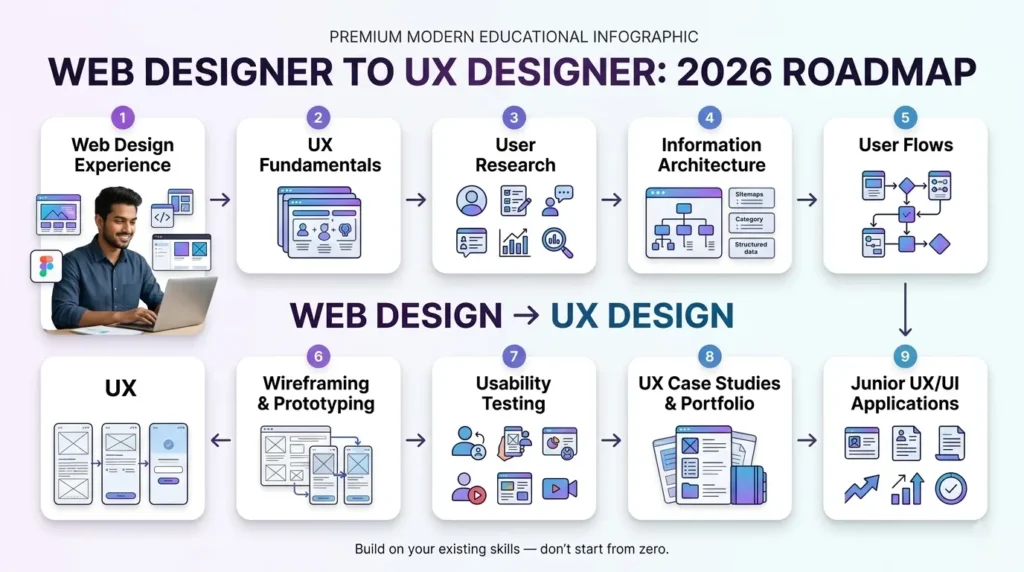
Web Design to UX Designer Career Roadmap
The complete transition can be summarized as:
Web Design Experience
↓
UX Fundamentals
↓
User Research
↓
Information Architecture & User Flows
↓
Wireframing & Prototyping
↓
Usability Testing
↓
UX Case Studies
↓
UX Portfolio
↓
Feedback & Mentorship
↓
Junior UX/UI Applications
This approach allows you to build on what you already know instead of treating UX as a completely unrelated career.
Frequently Asked Questions
Is UI/UX design a hard job?
UI/UX design is not inherently harder than web design, but it requires a more research-driven and analytical mindset. Designers transitioning from primarily visual work may need time to develop these skills when becoming a UX designer after web design.
Can I learn UX design in 3 months?
You can learn UX fundamentals and complete initial case studies in three months with focused practice. However, developing strong job-ready confidence and a competitive portfolio can take longer.
What qualifications do I need to become a UX designer?
There is no single qualification required for every UX role. A strong portfolio, practical skills, research knowledge, communication ability, and problem-solving skills can be more important than a specific degree.
Can a web designer become a UX designer?
Yes. Web designers already have transferable skills such as visual hierarchy, responsive design, layout, interface design, and familiarity with design tools. They need to add research, usability testing, information architecture, and structured UX thinking to successfully become a UX designer after web design.
Can I become a UX designer without a degree?
Yes, depending on the role and employer. Building a strong portfolio with well-documented UX case studies can demonstrate practical ability even when you do not have a specific UX degree.
What should a web designer learn first to become a UX designer?
Start with UX fundamentals and user research. Then learn user flows, information architecture, wireframing, prototyping, and usability testing to build the essential skills needed to become a UX designer after web design.
Is Figma enough to become a UX designer?
Figma is an important UX tool, but knowing Figma alone does not make someone a UX designer. You also need research, problem-solving, usability, interaction design, and portfolio skills.
How do I build a UX portfolio with no UX experience?
Start with existing web design projects and reframe them around user problems and design decisions. You can also create practice projects that document research, user flows, wireframes, prototypes, testing, and iterations.
Is UI/UX design being replaced by AI?
AI is changing UX workflows rather than eliminating the need for UX designers. For those becoming a UX designer after web design, AI can accelerate research synthesis, ideation, prototyping, and repetitive tasks, while human judgment remains important for understanding users and making strategic design decisions.
What’s the biggest skill gap between web design and UX design?
The biggest gap is usually structured user research and documented design reasoning. UX designers need to explain how evidence, user needs, and testing influenced their design decisions.
Conclusion
How to become a UX designer after web design is not about starting over. It is about extending the skills you already have with user research, usability testing, information architecture, deeper prototyping, and research-backed design thinking. Your web designer experience can give you a valuable head start. The next step is to learn how to understand users, define problems, test solutions, document your process, and communicate your decisions through strong UX case studies. With several months of focused learning and practical project work, moving from web design toward UX designer can be a realistic career transition. The most important thing is not simply learning another design tool. Build the ability to explain who the user is, what problem you are solving, why you chose a particular solution, and how you know that solution works. If you are a web designer considering this transition and want structured guidance, Digital Chaabi Academy can help you build on your existing web design foundation while developing practical UX skills.