
Web designing course
Choosing the best web designing course depends on who you are, how much time you have, and what you want to achieve. Students may need a structured program that builds strong fundamentals and provides career guidance. Freelancers usually need practical, client-ready skills and a portfolio they can use to attract projects. Working professionals often need flexible learning options that fit around an existing job. So, there isn’t one universal course that is automatically the best for everyone.
A student with several hours available each day may benefit from a different learning structure than a working professional who can study only in the evenings. Similarly, a freelancer who wants to start accepting client projects quickly may prioritize practical projects and portfolio development over extensive theory. This guide explains how to choose the best web designing course based on your learner type, goals, schedule, course format, projects, mentorship, and future career plans.
Why the Best Web Designing Course Depends on Your Goal
Before comparing courses, understand what you actually need from your training. Course advertisements often present one program as the perfect solution for everyone. In reality, your starting level, available time, learning style, and career goal can significantly affect which course is right for you.
Students
Students usually benefit from:
- Strong fundamentals
- Structured learning
- Multiple practice projects
- Career guidance
- Portfolio development
- Peer learning
- Mentorship
Freelancers
Freelancers generally need:
- Practical skills
- Client-style projects
- Portfolio-ready work
- Faster learning
- Client communication skills
- Pricing and project guidance
- Knowledge of commonly requested tools
Working Professionals
Working professionals often prioritize:
- Flexible schedules
- Recorded lessons
- Evening or weekend sessions
- Self-paced learning
- Mentor support
- Practical assignments
- Manageable weekly workloads
The best Web Development Syllabus : Complete Beginner to Advanced Roadmap is therefore the one that matches your actual learning requirements rather than simply having the longest syllabus or the most promotional claims.
Which Course Is Best for Web Designing?
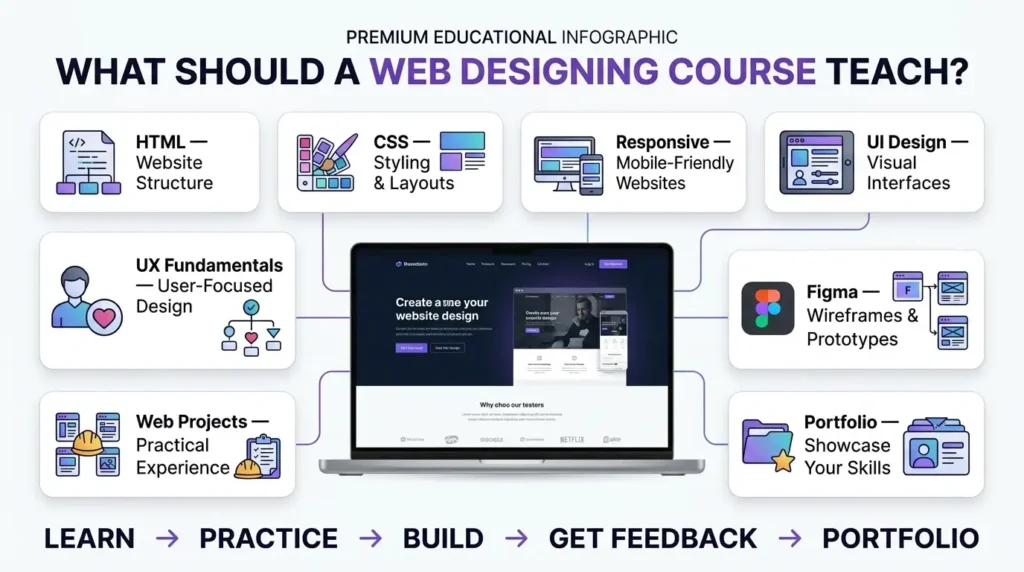
The best web designing course should combine design fundamentals, technical skills, practical projects, mentorship, and portfolio development. Before enrolling, check whether the course covers the core areas you need. A strong web designing course should typically include:
- HTML
- CSS
- Responsive web design
- UI design fundamentals
- UX principles
- Figma or another professional design tool
- Website layouts
- Typography
- Color theory
- Basic accessibility
- Website projects
- Portfolio development
Depending on the course and career path, learning platforms such as WordPress can also be useful for creating and managing real-world websites.
Look beyond the syllabus
A course may list dozens of subjects but still provide limited practical value. Ask:
- Are there real projects?
- Is the work reviewed by mentors?
- Can you ask questions?
- Will you build a portfolio?
- Are assignments based on realistic website requirements?
- Does the course provide career or freelancing guidance?
- Is the schedule compatible with your availability?
A good course should help you apply what you learn, not simply complete video lessons.
Best Web Designing Course for Students
Students usually have more flexibility than working professionals, so a comprehensive and structured program can be valuable.
What students should look for
1. Strong Fundamentals
Students should understand the basics before rushing toward advanced tools. Look for training that explains:
- HTML
- CSS
- Responsive design
- UI fundamentals
- UX principles
- Typography
- Color
- Layout
- Website structure
2. Multiple Projects
Practice is essential. A student-focused web designing course should provide opportunities to create different types of websites, such as:
- Business websites
- Landing pages
- Portfolio websites
- E-commerce layouts
- Service websites
- Personal websites
Projects help turn theoretical knowledge into practical skills.
3. Career Guidance
Students may be learning web design as their first professional skill. Useful guidance can include:
- Portfolio development
- Resume preparation
- Interview preparation
- Career options
- Internship guidance
- Freelancing basics
4. Mentorship
Having someone review your work can help you identify mistakes that may otherwise go unnoticed.
Best approach for students
For students, a structured 3–6 month web designing program can provide enough time to learn fundamentals, complete projects, build a portfolio, and explore career options. The exact duration should depend on curriculum depth and practice requirements rather than the number of months advertised.
Best Web Designing Course for Freelancers
Freelancers usually have a different priority: they need to turn their skills into client-ready services. Instead of focusing only on theoretical knowledge, freelancers should look for a practical, portfolio-first web designing course.
Important features for freelancers
Realistic Client Projects
Practice with project briefs similar to what actual clients may request. For example:
- Business website
- Restaurant website
- Landing page
- Portfolio website
- Local service website
- E-commerce website
Portfolio Development
Your portfolio is one of the most important assets when approaching potential clients. Choose a course that helps you create several polished projects rather than simply completing exercises.
Client Communication
Freelancers also need to understand how to:
- Collect requirements
- Communicate with clients
- Handle revisions
- Present design concepts
- Discuss timelines
- Manage expectations
Pricing and Project Management
A useful freelance-focused course should at least introduce:
- Project estimation
- Basic pricing considerations
- Scope management
- Revision policies
- Client communication
Tool Proficiency
Depending on your target clients, useful tools may include:
- Figma
- WordPress
- Design and prototyping tools
- Website builders
- Basic HTML and CSS
Best approach for freelancers
Freelancers should prioritize a course that gets them building useful projects quickly while still teaching the fundamentals needed to produce quality work.
Best Web Designing Course for Working Professionals
Working professionals often face one major limitation: time. A course can have excellent content, but if its schedule conflicts with your job, maintaining consistency becomes difficult.
Look for flexibility
The ideal course may offer:
- Evening batches
- Weekend batches
- Recorded lessons
- Self-paced learning
- Flexible assignment deadlines
- Mentor support
- Replayable sessions
Focus on practical learning
Working professionals generally benefit from a curriculum that allows them to apply each skill directly.
For example: Learn → Practice → Build → Receive Feedback → Improve
This approach can make limited study time more productive.
Avoid unnecessary schedule pressure
A working professional does not necessarily need a shorter course. They need a course whose delivery format is flexible enough to accommodate their existing responsibilities.
Which Online Web Designing Course Is Best for Working Professionals?
For working professionals, a strong online web designing course should combine flexibility with accountability. Pure self-learning can be convenient, but some learners struggle to stay consistent without deadlines or feedback. A useful online format may include:
- Recorded lessons
- Scheduled mentor sessions
- Practical assignments
- Flexible project timelines
- Regular feedback
- Clear learning milestones
A realistic weekly commitment of around 5–8 hours can be manageable for many working professionals, although the right schedule depends on the individual’s availability and the course workload. The key is consistency. Studying for a few hours every week and completing projects is generally more useful than enrolling in an intensive program that you cannot realistically maintain.
What Should a Web Designing Course Teach?
Before choosing a course, review the syllabus carefully.
Core Web Design Subjects
A comprehensive program may cover:
- HTML
- CSS
- Responsive design
- UI design
- UX fundamentals
- Figma
- Typography
- Color theory
- Layout and visual hierarchy
- Website navigation
- Basic accessibility
- Web design principles
Practical Skills
Look for:
- Website projects
- Landing page projects
- Responsive layouts
- Portfolio projects
- Client-style briefs
- Design revisions
- Prototype creation
Career Skills
Depending on your goal, additional training can include:
- Portfolio building
- Resume preparation
- Freelancing
- Client communication
- Interview preparation
- Personal branding
The exact syllabus will vary between institutes, so compare what you will actually be able to build by the end of the course, not just how many subjects are listed.
Is Web Design Still in Demand in 2026?
Yes, web design remains a useful professional skill in 2026.
Businesses continue to need websites and digital experiences that are:
- Easy to navigate
- Mobile-friendly
- Visually professional
- Accessible
- Fast and usable
- Designed around business and user goals
AI tools are changing how some website and design tasks are performed, but businesses still need people who can understand requirements, make design decisions, create effective user experiences, communicate with clients, and improve websites based on real objectives. This creates opportunities across several paths.
Students
Students can explore web design as a career foundation and develop additional skills over time.
Freelancers
Freelancers can use web design skills to offer services to businesses, entrepreneurs, and organizations.
Working Professionals
Professionals can add web design to existing skills in areas such as:
- Marketing
- Content creation
- Entrepreneurship
- Social media
- Branding
- Digital business
The market is evolving, so continuously improving your skills is important.
How to Choose the Best Web Designing Course
Before enrolling, use this checklist.
1. Check the Curriculum
Make sure the syllabus covers the skills you actually want to learn.
2. Check the Projects
Ask how many practical projects you will complete.
3. Check Portfolio Support
Find out whether the course helps you turn projects into professional portfolio pieces.
4. Check Mentor Accessibility
Understand:
- How do students ask questions?
- How quickly do mentors respond?
- Is project feedback included?
- Are live doubt sessions available?
5. Check the Learning Format
Choose between:
- Classroom
- Online
- Self-paced
- Hybrid
- Weekend
- Evening
based on your schedule.
6. Check Career Support
If career development is important, ask what support is actually provided. Avoid vague promises such as “100% career success” without specific details.
7. Check Real Student Work
Whenever possible, review actual student projects and portfolios. This can tell you more about course outcomes than promotional claims.
Digital Chaabi Academy Insights
At Digital Chaabi Academy, the goal is to accommodate different types of learners rather than assuming everyone has the same schedule and career objective. Students can focus on stronger fundamentals, practical projects, portfolio development, and career guidance. Freelancers can prioritize practical website projects, client-oriented skills, portfolio building, and freelance preparation. Working professionals can benefit from flexible learning options designed to work around existing commitments. The underlying principle remains the same across all paths:
Learn the skill → practice it → build projects → receive feedback → improve your portfolio.
This approach helps learners focus on practical outcomes rather than simply completing a syllabus.
How to Start Freelancing as a Web Designer
If your goal is to use web design as a freelance career, learning the skill is only the first step.
Step 1: Build 3–5 Strong Portfolio Projects
Create different types of websites to demonstrate range.
Step 2: Choose Your Target Services
You could focus on:
- Business websites
- Landing pages
- WordPress websites
- Portfolio websites
- E-commerce design
- UI design
Step 3: Create Freelance Profiles
Platforms such as Upwork and Fiverr can be considered alongside local networking and direct outreach.
Step 4: Start With Manageable Projects
Early projects can help you build:
- Experience
- Testimonials
- Reviews
- Confidence
- Client communication skills
Step 5: Improve Your Pricing
As your skills, portfolio, and experience grow, you can reassess your pricing and project scope.
Step 6: Collect Testimonials
After successfully completing projects, ask clients for honest feedback and testimonials.
Step 7: Specialize Gradually
Once you understand your strengths, consider specializing in an area such as:
- E-commerce
- Landing pages
- Local business websites
- SaaS websites
- WordPress
- UI design
Common Mistakes When Choosing a Web Design Course
Choosing a Course Because It Claims to Be “Best”
Marketing language alone does not tell you whether a course fits your needs.
Ignoring Your Schedule
Working professionals should not choose a rigid course they cannot consistently attend.
Choosing Speed Over Fundamentals
Freelancers may need speed, but skipping essential fundamentals can affect the quality of client work.
Choosing Theory Without Projects
Watching lessons is not enough.
You need to build.
Choosing a Course Without Mentor Support
Being able to receive feedback can significantly improve the learning process.
Ignoring Portfolio Development
Your skills become much easier to demonstrate when you have strong projects to show.
Comparing Only Course Fees
Price should be one factor, not the only factor.
Compare:
- Curriculum
- Projects
- Mentorship
- Duration
- Flexibility
- Portfolio support
- Career support
Comparing Web Designing Course Formats
| Course Format | Best For | Main Advantage | Trade-Off |
| Live Classroom | Students | Direct interaction | Less flexibility |
| Self-Paced Online | Working Professionals | Maximum flexibility | Requires discipline |
| Hybrid | Freelancers & Professionals | Flexibility + mentorship | Requires schedule management |
| Intensive Bootcamp | Career Switchers | Faster learning | Higher time commitment |
There is no universally best format.
The right choice depends on your schedule, learning style, goals, and ability to practice consistently.
Future Scope After Learning Web Design
Web design can lead to several career and income paths.
Career Opportunities
Depending on your skills and experience, you can explore roles such as:
- Web Designer
- UI Designer
- UX/UI Designer
- WordPress Designer
- Junior Product Designer
- Website Designer
- Freelance Web Designer
Freelancing Opportunities
You can also offer services such as:
- Website design
- Landing page design
- WordPress website creation
- UI design
- Website redesign
- Responsive website design
Combining Web Design With Other Skills
Web design becomes even more versatile when combined with skills such as:
- Digital marketing
- SEO
- Content creation
- Branding
- Social media marketing
- Copywriting
- Basic development
- AI-assisted design workflows
- AI is likely to continue changing the workflow, so designers should focus on both strong fundamentals and responsible use of modern tools.
Frequently Asked Questions
Which course is best for web designing?
The best web designing course should combine strong fundamentals, practical projects, accessible mentorship, portfolio development, and a learning format that matches your goals. The ideal course can differ for students, freelancers, and working professionals.
What is the best web designing course for students?
Students generally benefit from a structured course with strong fundamentals, multiple projects, mentorship, portfolio development, and career guidance.
What is the best web designing course for freelancers?
Freelancers should prioritize practical, portfolio-focused training that includes client-style projects, design tools, client communication, and basic freelancing guidance.
What is the best web designing course for working professionals?
Working professionals generally benefit from flexible online, evening, weekend, or hybrid learning formats with recorded lessons and mentor support.
Which online web designing course is best for working professionals?
A good online course for working professionals combines recorded or self-paced learning with structured milestones, practical projects, mentor feedback, and flexible scheduling.
Is web design still in demand in 2026?
Yes. Businesses continue to need professional, responsive, usable, and user-friendly websites. However, AI is changing the workflow, so modern web designers should continuously improve their skills.
How long does it take to learn web designing?
The timeline depends on your starting level, learning schedule, and course depth. A structured program may take several months, but becoming genuinely confident requires consistent practice and project experience.
Do I need coding to learn web designing?
Basic HTML and CSS are valuable for understanding how websites are structured and built. However, the amount of coding required depends on the type of web design role and tools you intend to use.
Is an online web designing course better than classroom training?
Neither format is automatically better. Online learning provides flexibility, while classroom learning can provide direct interaction. Hybrid learning can combine flexibility with mentorship.
Can I start freelancing after a web designing course?
Yes, you can begin exploring freelance work after developing sufficient practical skills and a portfolio. Start with manageable projects and continue improving your skills through real client experience.
Can students and working professionals take the same web designing course?
Yes, but flexible learning tracks or schedules can make the experience more suitable for each learner type.
Conclusion
There is no single course that deserves to be called the best web designing course for everyone. The right choice depends on your starting point, available time, learning style, and career goal. Students should prioritize strong fundamentals, structured learning, projects, and career guidance. Freelancers should prioritize practical skills, portfolio development, client-oriented projects, and freelance preparation. Working professionals should prioritize flexibility, manageable schedules, practical learning, and accessible mentorship. Before enrolling, don’t choose a course only because of its title, price, duration, or marketing claims. Look carefully at the curriculum, projects, mentor support, portfolio outcomes, learning format, and career guidance. The best web designing course is ultimately the one that fits your situation and helps you turn learning into practical skills you can actually use.