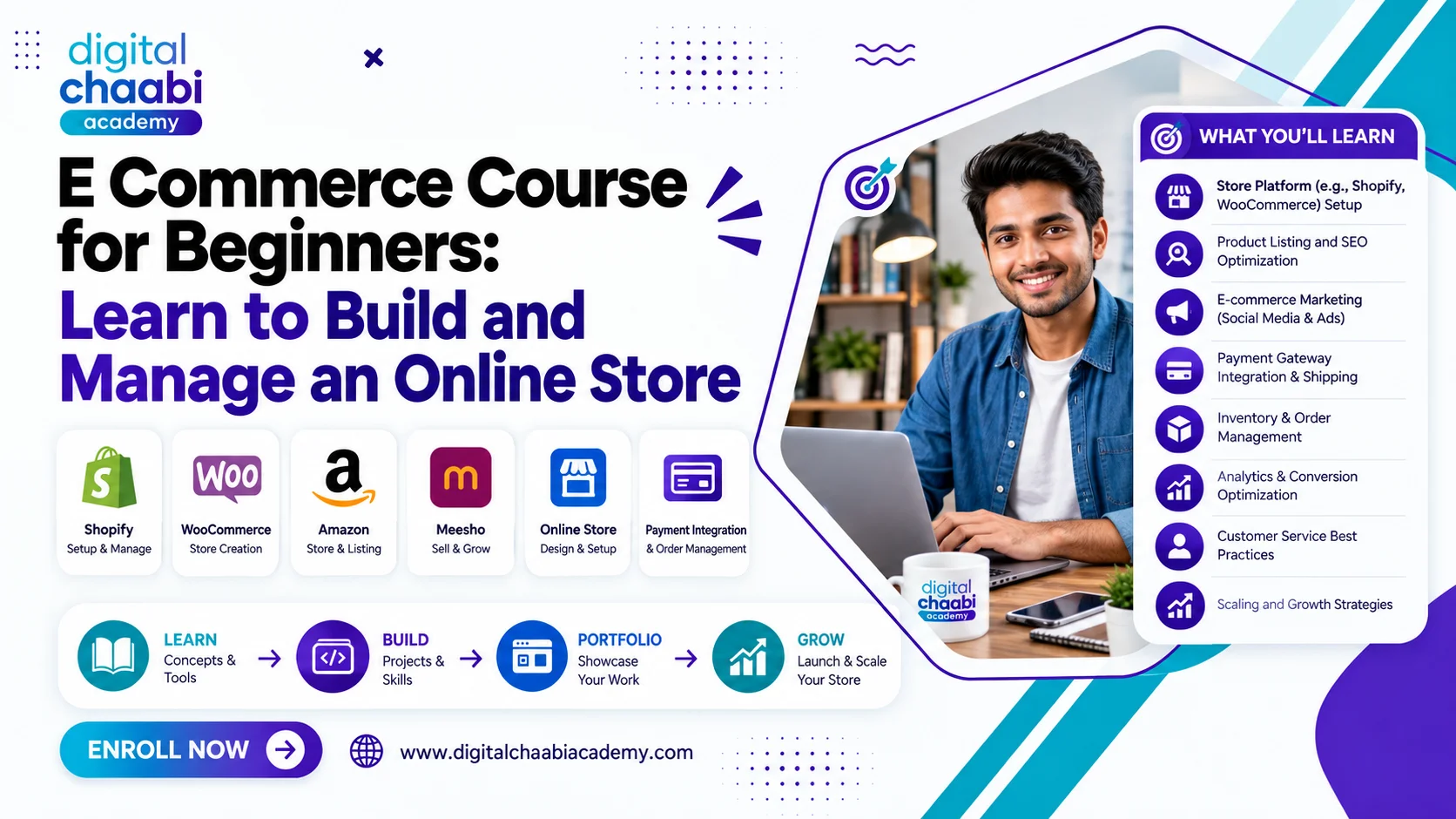
Someone told me recently, a little sheepishly, that she’d bought a domain name eight months ago and still hadn’t built anything on it. Not because she lacked ideas. She simply didn’t know where to start — product sourcing, platform selection, payment gateways, shipping logistics, store design, and marketing all felt like too many decisions at once.
That’s exactly where an E Commerce Course for Beginners can help. The purpose isn’t to overwhelm you with every possible e-commerce concept. It’s to give you a practical sequence: what to learn first, what can wait, and what you should understand before spending money on inventory or advertising.
Here’s the honest truth about starting an online store: the individual steps aren’t necessarily complicated. The difficult part is understanding which step comes next. Without a clear process, beginners often jump between platforms, product research, website design, social media, and advertising without completing any one part properly.
A structured E Commerce Course for Beginners can turn that scattered learning process into a step-by-step path. Instead of watching dozens of unrelated tutorials, you can learn how the different parts of an online business connect.
If you’ve been thinking about starting an online store for months, or you’ve already started but feel stuck somewhere in the middle, understanding this process can give you a much clearer starting point.

Why Most Beginners Get Stuck Before Launching
There’s a specific kind of confusion that hits people right before they launch an online store. Too many decisions arrive at once, and it’s difficult to know which one actually matters first.
Should you use Shopify or WooCommerce? Do you need business registration before selling? Which payment gateway should you choose? How will shipping work? What happens when a customer requests a return?
Each question can feel urgent.
The purpose of an E Commerce Course for Beginners is to organize these questions into a logical learning path. Instead of trying to solve everything simultaneously, you can work through the major components one at a time.
The Real Problem Is Often Lack of Structure
Most people who delay launching their first store aren’t necessarily lacking motivation. They may simply lack a process.
A beginner might spend three weeks designing a logo before validating a product. Another might install multiple plugins before understanding how their checkout process works. Someone else might start running advertisements before figuring out their product margins.
A structured E Commerce Course for Beginners helps reduce this scattered approach by connecting learning with practical implementation.
Start With the Fundamentals
Before choosing a platform or spending money, understand:
- What e-commerce actually involves
- How online stores generate revenue
- Different business and sourcing models
- Basic customer and product research
- The role of websites, marketplaces, payments, and logistics
Then Move Toward Implementation
Once the fundamentals are clear, you can move toward product selection, store setup, payments, shipping, marketing, and analytics.
The Goal: A Functional Store
The ultimate objective isn’t simply completing lessons. It’s understanding how to build and manage a functioning online store.
How to Learn E-Commerce for Beginners
One of the most common questions beginners ask is how to learn e-commerce without becoming overwhelmed. The answer is to learn in the same sequence in which you would eventually build your business.
1. Start With E-Commerce Fundamentals
First, understand how online commerce works. Learn about:
- Online stores and marketplaces
- B2C and B2B business models
- D2C brands
- Product sourcing
- Customer journeys
- Online payments
- Shipping and returns
- Digital marketing
These concepts provide the foundation for everything that follows.
2. Choose One Platform
Beginners often make the mistake of trying to learn multiple platforms simultaneously. Instead, choose one platform based on your business requirements and learn it properly.
Shopify can be useful for beginners who want a relatively straightforward hosted solution, while WooCommerce provides extensive customization within the WordPress ecosystem.
The right choice depends on your technical comfort, budget, desired flexibility, and business model.
3. Study Existing Online Stores
Look at successful stores within your intended niche. Don’t simply copy their designs. Study how they handle:
- Product presentation
- Navigation
- Pricing
- Product descriptions
- Reviews
- Checkout
- Offers
- Customer support
- Mobile experience
This can help you understand what customers may expect from an online shopping experience.
4. Understand Product Sourcing
Your learning should also cover different sourcing approaches, such as:
- Manufacturing
- Wholesale
- Dropshipping
- Private labeling
- Marketplace sourcing
Each model has different considerations related to investment, inventory, margins, fulfillment, and control.
5. Learn Payments and Shipping
Payment and logistics aren’t secondary details.
Customers need a reliable checkout experience, while businesses need a practical way to deliver orders and manage returns.
An E Commerce Course for Beginners should therefore cover payment gateways, shipping workflows, order management, and basic return processes.

What to Look for in an E-Commerce Course
There are many free videos, blogs, tutorials, and paid courses available online. The challenge isn’t finding information. It’s finding a learning structure that makes sense. Before enrolling in an E Commerce Course for Beginners, check whether it covers practical implementation rather than theory alone.
Practical Store Setup
Look for training that explains how to:
- Set up an online store
- Add products
- Create categories
- Configure basic store settings
- Build important pages
- Optimize product information
- Create a usable checkout experience
Business Fundamentals
A useful course should also explain the business side of e-commerce. This can include:
- Niche research
- Product validation
- Customer research
- Pricing basics
- Competition analysis
- Sourcing models
- Basic profit and cost calculations
Payments and Operations
Training should ideally explain:
- Payment gateway basics
- Order processing
- Shipping options
- Returns and refunds
- Inventory management
- Customer communication
Marketing and Analytics
Building a store is only one part of e-commerce. You should also understand basic:
- Social media marketing
- Search engine optimization
- Email marketing
- Paid advertising
- Conversion optimization
- Website analytics
The best fit depends on your goals, learning style, budget, and the amount of practical support you need.
What Are the 7 Types of E-Commerce?
Understanding different e-commerce models can make it easier to identify which type of business you want to build. The commonly discussed models include B2C, B2B, C2C, C2B, B2A, C2A, and D2C.
1. B2C — Business to Consumer
B2C is the model most people associate with online shopping. A business sells products or services directly to individual customers. Examples include online fashion stores, electronics websites, beauty brands, and many consumer-focused online businesses.
2. B2B — Business to Business
B2B businesses sell products or services to other businesses. For example, a company may sell office supplies, software, packaging materials, or industrial products to other organizations.
3. C2C — Consumer to Consumer
In a C2C model, one individual sells to another individual. Online marketplaces and resale platforms can facilitate this type of transaction.
4. C2B — Consumer to Business
C2B involves individuals providing products or services to businesses. Freelancers, creators, photographers, consultants, and independent professionals can operate within this type of model.
5. B2A — Business to Administration
B2A refers to businesses providing products or services to government or public administration organizations. This model can involve technology, professional services, infrastructure, or other business-to-government activities.
6. C2A — Consumer to Administration
C2A involves individuals interacting with government or public administration services digitally. Examples can include online applications, payments, registrations, and other digital government services.
7. D2C — Direct to Consumer
D2C brands sell directly to customers without relying entirely on traditional intermediaries.
This model has become increasingly relevant for digitally native brands because businesses can build direct customer relationships through their own online channels. For beginners, B2C and D2C may be particularly relevant when the goal is to build a consumer-focused online store.
What You’ll Learn in an E Commerce Course for Beginners
A well-structured E Commerce Course for Beginners should cover both technical store-building skills and the business concepts needed to operate an online store.
Foundational Skills
Niche and Product Selection
You’ll learn how to evaluate potential products based on factors such as:
- Customer demand
- Competition
- Pricing
- Product margins
- Sourcing availability
- Target audience
- Repeat-purchase potential
The goal isn’t to guarantee that a product will succeed. It’s to make decisions using research rather than assumptions.
Platform Setup
You may learn the basics of platforms such as:
- Shopify
- WooCommerce
- Product management
- Store navigation
- Categories
- Product pages
- Basic website customization
Operational Skills
Payment Gateway Integration
An E Commerce Course for Beginners should introduce the basics of online payments and explain how payment gateways fit into the customer checkout process. Depending on the course and target market, examples may include Razorpay, PayU, and other payment providers.
Inventory and Sourcing
You’ll also need to understand how products reach your store.
Possible models include:
- Manufacturing
- Wholesale
- Dropshipping
- Private labeling
Each approach involves different costs, responsibilities, and operational requirements.
Shipping and Logistics
Shipping can have a major impact on customer experience. Training may cover:
- Courier selection
- Shipping charges
- Delivery timelines
- Order tracking
- Returns
- Refund workflows
- Basic fulfillment processes
GST and Compliance Awareness
Beginners should understand that tax and legal requirements can vary depending on the business structure, products, location, turnover, and applicable regulations. An e-commerce course can provide basic awareness, but businesses should consult qualified professionals when they need advice specific to their circumstances.
Growth Fundamentals
Basic Marketing
Once the store is ready, you’ll need a way to attract relevant visitors. An E Commerce Course for Beginners may introduce:
- Social media marketing
- Search engine optimization
- Content marketing
- Email marketing
- Paid advertising
- Influencer collaborations
Analytics
Analytics helps you understand what happens after visitors reach your website. You can learn to monitor metrics such as:
- Traffic
- Product views
- Add-to-cart activity
- Checkout activity
- Purchases
- Conversion rate
- Revenue
This turns e-commerce from a guessing game into a process where decisions can be informed by data.
How Digital Chaabi Academy Structures Its E-Commerce Training
Digital Chaabi Academy approaches its e-commerce training around the idea that beginners benefit from learning through a structured, practical process. Rather than focusing only on definitions and theory, the training can be used to understand how the different parts of an online store connect.
Practical Store-Building Approach
The learning process focuses on areas such as:
- Store setup
- Product listings
- Payment gateway configuration
- E-commerce operations
- Marketing fundamentals
- Practical exercises
The objective is to help students understand not only what an online store contains but also how its different components work together.
Learning Through Real-World Examples
Practical examples can make concepts easier to understand. For instance, instead of learning about product descriptions only as a theory, students can examine how product information affects customer understanding and purchasing decisions. Similarly, payment and shipping concepts become easier to understand when connected to an actual store workflow.
Realistic Expectations
E-commerce isn’t usually an instant-sales business. Launching a website doesn’t automatically generate customers. Businesses generally need product research, marketing, customer service, testing, optimization, and consistent execution.
This is an important part of learning through an E Commerce Course for Beginners because it helps students understand the difference between launching a store and building a sustainable online business.
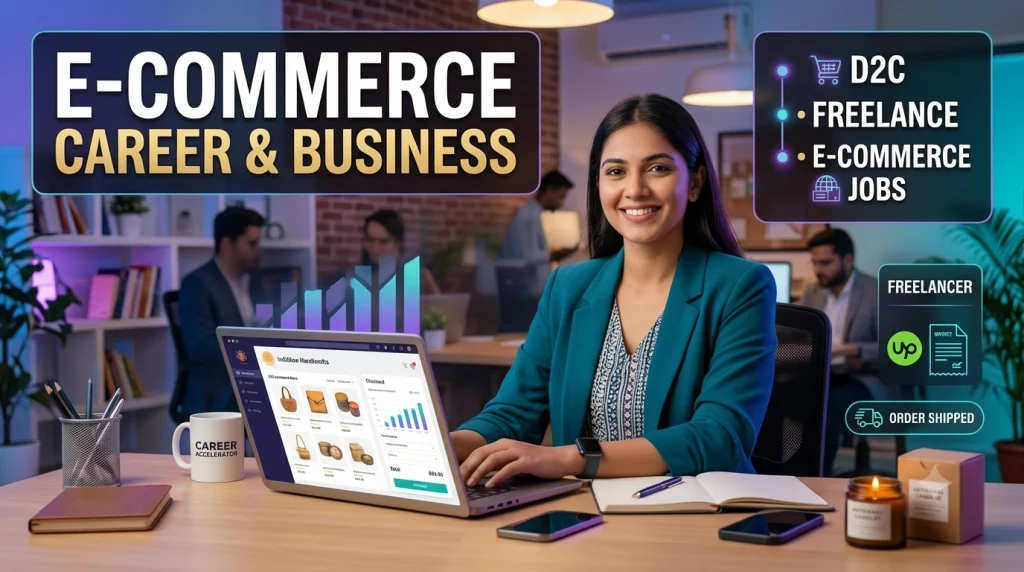
Practical Career and Business Paths After the Course
Completing an E Commerce Course for Beginners can provide a foundation for several different directions.
1. Launch Your Own D2C Brand
You can use your skills to build an online store around a product category or brand concept. This involves much more than website creation, including product research, sourcing, customer acquisition, fulfillment, and ongoing optimization.
2. Freelance E-Commerce Services
Businesses often need help with tasks such as:
- Store setup
- Product uploading
- Website maintenance
- Product-page optimization
- Basic e-commerce management
These skills can potentially be offered as freelance services.
3. Manage E-Commerce for Local Businesses
Many offline businesses want to establish an online presence. People with e-commerce skills may help businesses move products online, manage catalogs, maintain websites, or coordinate digital sales activities.
4. Combine E-Commerce With Performance Marketing
E-commerce and digital marketing work closely together. Understanding both areas can help you manage the complete customer journey from advertising and traffic generation to product pages and conversion.
5. Work With D2C Brands
Growing online brands may hire people for roles related to:
- E-commerce operations
- Store management
- Product catalog management
- Digital marketing
- Customer experience
- Marketplace management
An E Commerce Course for Beginners can provide foundational knowledge, although individual job requirements vary by employer and role.
Common Mistakes First-Time Store Owners Make
Learning what not to do can be just as useful as learning the technical steps.
Choosing a Product Without Research
Personal excitement about a product doesn’t automatically mean there is sufficient market demand. Research competitors, customer needs, pricing, reviews, and search behavior before committing significant resources.
Overcomplicating the Store
Some beginners spend months adjusting colors, animations, logos, and layouts without validating whether customers actually want the product. A functional store that can be tested is often more useful than a perfect-looking store that never launches.
Ignoring Shipping
Shipping problems can quickly affect customer satisfaction. Before launch, understand:
- Delivery areas
- Expected timelines
- Shipping costs
- Tracking
- Returns
- Refunds
Making Checkout Difficult
Customers may leave if the checkout process is confusing, slow, or lacks expected payment options. Keep the purchase process clear and test it before sending significant traffic to the website.
Expecting Instant Sales
Launching a store doesn’t guarantee immediate revenue. Marketing, product-market fit, customer trust, pricing, website experience, and ongoing optimization can all influence results.
Trying to Learn Everything at Once
This is one of the biggest problems an E Commerce Course for Beginners is designed to address. Instead of learning website design, advertising, SEO, sourcing, analytics, and logistics simultaneously, work through them in a logical order.
How to Build an Online E-Commerce Store Step-by-Step
If you’re ready to move from learning to implementation, use a simple sequence.
Step 1: Choose a Niche and Validate Demand
Research:
- Existing competitors
- Customer needs
- Search behavior
- Product pricing
- Reviews
- Market gaps
Don’t assume demand simply because you personally like a product.
Step 2: Choose a Sourcing Model
Decide whether your business will use:
- Manufacturing
- Wholesale
- Dropshipping
- Private labeling
Consider your budget, control requirements, inventory needs, margins, and operational capacity.
Step 3: Choose Your E-Commerce Platform
Compare platforms based on:
- Ease of use
- Customization
- Cost
- Integrations
- Payment options
- Scalability
- Technical requirements
Shopify and WooCommerce are two commonly considered options, but the appropriate choice depends on the specific business.
Step 4: Set Up Your Store
Create:
- Homepage
- Product pages
- Categories
- About page
- Contact page
- Shipping information
- Return/refund information
- Privacy and other applicable policy pages
Your store should be easy to navigate on both desktop and mobile devices.
Step 5: Add Products
Each product page should clearly communicate:
- Product name
- Price
- Features
- Benefits
- Specifications
- Images
- Availability
- Shipping information
Good product information helps customers make informed purchasing decisions.
Step 6: Configure Payments
Connect suitable payment methods and test the checkout experience before launch. Make sure customers can understand the total amount payable and complete the transaction without unnecessary friction.
Step 7: Arrange Shipping and Fulfillment
Decide:
- Who will fulfill orders
- Which courier partners you’ll use
- Shipping charges
- Delivery areas
- Expected delivery timelines
- Return procedures
Step 8: Launch Your Marketing
Start with channels relevant to your audience. These could include:
Don’t spend heavily before you understand your audience and basic conversion data.
Step 9: Track and Improve
After launch, review your data. Look at:
- Traffic
- Product views
- Add-to-cart rate
- Checkout activity
- Sales
- Conversion rate
- Customer acquisition costs
Then improve the areas where customers are dropping off. This step-by-step process is one of the most useful things an E Commerce Course for Beginners can teach because it connects individual skills into a complete workflow.
Where E-Commerce Is Headed
E-commerce continues to evolve as consumers become more comfortable shopping through websites, marketplaces, social platforms, and mobile devices. Technology is also changing how store owners work. AI tools can assist with tasks such as:
- Product description drafting
- Customer-support workflows
- Content creation
- Basic data analysis
- Marketing ideas
- Research assistance
However, automation doesn’t remove the need to understand the broader business process. A store owner still needs to think about products, customers, pricing, margins, inventory, shipping, compliance, customer experience, and marketing. That’s why an E Commerce Course for Beginners should focus on transferable principles rather than only teaching individual software tools.
Related Digital Marketing Skills
E-commerce also connects naturally with digital marketing. For readers interested in expanding their skill set, these related resources can be useful:
Learning these areas alongside e-commerce can help you understand how traffic is generated and converted into customers.
Additional Learning Resources
Platform-specific learning resources can also be useful. For example, Shopify’s official learning resources can provide supplementary information about its platform and e-commerce ecosystem. However, platform documentation is different from structured training because it generally focuses on using a particular platform rather than providing a complete beginner-to-launch learning sequence.
Frequently Asked Questions
Q1. How to learn e-commerce for beginners?
Start with the fundamentals, then learn product research, sourcing, platform setup, payments, shipping, marketing, and analytics in sequence. An E Commerce Course for Beginners can organize these topics into a structured learning path.
Q2. What is the best online course for learning about e-commerce?
Look for a course that combines theory with practical store-building exercises. Check whether it covers product research, platform setup, payments, shipping, marketing, analytics, and practical support.
Q3. What are the 7 types of e-commerce?
The commonly discussed types are B2C, B2B, C2C, C2B, B2A, C2A, and D2C. B2C and D2C are particularly relevant for many beginners interested in selling products directly to consumers.
Q4. How do I build an online e-commerce store?
Start by choosing and validating a niche, select a sourcing model, choose an appropriate platform, create product pages, configure payments, arrange shipping, launch marketing, and monitor performance.
Q5. Do I need coding skills to start an online store?
Not necessarily. Platforms such as Shopify and WooCommerce provide tools that allow many store-building tasks to be completed without traditional programming. More advanced customization may require technical skills or developer assistance.
Q6. How much money do I need to start an e-commerce store?
The cost varies significantly depending on your platform, products, sourcing model, inventory requirements, marketing budget, packaging, shipping, and business setup. A dropshipping model may have different upfront requirements from manufacturing or holding inventory.
Q7. How long does it take to see sales after launching?
There is no fixed timeline. Results depend on factors such as product demand, pricing, competition, website experience, marketing, audience targeting, and customer trust. A new store may require ongoing testing and optimization before it develops consistent sales.
Q8. What makes an E Commerce Course for Beginners different from free tutorials?
A structured course can organize related topics into a sequence and provide practical exercises. Free tutorials can be useful, but beginners may have to determine the correct order themselves and connect information from different sources.
Conclusion
Starting an online store can feel complicated when product research, sourcing, website development, payments, shipping, marketing, and analytics all appear to demand attention at the same time. An E Commerce Course for Beginners can make the process easier to understand by putting these skills into a logical sequence.
The objective isn’t simply to watch lessons or collect information. It’s to understand how each part of an e-commerce business works together — from choosing a product and building the store to processing orders, attracting customers, analyzing performance, and improving the experience.
If you’ve been thinking about starting an online store but haven’t known where to begin, Digital Chaabi Academy’s E Commerce Course for Beginners can provide a structured starting point covering practical store setup, e-commerce fundamentals, and the skills needed to understand the online selling process.