
A new online seller often faces a simple-looking question: Should I sell on Amazon or build my own Shopify store? The reality is that these aren’t necessarily competing choices. A Shopify store and online marketplaces solve different problems, and many businesses eventually use both channels as part of their e-commerce strategy.
A Shopify store gives you greater control over your branding, website experience, customer journey, product presentation, and first-party customer relationships. Marketplaces such as Amazon and Flipkart, on the other hand, provide access to established shopping platforms where customers are already searching for products.
That’s why an E Commerce Course for Shopify should not focus only on clicking through the Shopify dashboard. A useful course should also help learners understand product listings, payments, fulfillment, analytics, customer experience, marketplace selling, and digital marketing. If you’re a beginner wondering which e-commerce skills to learn first, this guide explains the practical knowledge required to build and manage a Shopify store while understanding how marketplace selling fits into the bigger picture.
Shopify Store vs Marketplace Selling: What’s the Difference?
Shopify and marketplaces are different selling environments.
Shopify allows a business to create and manage its own online storefront. The business controls the design, navigation, product presentation, checkout experience, marketing integrations, and much of the customer journey.
A marketplace such as Amazon or Flipkart operates differently. The platform already has shoppers, search functionality, payment infrastructure, seller policies, reviews, and fulfillment options. Sellers benefit from that existing ecosystem but must operate within the platform’s rules. An E Commerce Course for Shopify should therefore explain both models rather than presenting them as an either-or decision.
Shopify Store
A Shopify store can provide:
- Greater control over branding
- Customizable website design
- Control over product presentation
- Direct website traffic strategies
- Integration with marketing tools
- Opportunities for repeat purchases
- Greater control over the overall customer experience
The trade-off is that the store owner must actively generate traffic through SEO, social media, advertising, email marketing, content marketing, partnerships, or other channels.
Marketplace Selling
Marketplace selling provides a different set of advantages:
- Access to an established shopping platform
- Existing customer search traffic
- Built-in product discovery
- Marketplace payment infrastructure
- Platform-supported fulfillment options
- Established review and rating systems
However, sellers also have to manage marketplace fees, competition, policies, seller metrics, returns, and platform-specific listing requirements. An E Commerce Course for Shopify becomes more useful when learners understand these differences instead of simply learning how to create a website.
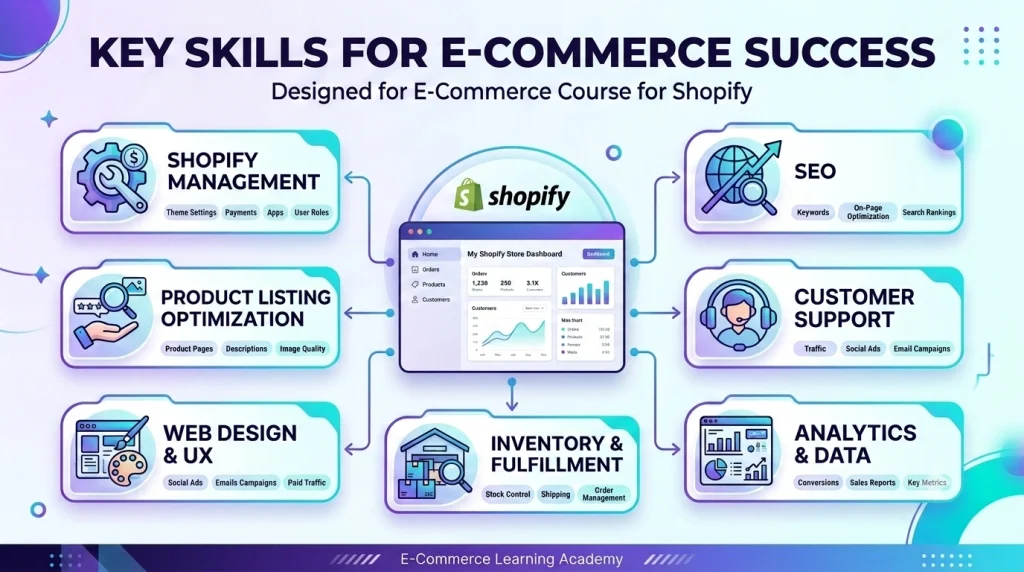
What Are the Key Skills Needed for E-Commerce
E Commerce Course for Shopify requires a combination of technical, operational, marketing, and analytical skills. Someone asking what are the key skills needed for e-commerce should think beyond website creation. Running an online business involves multiple interconnected activities.
1. Platform Management
You should understand how to navigate Shopify, seller dashboards, product catalogs, orders, payments, and basic settings. An E Commerce Course for Shopify can help beginners develop these platform-management skills through structured, practical learning. Platform familiarity reduces mistakes and allows you to make routine changes without depending on someone else for every task.
2. Product Listing Optimization
A product listing needs more than a product name. You should understand:
- Keyword research
- Product titles
- Product descriptions
- Product images
- Specifications
- Benefits and features
- Pricing information
- Frequently asked questions
- Search optimization
These skills are important for both Shopify product pages and marketplace listings.
3. Basic Design Skills
A Shopify store needs a clear visual hierarchy. Learners should understand:
- Typography
- Color consistency
- Image selection
- Navigation
- Mobile responsiveness
- Calls to action
- Trust elements
- Product-page structure
You don’t necessarily need to become a professional designer, but basic design knowledge can make store management much easier.
4. Inventory and Fulfillment
A successful online store needs accurate inventory management. You should understand:
- Stock levels
- Order processing
- Shipping
- Returns
- Packaging
- Delivery timelines
- Inventory forecasting
An E Commerce Course for Shopify should connect store management with these operational responsibilities instead of treating website creation as the final goal.
5. Analytics
Data helps identify what is working. Important metrics can include:
- Website traffic
- Conversion rate
- Average order value
- Revenue
- Customer acquisition cost
- Return rate
- Product performance
- Cart abandonment
What Are the Key Skills Needed for E-Commerce Beyond Technology?
The answer also includes consistency, customer understanding, problem-solving, and willingness to test and improve. E-commerce rarely becomes successful simply because a store was launched. Products, pricing, listings, traffic sources, and customer experience often need continuous refinement. An E Commerce Course for Shopify can teach you how to monitor these areas, analyze performance, and make practical improvements as your online store grows.
What Are the 7 C’s of E-Commerce?
The 7 C’s of e-commerce provide a useful framework for thinking about the customer experience. They are commonly described as:
- Customer
- Content
- Community
- Convenience
- Coordination
- Customization
- Communication
Customer
Everything starts with understanding the target customer. You need to know:
- Who is buying?
- What problem are they solving?
- What influences their purchase?
- What price range do they consider?
- What information do they need before ordering?
Content
Content includes product descriptions, images, videos, guides, FAQs, reviews, and other information that helps customers make decisions.
Community
Community is particularly relevant to businesses building their own Shopify presence through social media, email, content, and customer engagement. An E Commerce Course for Shopify can help you understand how to build stronger customer communities and use these channels to support brand awareness, engagement, and repeat purchases.
Convenience
The purchasing process should be easy to understand.
Customers should be able to find products, understand pricing, select variants, complete payment, and receive delivery information without unnecessary friction. An E Commerce Course for Shopify can teach you how to create a smoother shopping journey by improving store navigation, product pages, checkout, payment options, and customer experience.
Coordination
Coordination involves connecting inventory, orders, shipping, customer service, payments, and other operational processes.
Customization
Personalization can include relevant product recommendations, offers, email campaigns, or tailored shopping experiences.
Communication
Clear communication matters before, during, and after a purchase. For learners taking an E Commerce Course for Shopify, the 7 C’s provide a useful way to connect individual technical skills with the broader customer experience.
Why Do the 7 C’s Matter?
The framework reminds beginners that e-commerce isn’t simply about uploading products. A technically functional website can still struggle if customers don’t understand the products, can’t navigate the store, don’t trust the business, or face friction during checkout. An E Commerce Course for Shopify helps beginners understand these important elements, from product presentation and store navigation to trust signals, checkout experience, and customer satisfaction.
Shopify-Specific Skills You Should Learn
A good E Commerce Course for Shopify should move beyond basic account creation and teach the practical skills required to manage a store.
Store Setup and Design
Theme Selection
Shopify provides themes that can be customized according to a brand’s requirements. You should understand:
- Theme selection
- Layout customization
- Homepage sections
- Typography
- Colors
- Navigation
- Mobile presentation
Product Page Optimization
A product page should answer the customer’s important questions quickly. Learn how to structure:
- Product title
- Images
- Product description
- Benefits
- Specifications
- Pricing
- Variants
- Shipping information
- FAQs
- Reviews
Navigation and Categories
A customer should be able to locate important products without unnecessary clicks. Clear menus, collections, filters, and category structures can improve usability. An E Commerce Course for Shopify can teach you how to organize these elements effectively so customers can navigate your online store easily and find relevant products faster.
Operational Shopify Skills
Payment Gateway Setup
Depending on the target market, a store may require suitable payment options and configurations. Learners should understand the basic process of setting up payments, testing transactions, and checking order status. An E Commerce Course for Shopify can teach these essential payment-management skills, helping beginners understand how to configure payment options and manage online orders efficiently.
Shipping Configuration
Shipping settings may include:
- Delivery zones
- Shipping rates
- Free-shipping thresholds
- Estimated delivery information
- Order tracking
- Return policies
App and Tool Integration
Shopify has an ecosystem of apps that can support different business functions. These can include tools for:
- Email marketing
- Reviews
- Customer support
- Analytics
- Inventory
- Promotions
- Upselling
However, installing too many apps can create unnecessary complexity. A practical E Commerce Course for Shopify should teach learners to select tools based on actual business requirements.
Shopify Growth Skills
Product SEO
Product pages can be optimized for search engines using:
- Relevant keywords
- Descriptive titles
- Useful product descriptions
- Search-friendly URLs
- Optimized images
- Internal links
- Structured information where appropriate
Email Marketing
Email can help businesses communicate with existing customers and encourage repeat purchases. An E Commerce Course for Shopify can teach you how to use email marketing to nurture customers, share product updates, promote relevant offers, and support long-term customer relationships. Common campaigns include:
- Welcome emails
- Product announcements
- Promotional campaigns
- Abandoned-cart reminders
- Post-purchase communication
Conversion Optimization
Traffic alone doesn’t guarantee sales. You should learn how to analyze product pages, checkout journeys, calls to action, pricing, trust signals, and other factors that can affect conversions.
Marketplace Selling Skills You Need
Marketplace selling requires a somewhat different approach from running an independent Shopify store.
Marketplace Listing Optimization
A marketplace listing needs to communicate product information clearly while helping the product appear relevant to customer searches. Important areas include:
- Product title
- Search terms
- Images
- Bullet points
- Product description
- Specifications
- Variations
- Pricing
- Reviews
Reviews and Ratings
Reviews can influence customer purchasing decisions. Sellers should focus on delivering accurate product information, quality products, reliable fulfillment, and responsive customer service rather than attempting to manipulate review systems.
Fulfillment
Depending on the marketplace and seller setup, fulfillment may involve:
- Marketplace fulfillment programs
- Third-party logistics
- Self-fulfillment
- Shipping partners
Understanding the operational differences is an important part of marketplace training.
Marketplace Fees
Marketplace selling can involve different fees depending on the platform, category, fulfillment method, and seller arrangement. Therefore, sellers should calculate:
Selling Price − Product Cost − Marketplace Fees − Shipping/Fulfillment Costs − Other Costs = Estimated Contribution
The exact fee structure should always be checked against the current platform’s official seller documentation before pricing products.
Marketplace Compliance
Sellers need to understand the rules governing:
- Product information
- Packaging
- Returns
- Shipping
- Customer communication
- Restricted products
- Seller performance
- Tax and documentation requirements
A strong E Commerce Course for Shopify that also introduces marketplace selling can help learners understand why marketplace compliance differs from managing an independent website.
Shopify vs Marketplace: Skills Comparison
| Skill | Shopify Store | Marketplace Selling |
|---|---|---|
| Store design | High importance | Limited platform control |
| Product listings | Important | Extremely important |
| SEO | Website and product SEO | Marketplace search optimization |
| Customer relationship | Greater control | Platform-mediated |
| Branding | High control | More platform-dependent |
| Traffic generation | Usually seller responsibility | Existing marketplace traffic |
| Marketplace fees | Not applicable in the same way | Important pricing consideration |
| Fulfillment | Seller chooses setup | Platform options may be available |
| Analytics | Store and marketing analytics | Marketplace analytics |
| Customer retention | Email and other channels | More platform-dependent |
This comparison shows why learning only one environment may leave gaps in an e-commerce professional’s skill set.
How Digital Chaabi Academy Structures E-Commerce Learning
Digital Chaabi Academy approaches e-commerce training around practical skills rather than treating e-commerce as a single software tool. The learning path can begin with understanding how an online store works, followed by practical Shopify store-building skills and then marketplace concepts. This sequence can help beginners understand the fundamentals before dealing with the additional complexity of marketplace selling. A structured E Commerce Course for Shopify may cover areas such as:
- Shopify store setup
- Theme customization
- Product management
- Product-page optimization
- Payment configuration
- Shipping setup
- Basic SEO
- Marketplace selling
- Listing optimization
- E-commerce analytics
- Digital marketing fundamentals
Practical Learning Approach
For beginners, hands-on practice can be more useful than learning concepts only through theory. A practical training environment can allow students to work through tasks such as creating products, organizing collections, improving product pages, setting up store elements, and understanding marketplace listings. The objective should be to develop skills that can be applied to a real business or professional assignment.
Career and Business Opportunities After the Course
Completing an E Commerce Course for Shopify can support several different career or business directions.
1. Shopify Store Management
Businesses may need people who can manage:
- Products
- Collections
- Website content
- Basic SEO
- Store updates
- Promotions
2. Freelance Shopify Services
Freelancers can offer services such as:
- Shopify store setup
- Theme customization
- Product uploading
- Product-page optimization
- Store maintenance
3. Marketplace Management
Marketplace professionals may help businesses with:
- Product listings
- Catalog management
- Search optimization
- Order monitoring
- Seller account operations
- Marketplace reporting
4. E-Commerce Executive Roles
An e-commerce executive may coordinate website operations, marketplaces, inventory, promotions, analytics, and customer experience.
5. D2C Business Operations
Direct-to-consumer brands often need people who understand both their own website and external marketplaces. This combination can be useful when a company operates across multiple selling channels.
Common E-Commerce Mistakes Beginners Should Avoid
Many beginners make similar mistakes when launching their first online business.
Mistake 1: Treating Shopify and Marketplaces as Identical
The platforms have different customer journeys, traffic models, costs, and operational requirements.
Mistake 2: Ignoring Product Economics
Revenue doesn’t equal profit. Before launching, calculate product costs, packaging, shipping, payment charges, marketplace fees where applicable, advertising expenses, returns, and other operational costs.
Mistake 3: Focusing Only on Store Design
A beautiful Shopify store cannot compensate for poor products, unclear messaging, weak traffic generation, or an inconvenient buying process.
Mistake 4: Publishing Weak Product Listings
Low-quality images, incomplete specifications, generic descriptions, and unclear pricing can reduce customer confidence.
Mistake 5: Launching Too Many Channels Too Quickly
Managing Shopify, Amazon, Flipkart, social media, advertising, email, and other channels simultaneously can overwhelm beginners. It’s often more practical to establish a repeatable process on one channel before expanding.
Mistake 6: Ignoring Analytics
Without data, it’s difficult to determine whether a problem comes from traffic, pricing, product demand, product pages, checkout, or fulfillment.
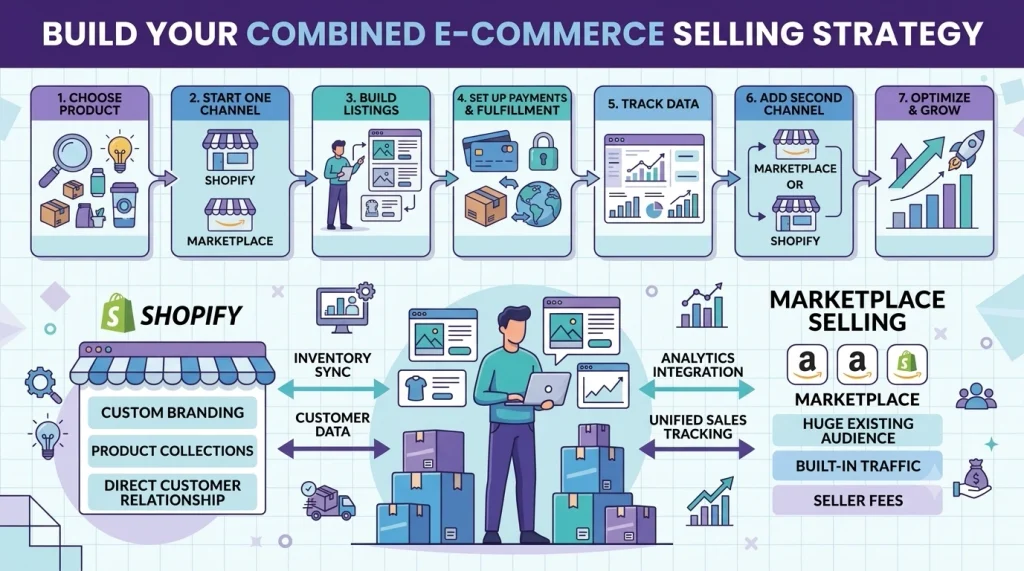
Step-by-Step: Building Your Combined Selling Strategy
A combined Shopify and marketplace strategy can be developed gradually.
Step 1: Understand Your Product
Identify:
- Target audience
- Product demand
- Competition
- Pricing
- Margins
- Differentiation
Step 2: Choose Your Initial Channel
Consider whether you need stronger brand control, access to marketplace traffic, or a combination of both.
Step 3: Build Strong Product Listings
Use accurate product information, professional images, relevant keywords, clear benefits, and transparent pricing.
Step 4: Set Up Payments and Fulfillment
Make sure customers can pay easily and understand how their orders will be delivered.
Step 5: Track Initial Performance
Monitor traffic, orders, conversions, returns, customer questions, and product-level performance.
Step 6: Expand to a Second Channel
Once your initial process becomes manageable, consider adding another sales channel.
Step 7: Improve Continuously
Use performance data to improve:
- Product pages
- Pricing
- Images
- Search visibility
- Advertising
- Customer experience
- Fulfillment
A Simple Channel Expansion Model
Product → One Channel → Data → Optimization → Second Channel → Cross-Channel Growth
This approach can help reduce unnecessary complexity while allowing the business to expand gradually.
Where Shopify and Marketplace Selling Is Headed
E-commerce continues to evolve as businesses combine websites, marketplaces, social media, search, advertising, and automation.
AI tools are increasingly being used for tasks such as:
- Product description drafting
- Customer-service assistance
- Content creation
- Data analysis
- Keyword research
- Marketing workflows
However, automation does not eliminate the need for e-commerce knowledge.
A seller still needs to understand the product, customer, pricing, positioning, margins, platform rules, and business objectives.
That’s why an E Commerce Course for Shopify should focus not only on software features but also on decision-making and practical business skills.
For learners interested in customer acquisition, Shopify skills can also be combined with:
- Performance Marketing
- Social Media Marketing
- SEO
- Email Marketing
- Content Marketing
- Digital Marketing
Suggested internal links:
- Performance Marketing Course
- Social Media Marketing Course
- Digital Marketing Course
- Website Development Course
- SEO Course
For platform-specific information, learners should also consult the latest official documentation from Shopify and the relevant marketplace before implementing operational or fee-related changes.
FAQs
Q1. What are the key skills needed for e-commerce?
The key skills include platform management, product listing optimization, basic design, inventory and fulfillment, customer service, digital marketing, analytics, and conversion optimization. An E Commerce Course for Shopify can help beginners build these skills systematically.
Q2. What are the 7 C’s of e-commerce?
The commonly used 7 C’s framework includes Customer, Content, Community, Convenience, Coordination, Customization, and Communication. These principles help explain different parts of the online customer experience.
Q3. Which course is best for e-commerce covering Shopify and marketplaces?
Look for training that covers practical Shopify store management alongside marketplace concepts, product listings, fulfillment, analytics, and digital marketing. The right curriculum depends on whether your goal is employment, freelancing, or building your own online business.
Q4. What are the 7 types of e-commerce?
Commonly discussed e-commerce models include:
- B2C — Business to Consumer
- B2B — Business to Business
- C2C — Consumer to Consumer
- C2B — Consumer to Business
- B2A — Business to Administration
- C2A — Consumer to Administration
- D2C — Direct to Consumer
The exact classification can vary between educational frameworks.
Q5. Should I start with Shopify or Amazon?
There isn’t one universal answer. Shopify may be relevant when you want greater control over branding and your own storefront. A marketplace may be useful when access to an established shopping platform is a priority. Your product, budget, marketing capability, operational resources, and business objectives should determine the starting point.
Q6. Can I sell on Shopify and Amazon at the same time?
Yes. Businesses can operate their own Shopify website while also selling through marketplaces, provided they meet each platform’s applicable requirements. The challenge is coordinating inventory, pricing, fulfillment, customer support, and product information across channels.
Q7. How much do marketplace fees affect profit margins?
The impact varies by platform, category, fulfillment method, seller arrangement, and other applicable charges. Instead of using one universal percentage, calculate the current fees for your specific products before setting prices.
Q8. What makes an E Commerce Course for Shopify different from a marketplace-only course?
A Shopify-focused course teaches you how to build and manage your own online storefront, while marketplace training focuses more heavily on platform-specific listings, seller operations, fulfillment, competition, and compliance. Learning both can provide a broader understanding of multi-channel e-commerce.
Q9. Do I need coding skills to learn Shopify?
Basic Shopify store management generally does not require advanced coding knowledge. You can learn store setup, theme customization, product management, navigation, and many routine tasks without becoming a professional developer. Technical requirements depend on the level of customization you want.
Q10. Is an e-commerce course useful for beginners?
Yes, structured training can help beginners understand the sequence of tasks involved in building and managing an online selling operation. The value depends heavily on the curriculum, practical assignments, instructor quality, and how much real-world practice is included.
Conclusion
The question isn’t simply whether you should learn Shopify or marketplace selling. The more useful question is which e-commerce skills will help you manage an online business effectively across different selling environments? A strong E Commerce Course for Shopify should teach more than store creation. It should introduce product-page optimization, SEO, payments, shipping, analytics, customer experience, marketplace listings, fulfillment, and digital marketing.
Shopify can provide greater control over your own online storefront, while marketplaces can provide access to established shopping ecosystems. Understanding how these channels differ can help you make more informed business decisions.
For someone starting from zero, the practical approach is to learn the fundamentals, build one channel properly, analyze the results, and then expand when the operation is ready. If you’re exploring structured training, Digital Chaabi Academy’s E Commerce Course for Shopify can be considered as a learning path covering Shopify store creation, e-commerce operations, marketplace concepts, and practical online-selling skills.