
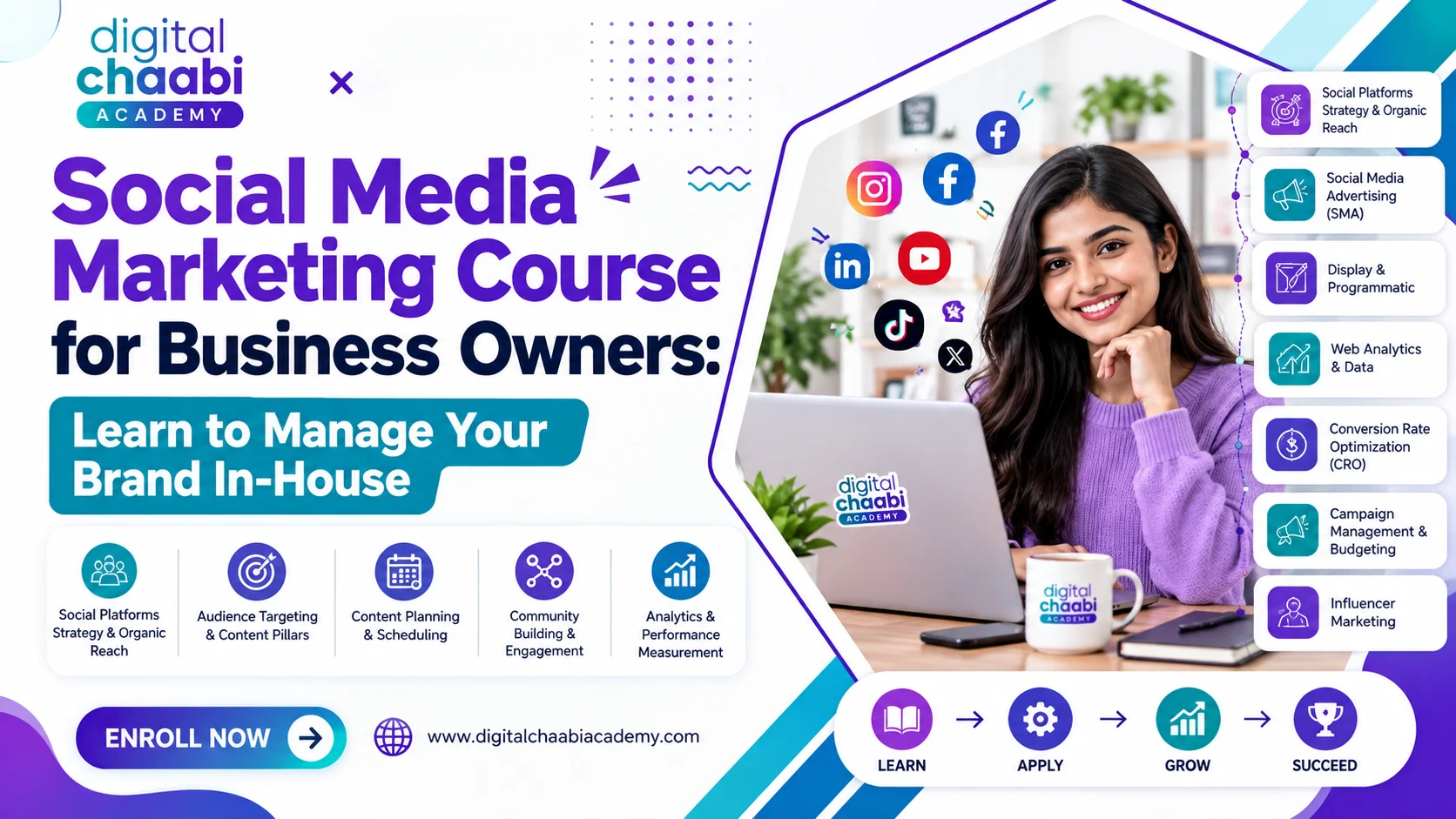
A business owner once told me, half-joking, “I’m paying someone ₹15,000 a month to post three reels I could probably make myself if I actually understood what I was doing.”
That sentence highlights a common challenge for small and growing businesses. Owners know social media matters, but they may not understand how content planning, audience targeting, analytics, engagement, and brand communication work together. That is exactly where a Social Media Marketing Course for Business Owners can be useful.
The goal of a Social Media Marketing Course for Business Owners is not necessarily to turn every business owner into a professional social media manager. Instead, practical training can help owners understand what should be posted, why it should be posted, how results should be measured, and when it makes sense to manage social media internally or hire outside support.
If you are considering bringing your social media activities in-house, evaluating an agency, or simply learning how to manage your brand more confidently, understanding the fundamentals can make everyday marketing decisions easier.
Why Business Owners Are Bringing Social Media In-House
Social media has become an important communication channel for many businesses. A Social Media Marketing Course for Business Owners can help entrepreneurs understand how customers discover brands, check reviews, view products, watch videos, compare services, and contact businesses through social platforms.
For this reason, some small and medium-sized businesses are choosing to understand social media internally instead of depending entirely on agencies or freelancers. Cost is one factor. However, control and communication can be equally important.

Nobody understands a business’s products, customers, personality, and daily operations exactly like the owner. A Social Media Marketing Course for Business Owners can help owners use this knowledge to guide content more effectively. When social media is completely outsourced, the person creating the content may need to learn those details from the owner.
Learning the fundamentals through a Social Media Marketing Course for Business Owners can help reduce this communication gap. You may not create every reel or write every caption yourself. Instead, you can understand:
- What type of content your audience needs
- Which platforms are relevant to your business
- How to create a basic content strategy
- Which social media metrics matter
- How to evaluate an agency or freelancer
- How paid and organic social media differ
- How social media can support business objectives
The objective is not necessarily to replace professionals. It is to become informed enough to manage the process effectively.
What to Look for in a Social Media Marketing Course
There is no single course that is perfect for every business owner. The right Social Media Marketing Course for Business Owners depends on your industry, existing knowledge, available time, budget, and marketing objectives.
Before choosing one, look for practical topics rather than theory alone. A Social Media Marketing Course for Business Owners should focus on skills that can be applied to real business situations.
1. Real Business Examples
A useful Social Media Marketing Course for Business Owners should explain concepts through realistic business situations. For example, a local clinic, restaurant, retail shop, consultant, D2C brand, or service provider may require different content strategies. Real examples can help you understand how the same social media principle may need to be adapted according to the audience and business model.
2. Content Planning
You should understand how to develop content themes, create a basic calendar, select topics, and maintain consistency. Content planning can help prevent the common problem of opening Instagram or Facebook and wondering what to publish that day.
3. Analytics and Reporting
Business owners should know how to interpret basic metrics such as:
- Reach
- Impressions
- Engagement
- Video views
- Profile visits
- Website clicks
- Leads
- Conversions
A Social Media Marketing Course for Business Owners should explain these numbers in a practical way rather than overwhelming learners with unnecessary reporting terminology.
4. Brand Communication
A Social Media Marketing Course for Business Owners should also explain how to maintain a consistent tone and visual identity across social platforms. Your social media profile should sound and look like your business rather than a collection of unrelated posts.
5. Practical Support
If possible, look for training that includes assignments, examples, demonstrations, or guidance that allows you to apply concepts to your own business.
The purpose of a Social Media Marketing Course for Business Owners should be to help you make better marketing decisions rather than simply teach you a list of social media features.
What Is the 5-5-5 Rule in Social Media?
The 5-5-5 rule is sometimes discussed as a simple engagement routine for social media users. A Social Media Marketing Course for Business Owners can explain how this approach may involve spending around five minutes engaging with relevant accounts, connecting with five relevant profiles, and thoughtfully interacting with five posts.
The exact interpretation can vary, so it should not be treated as an official platform rule. For a business owner, the larger lesson is consistency. Instead of disappearing for several weeks and then publishing a large amount of content in one day, a business can develop a sustainable routine. For example, a simple weekly process might include:
- Researching relevant customer questions
- Creating educational content
- Sharing product or service information
- Responding to comments
- Answering messages
- Reviewing analytics
- Engaging with relevant industry accounts
A Social Media Marketing Course for Business Owners should explain why consistency, relevance, audience understanding, and meaningful engagement matter more than blindly following a fixed posting formula.
What You Can Learn as a Business Owner
Business owners generally do not need the same level of technical training as someone pursuing social media management as a full-time career. A Social Media Marketing Course for Business Owners can instead focus on practical skills that support business decisions.
Practical Social Media Skills
Content Planning
You can learn how to create a simple content calendar instead of deciding what to publish at the last minute. Content categories may include:

- Educational posts
- Product demonstrations
- Customer questions
- Behind-the-scenes content
- Testimonials
- Frequently asked questions
- Industry information
- Promotional offers
Caption Writing
A caption should communicate clearly with the intended audience. Instead of copying generic templates, business owners can learn how to write captions that reflect their actual brand personality.
Basic Analytics
You do not need to become a data analyst to understand social media performance. Start with a few useful measurements and connect them with business objectives. For example:
Content → Reach → Engagement → Website Visit → Inquiry → Customer
The exact customer journey will differ between businesses, but the principle is to connect social activity with meaningful outcomes.
Strategic Understanding
A Social Media Marketing Course for Business Owners should also help you understand strategy. This includes:
- Choosing relevant platforms
- Understanding your target audience
- Creating content pillars
- Setting realistic goals
- Developing a posting schedule
- Evaluating competitors
- Understanding organic and paid promotion
- Reviewing campaign performance
What You May Not Need to Learn
Business owners do not necessarily need advanced skills in every area of digital marketing. For example, you may not need:
- Advanced video editing
- Complex agency reporting
- Advanced graphic design
- Advanced marketing automation
- Highly technical analytics implementation
You can learn enough to manage the strategy while outsourcing specialist tasks when necessary.
The Mindset Shift From Business Owner to Content Creator
One of the biggest changes that a Social Media Marketing Course for Business Owners can help you understand is how social media communication differs from traditional advertising. Business owners naturally think about:
- Sales
- Revenue
- Appointments
- Customers
- Footfall
- Profit
Social media also requires attention to communication and relationship building. Customers may want to see how a product is used, meet the people behind a business, understand a service, or find answers to common questions before making a purchase.
This means useful social media content does not always need to be a direct sales message. A Social Media Marketing Course for Business Owners can help you develop a more balanced approach between promotion, education, engagement, and brand building. For example, a local service business could create content around:
- Common customer problems
- Frequently asked questions
- Service explanations
- Customer experiences
- Behind-the-scenes activities
- Helpful industry information
- Relevant offers
The result can be a more consistent communication system rather than random posting.
How Digital Chaabi Academy Approaches Social Media Training
Digital Chaabi Academy focuses its digital marketing training around practical skills and business applications.
For business owners, the value of social media training is not limited to learning how to publish posts. Understanding the process can also make it easier to communicate with freelancers, agencies, designers, and marketing professionals. A business owner who understands basic social media strategy can ask better questions. For example:
- Why are we targeting this audience?
- What is the objective of this campaign?
- Why are we using this content format?
- Which metric are we trying to improve?
- Are these leads relevant to the business?
- What should we test next?
This type of understanding can make marketing discussions more productive. A Social Media Marketing Course for Business Owners can therefore be useful even when the owner does not intend to manage every task personally.
Potential Business Outcomes After Social Media Training
A Social Media Marketing Course for Business Owners does not guarantee a particular number of followers, leads, or sales. Learning social media instead helps business owners develop practical skills for creating content, understanding audiences, and making informed marketing decisions. However, practical knowledge can help business owners improve how they approach social media.

1. Better Hiring Decisions
You can ask more relevant questions when hiring a freelancer, content creator, or agency.
2. Better Content Planning
Instead of posting randomly, you can build content around specific business and customer needs.
3. More Consistent Brand Communication
You can provide clearer direction about your brand voice, offers, products, and audience.
4. Better Performance Evaluation
You can understand basic analytics and ask questions when results do not match expectations.
5. Less Dependence on Guesswork
A Social Media Marketing Course for Business Owners can help you understand the work even if you still outsource execution. The goal of training should therefore be informed decision-making rather than unrealistic promises of viral growth.
Common Social Media Mistakes Business Owners Make
Even experienced business owners can make avoidable social media mistakes.
1. Posting Inconsistently
Publishing ten posts one week and then disappearing for a month makes it difficult to develop a sustainable content routine.
2. Trying Every Platform
A business does not necessarily need to maintain every social network. It can be more practical to focus on platforms where the target audience is actually active and where the business can consistently create useful content.
3. Focusing Only on Followers
Follower count is only one measurement. Depending on the business objective, metrics such as inquiries, website visits, engagement, conversions, or qualified leads may be more relevant.
4. Outsourcing Without Understanding the Basics
Hiring someone does not remove the need for business oversight. Owners should still understand what the marketing activity is intended to achieve.
5. Expecting Immediate Results
Organic social media growth can take time. Content performance can vary because of the audience, topic, creative format, competition, platform changes, and consistency.
Step-by-Step Guide to Bringing Social Media In-House
If you are considering managing your social media internally, follow a simple process.
Step 1: Learn the Fundamentals
Start with a structured Social Media Marketing Course for Business Owners or another practical learning resource.
Understand content, platforms, audience research, analytics, and basic strategy before making major changes.
Step 2: Audit Your Existing Accounts
Review your current profiles. Check:
- Profile information
- Branding
- Content quality
- Posting consistency
- Engagement
- Website links
- Calls to action
- Audience response
Step 3: Identify Your Main Platforms
Choose platforms based on your customers, business model, resources, and content capabilities. You do not have to be active everywhere.
Step 4: Create Content Pillars
Choose three to five broad topics that your business can discuss consistently. For example:
- Education
- Products or services
- Customer questions
- Behind the scenes
- Social proof
Step 5: Create a Content Calendar
Plan content weekly or monthly. A simple calendar can include:
| Day | Content Type | Purpose |
|---|---|---|
| Monday | Educational | Awareness |
| Wednesday | Product/Service | Consideration |
| Friday | FAQ or Story | Engagement |
| Saturday | Testimonial | Trust |
The exact schedule should depend on your business rather than following a universal formula.
Step 6: Track Important Metrics
Start with a manageable set of metrics. For example:
- Reach
- Engagement
- Profile visits
- Website clicks
- Inquiries
- Leads
- Conversions
Step 7: Review and Improve
After collecting enough data, identify which topics and formats receive useful responses. Then adjust your content plan.
Step 8: Decide What to Outsource
Once you understand the workflow, you can decide which activities should remain in-house and which can be delegated. For example, you may handle strategy and customer communication while outsourcing video editing or graphic design.
How Social Media Marketing Is Changing
Social media continues to evolve as platforms introduce new formats, recommendation systems, advertising options, analytics features, and content tools. That means learning social media should not be treated as a one-time activity.
Business owners should develop a habit of testing, measuring, learning, and adapting. The fundamentals remain useful:
- Know your audience
- Create relevant content
- Communicate clearly
- Maintain consistency
- Measure meaningful results
- Improve based on evidence
Tools may change, but these principles can continue to support a long-term social media strategy.
How to Earn ₹1 Lakh Per Month in Digital Marketing
Another common question is whether digital marketing skills can eventually generate ₹1 lakh per month. There is no guaranteed income level or fixed timeline. People can pursue digital marketing income through different models, including:
- Freelancing
- Consulting
- Social media management
- SEO services
- Performance marketing
- Content marketing
- Agency work
Some professionals combine several services rather than relying on social media management alone. For someone interested in freelancing, developing complementary skills can expand the range of services they can offer. You can explore related learning topics such as:
- Performance Marketing Course
- Digital Marketing Course
- Content Marketing Course
For platform-level learning, Meta Blueprint can also provide official educational resources about Meta advertising and marketing tools.
Frequently Asked Questions
What are the 7 C’s of social media?
The commonly discussed 7 C’s are Content, Community, Curation, Conversion, Consistency, Creativity, and Conversation. A Social Media Marketing Course for Business Owners can explain how these principles provide a framework for thinking about different aspects of social media communication.
How can I earn ₹1 lakh per month in digital marketing?
There is no guaranteed method or fixed timeline. Digital marketing professionals may combine services such as social media management, SEO, performance marketing, content marketing, or consulting. Income depends on skills, clients, pricing, workload, experience, and market demand.
Which course is best for social media marketing if I run a business?
Look for training that covers practical business applications, content planning, audience research, analytics, platform strategy, and real examples. A Social Media Marketing Course for Business Owners should focus on skills that you can apply to your own business.
Do I need to post every day?
No. There is no universal requirement to post every day. A consistent schedule that you can maintain while producing useful content is generally more practical than publishing rushed content simply to meet a daily target.
Can I manage my own brand’s social media?
Many small business owners can manage some or all of their social media activities after learning the fundamentals. The amount of work depends on the number of platforms, content formats, posting frequency, audience engagement, and business goals.
How long does it take to see social media results?
There is no universal timeline. A Social Media Marketing Course for Business Owners can help you understand that results depend on factors such as the business, audience, content quality, platform, consistency, competition, and whether paid advertising is involved. It is better to establish baseline metrics and evaluate performance over a meaningful period.
What if I don’t have time to create content?
You can separate strategy from execution. For example, you can define the brand message and content direction while a freelancer or employee handles design, editing, or publishing.
What makes a social media course for business owners different from a general course?
A business-owner-focused course can place more emphasis on decision-making, brand communication, content planning, analytics, outsourcing, and evaluating marketing work rather than preparing students specifically for a full-time social media marketing career.
Conclusion
A Social Media Marketing Course for Business Owners is not about turning every entrepreneur into a professional content creator. The more practical objective is to develop enough knowledge to understand your audience, plan content, evaluate performance, communicate with marketing professionals, and make informed decisions about your brand’s social media presence.
You may eventually manage everything yourself, or you may continue working with an employee, freelancer, or agency. Either way, understanding the fundamentals gives you greater visibility into the process. If you are ready to stop guessing about your social media strategy, Digital Chaabi Academy’s Social Media Marketing Course for Business Owners can be explored as a practical training option focused on applying social media concepts to business situations.


